Introduction to Artificial Intelligence
Introduction to Artificial Intelligence
What Is AI Anyway?
At its core, artificial intelligence is the science of making machines smart. It's a broad field of computer science focused on building systems that can perform tasks that typically require human intelligence.
Artificial Intelligence
noun
A field of computer science dedicated to creating systems capable of performing tasks that normally require human intelligence, such as visual perception, speech recognition, decision-making, and translation between languages.
Think about how you learn. You observe, you make connections, and you adapt based on new information. AI aims to replicate this process in machines. This includes everything from understanding spoken words and identifying faces in photos to solving complex problems and even creating art.
The ultimate goal isn't just to make machines do things, but to enable them to understand, reason, and learn.
A Quick Trip Through Time
The idea of intelligent machines has been around for centuries, but the formal field of AI research is relatively new. It officially kicked off at a conference at Dartmouth College in 1956, where the term "artificial intelligence" was first coined.
Early researchers were incredibly optimistic, predicting that machines with human-level intelligence were just a few decades away. But progress was slower than expected. The field went through periods known as "AI winters," when funding and interest dried up because the technology couldn't live up to the hype.
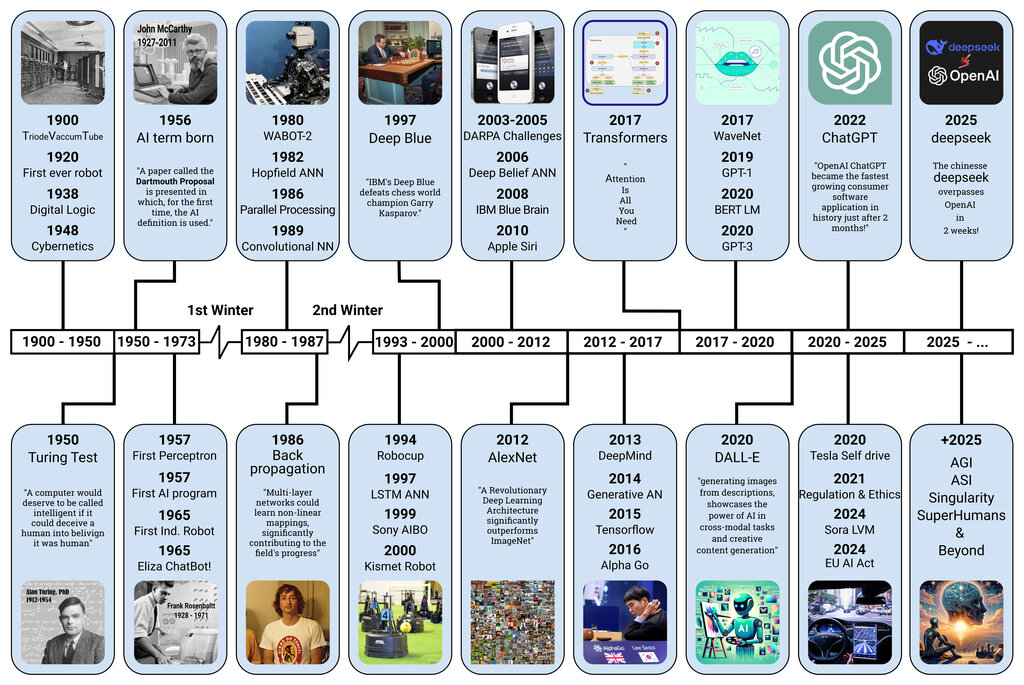
Things started to change in the late 1990s and early 2000s. Two key ingredients became widely available: massive amounts of data (thanks to the internet) and much more powerful computers. These ingredients fueled the rise of machine learning, a subfield of AI that allows systems to learn from data without being explicitly programmed for every task.
The Core Ideas
So how does AI actually work? While the details can get complex, the basic principles are straightforward. At its foundation, AI is about creating algorithms, which are sets of rules or instructions, that can process information and produce an outcome. The magic happens when these algorithms are designed to learn and improve on their own.
This leads us to the most important concept in modern AI: Machine Learning (ML). Instead of writing step-by-step instructions for a task, developers create a model and train it on a huge dataset. For example, to build an AI that recognizes cats, you would show it millions of cat photos. The model learns the patterns—pointy ears, whiskers, feline eyes—on its own.
Deep Learning is a specialized type of machine learning that uses structures called neural networks, which are loosely inspired by the human brain. These networks have many layers, allowing them to learn very complex patterns from data. Deep learning is the engine behind many of today's most advanced AI applications, like natural language processing and image generation.
Now, let's test what you've learned about the basics of AI.
What is the core goal of the field of artificial intelligence?
The term "artificial intelligence" was officially coined at a 1956 conference held at which institution?
Understanding these foundational ideas is the first step in seeing how AI is already shaping our world and what it might do in the future.