Introduction to Artificial Intelligence
Introduction to Artificial Intelligence
What Is Artificial Intelligence?
Artificial Intelligence, or AI, is about creating systems that can think, learn, and adapt. It's a branch of computer science focused on building machines that can perform tasks that typically require human intelligence, like recognizing speech, making decisions, or identifying patterns.
Artificial intelligence (AI) is commonly defined as “a system’s ability to interpret external data correctly, to learn from such data, and to use those learnings to achieve specific goals and tasks through flexible adaptation.”
Think of it this way: when you were a child, you learned to identify a cat by seeing different examples. Your brain learned the common features — whiskers, pointy ears, a tail — and can now recognize a cat you've never seen before. AI works in a similar way, but instead of a brain, it uses data and algorithms to learn.
A Quick History of AI
The idea of intelligent machines has been around for centuries, but the modern field of AI officially began in the summer of 1956. A group of researchers gathered at Dartmouth College for a workshop to explore the idea that every aspect of learning or intelligence could, in principle, be so precisely described that a machine could be made to simulate it.
It was at this Dartmouth workshop that the term "Artificial Intelligence" was first coined, giving a name to this new field of study.
The early years were filled with optimism. Researchers developed programs that could solve algebra problems, prove theorems in logic, and speak simple English. But the initial excitement soon met reality. The complexity of creating true intelligence was far greater than anticipated, and the available computers weren't powerful enough. This led to periods known as "AI winters," when funding and interest dwindled.
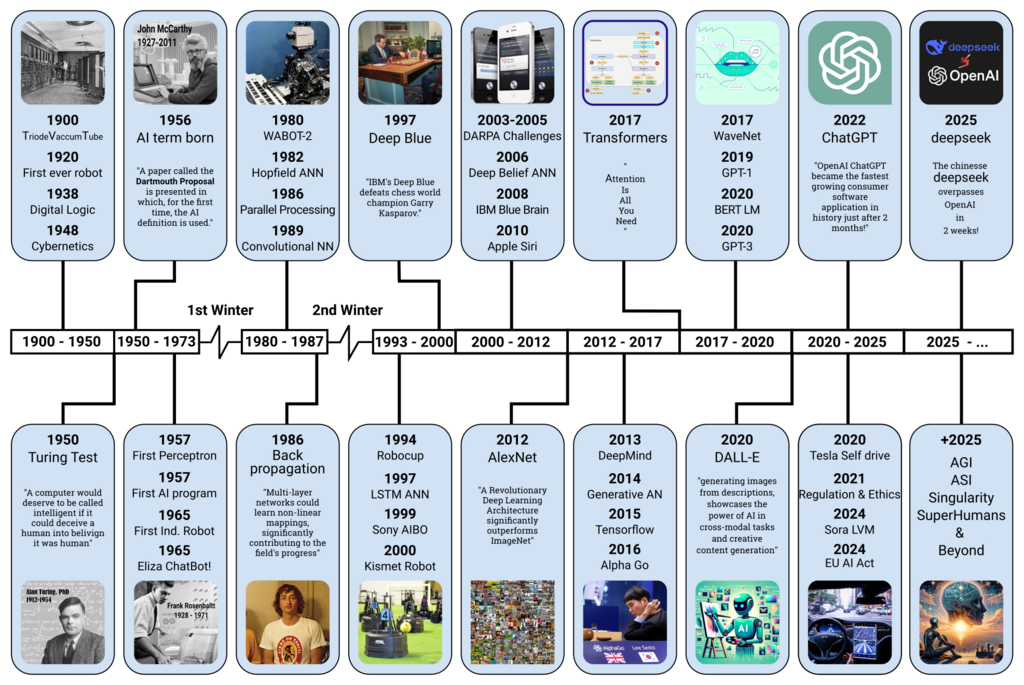
Things began to change in the late 1990s and into the 21st century. Two key ingredients became widely available: massive amounts of data from the internet and significantly more powerful computers. These factors fueled a resurgence in AI, leading to the breakthroughs we see today.
Why AI Matters Now
Today, AI is no longer a niche academic field. It's a powerful force that is reshaping our world. While the technology is complex, its significance is straightforward: AI helps us make sense of the vast amount of information in the world and use it to solve problems.
It’s the technology that powers the recommendation engine suggesting what you should watch next, the navigation app finding the fastest route, and the spam filter in your email. It's a general-purpose tool that, like electricity or the internet, is becoming integrated into the fabric of modern life.
AI's main role is to augment human capabilities, not just automate tasks. It allows us to analyze complex data, find hidden patterns, and make better-informed decisions on a scale never before possible.
Understanding the basics of what AI is and where it came from is the first step in navigating a world where this technology is becoming increasingly important.
What is the primary goal of Artificial Intelligence?
According to the text, the modern field of AI is considered to have officially begun at what event?