Introduction to Amazon Web Services
Introduction to Cloud Computing
What Is the Cloud?
You’ve probably heard the term "cloud computing." It powers everything from your favorite streaming service to the apps you use for work. But what is it, really?
Simply put, cloud computing is the delivery of computing services—like servers, storage, databases, and software—over the internet. Instead of owning and maintaining your own computing infrastructure, you can access these services from a cloud provider like Amazon Web Services (AWS), Google Cloud, or Microsoft Azure.
Cloud computing is the delivery of computing services—servers, storage, databases, networking, software, analytics, and intelligence—over the internet (“the cloud”).
Think of it like your home's electricity. You don't own a power plant in your backyard. You just plug into the wall and pay a utility company for the electricity you use. The cloud works on a similar pay-as-you-go model. This approach avoids the massive upfront cost of buying and managing physical hardware, allowing companies to be more flexible and scale their operations up or down as needed.
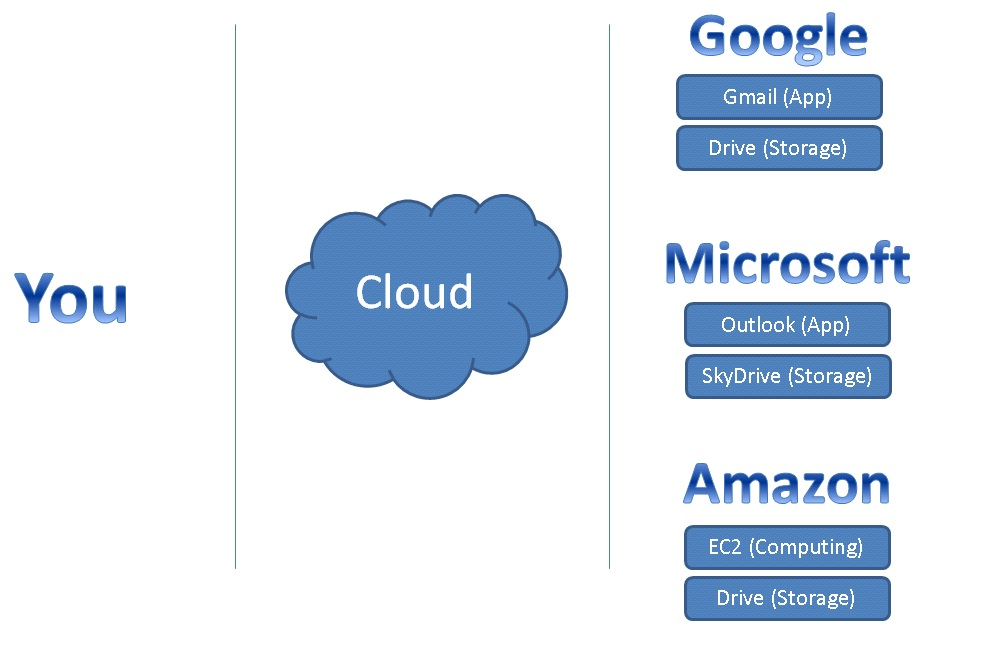
This on-demand availability of resources is a core characteristic of the cloud. You can get powerful computing resources in minutes, access them from anywhere, and only pay for what you consume. This flexibility has completely changed how businesses build and run software.
The Three Service Models
Cloud services are typically offered in three main models, each providing a different level of control and management. A popular way to understand them is the "Pizza as a Service" analogy.
Imagine you want to host a pizza night. You have a few options.
| Service Model | What You Manage | Pizza Analogy |
|---|---|---|
| IaaS (Infrastructure) | Servers, Storage, Networking | Make at Home: The cloud provider gives you the kitchen—oven, gas, water. You bring your own pizza dough, sauce, and toppings, and you bake it yourself. |
| PaaS (Platform) | Applications, Data | Pizza Delivery: The pizza place handles the dough, sauce, and baking. You just provide the final touches (the order) and a place to eat it. |
| SaaS (Software) | Nothing | Dine Out: You just show up at a restaurant and eat the pizza. They handle everything from the kitchen to the cooking to the cleanup. |
Infrastructure as a Service (IaaS) is the most flexible model. It provides fundamental building blocks like virtual servers, storage, and networking. You rent the hardware but are responsible for managing the operating system, middleware, and applications.
Platform as a Service (PaaS) abstracts away the underlying infrastructure. It provides a platform where developers can build, test, and deploy applications without worrying about managing servers or operating systems. Think of services like Heroku or Google App Engine.
Software as a Service (SaaS) is the most common model you interact with daily. The software is hosted and managed entirely by the provider. You access it through a web browser or app. Examples include Gmail, Salesforce, and Dropbox.
Where the Cloud Lives
Beyond how you use the cloud, it's also important to know where the infrastructure is located and who has access to it. This leads to three deployment models.
A Public Cloud is owned and operated by a third-party provider, like AWS. The computing resources are shared by multiple organizations, or "tenants." It offers massive scale and is generally the most cost-effective option.
A Private Cloud is infrastructure used exclusively by a single organization. It can be located at the company's own data center or hosted by a third-party provider. This model offers greater control and is often used for sensitive data or applications with strict regulatory requirements.
A Hybrid Cloud combines public and private clouds, allowing data and applications to be shared between them. This gives businesses greater flexibility and more deployment options. For example, a company might use its private cloud for sensitive operations but use the public cloud to handle bursts of traffic during peak season.
Time to check what you've learned.
What is the primary concept behind cloud computing?
The "pay-as-you-go" model in cloud computing means you pay a large, fixed upfront cost for hardware and then have unlimited usage.