Introduction to Algebraic Geometry
Affine Varieties
From Equations to Shapes
At its heart, algebraic geometry is about the beautiful relationship between algebra and geometry. It starts with a simple idea: polynomial equations can draw pictures. You've seen this before. The equation isn't just a string of symbols; it's a circle with a radius of 1 centered at the origin. The equation is a graceful parabola.
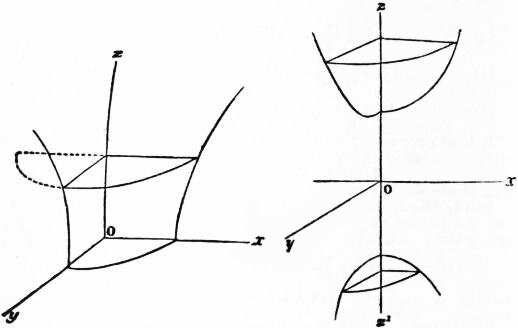
These shapes are the simplest examples of affine varieties. An affine variety is the set of all points that are solutions to a system of one or more polynomial equations. We call the space these points live in affine space, denoted . For now, you can think of as the familiar -dimensional space you're used to, like a plane () or 3D space ().
Here, are the polynomials that define the variety . Every point in makes all of these polynomials equal to zero.
The Shape's Algebraic ID
Every variety has a corresponding algebraic object that acts like its unique identification card. This is called the coordinate ring. Imagine you have a variety, like our circle . What kind of functions can we define on it using just polynomials? Any polynomial in two variables, , can be evaluated at any point on the circle.
However, some different-looking polynomials will behave identically on the circle. For example, the polynomials and are the same everywhere on the circle, because for every point on it. The coordinate ring is the collection of all polynomial functions on the variety, where we don't distinguish between polynomials that give the same values everywhere on that variety.
To do this formally, we gather all the polynomials that are zero on every single point of our variety . This collection is called the ideal of V, written . The coordinate ring, written , is then constructed by taking all polynomials and grouping them based on their behavior on . It gives us a complete algebraic description of our geometric shape.
This correspondence is the central theme of algebraic geometry. We can study geometric shapes by analyzing their coordinate rings, and we can discover properties of rings by visualizing them as varieties.
A New Topology for Space
How do we talk about nearness or regions in affine space? Usually, we think about distance and open balls. But in algebraic geometry, we use a different system called the Zariski topology. It might feel strange at first, because it redefines what it means for a set to be "closed".
In the Zariski topology, the only closed sets are the affine varieties themselves. That's it.
A single point is a variety (for example, the point is the solution to and ). A line is a variety. A circle is a variety. All of these are closed sets. An "open set" is simply the complement of a variety, meaning everything not on the variety.
This topology is much coarser than the usual one. Open sets are huge, and it's hard for two points to be separated. But it's perfectly suited for studying polynomials, because the sets it cares about are precisely the ones that polynomials define.
| Concept | Usual Topology (on ) | Zariski Topology (on ) |
|---|---|---|
| Closed Sets | Any set containing its boundary points (lines, circles, filled squares, etc.) | Only affine varieties (solution sets to polynomial equations) |
| Open Sets | Complements of closed sets (e.g., the inside of a circle, excluding the boundary) | Complements of varieties (e.g., the whole plane minus a parabola) |
| Separation | Any two distinct points can be put in separate, non-overlapping open sets. | Almost any two open sets will overlap. Points are hard to separate. |
Irreducible Varieties
Some varieties can be broken down into simpler pieces. For example, the equation describes a variety consisting of two lines: the x-axis (where ) and the y-axis (where ). We can see this as the union of two smaller varieties, (defined by ) and (defined by ).
When a variety cannot be written as the union of two smaller, proper subvarieties, we call it irreducible. An irreducible variety is a fundamental, connected geometric object. A single line is irreducible. A parabola is irreducible. The two crossed lines are not.
This geometric idea has a perfect algebraic parallel. A variety is irreducible if and only if its ideal is a prime ideal. This is another powerful link in our algebra-geometry dictionary.
Irreducible Variety Prime Ideal
Hilbert's Nullstellensatz
We've seen that for any variety , we can find its ideal . But can we go the other way? If we start with an ideal of polynomials, does it correspond to a variety? And what if two different ideals define the same variety (which is the empty set)?
These questions are answered by one of the most important theorems in this field: Hilbert's Nullstellensatz, which is German for "theorem of the zeros."
The theorem has a few parts, but its core message is this: there is an almost perfect correspondence between varieties in affine space and a special type of ideal in the polynomial ring (called radical ideals). It tells us that the only way an ideal of polynomials can fail to have any common solutions is if you can generate the polynomial '1' from them. Since '1' can never be zero, this makes perfect sense.
Finally, the last two chapters of the book discuss, respectively, introductory algebraic geometry (in affine spaces, up to and including the Hilbert Basis Theorem and Nullstellensatz, and some accompanying commutative algebra) and some of the algebraic aspects of cryptography (including a brief mention of elliptic curves).
The Nullstellensatz forges the final, strongest link in our dictionary. It assures us that when we move between the geometric world of varieties and the algebraic world of ideals and coordinate rings, we aren't losing information. The two are deeply and fundamentally connected.
Let's check your understanding of these foundational ideas.
What is the definition of an affine variety?
Consider the variety V defined by the equation (a circle). In the coordinate ring of V, which of the following polynomials is equivalent to the polynomial ?
With these concepts, we've laid the groundwork for exploring the rich world of algebraic geometry, where solving equations becomes a visual and intuitive art.