Introduction to Algebra
Introduction to Variables
What is a Variable?
Think of a variable as a placeholder in a sentence, like a box waiting to be filled. In algebra, this box is usually represented by a letter, such as , , or . It's a symbol that stands for a number we don't know yet or a value that can change.
variable
noun
A symbol, typically a letter, used to represent a quantity that can change or is unknown.
We use variables to turn real-world problems into mathematical language. If you're saving money for a bike but don't know its exact price, you could use the variable to represent the cost. This allows you to build mathematical statements around that unknown cost.
Building with Variables
When we combine variables with numbers and arithmetic operations like addition, subtraction, multiplication, and division, we create an algebraic expression. An expression doesn't have an equals sign; it's like a mathematical phrase.
For example, if you have a bag with an unknown number of apples, which we'll call , and you add 3 more apples, the total can be represented by the expression:
This simply means "three more than whatever number 'a' is." Similarly, if you have 4 boxes, each containing pencils, the total number of pencils is:
Notice that is a shorthand way of writing . In algebra, when a number is right next to a variable, it means they are multiplied. This helps avoid confusion with the letter 'x'.
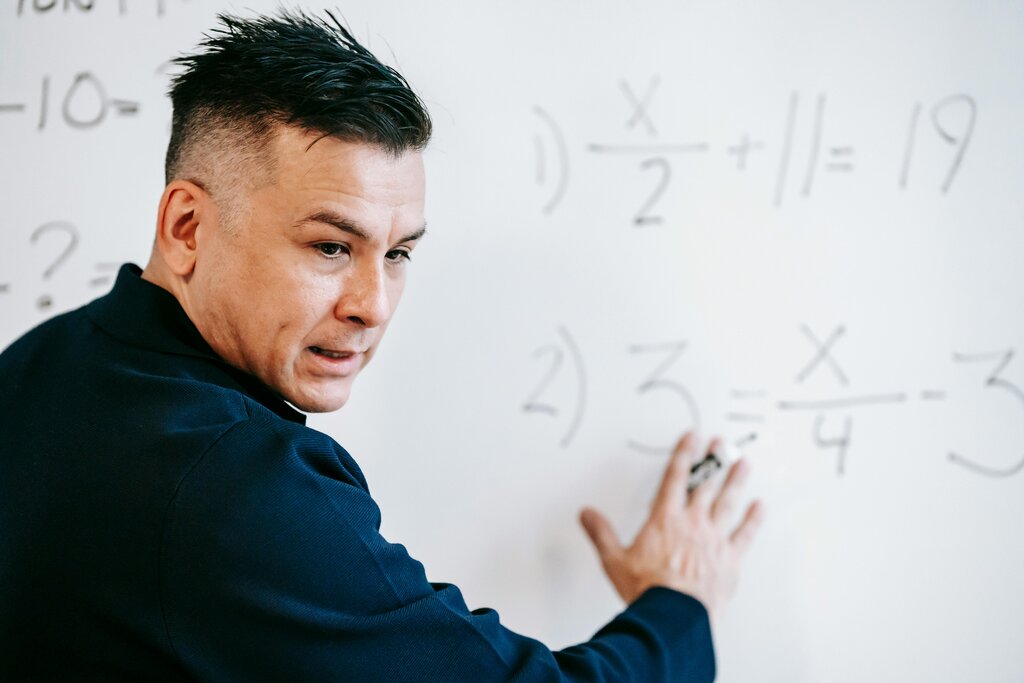
An expression is a recipe for a calculation, but it doesn't give a final answer until you know what the variable stands for.
From Expressions to Equations
So what happens when you put an equals sign after an expression? You get an equation. An equation is a statement that two expressions are equal. It's a complete mathematical sentence that makes a claim of equality.
If an expression is a phrase like "a number plus five," then an equation is a full sentence like "a number plus five equals twelve."
This equation asserts that the expression on the left () has the exact same value as the expression on the right (12). It poses a puzzle: what value of makes this statement true? (We won't worry about solving that just yet!)
Here’s a simple way to see the difference:
| Type | Example | Meaning |
|---|---|---|
| Expression | "2 less than 7 times a number y" | |
| Equation | "2 less than 7 times a number y is equal to 19" |
Use variables to represent two quantities in a real-world problem that change in relationship to one another; write an equation to express one quantity, thought of as the dependent variable, in terms of the other quantity, thought of as the independent variable.
Understanding variables is the first step into the world of algebra. They are the basic building blocks for expressions and equations, which are powerful tools for describing relationships and solving problems.