Introduction to AI Technology
Introduction to Artificial Intelligence
What Is Artificial Intelligence?
Artificial Intelligence, or AI, is about creating systems that can perform tasks that normally require human intelligence. This includes things like learning from experience, solving problems, understanding language, and recognizing patterns.
Think of it this way: when you teach a dog to fetch, you're using repetition and reward. The dog learns to associate the command with the action. AI works on a similar principle, but on a massive scale with computers. Instead of a simple command, an AI might learn to identify a cat in a photo by analyzing thousands of cat pictures.
AI isn't about creating a conscious robot like in the movies. It's about building tools that can learn, reason, and act to achieve a specific goal.
The scope of AI is vast. It ranges from the program that recommends your next song to complex systems that help doctors diagnose diseases. At its core, AI is a field of computer science dedicated to simulating intelligent behavior in machines.
How AI Learns
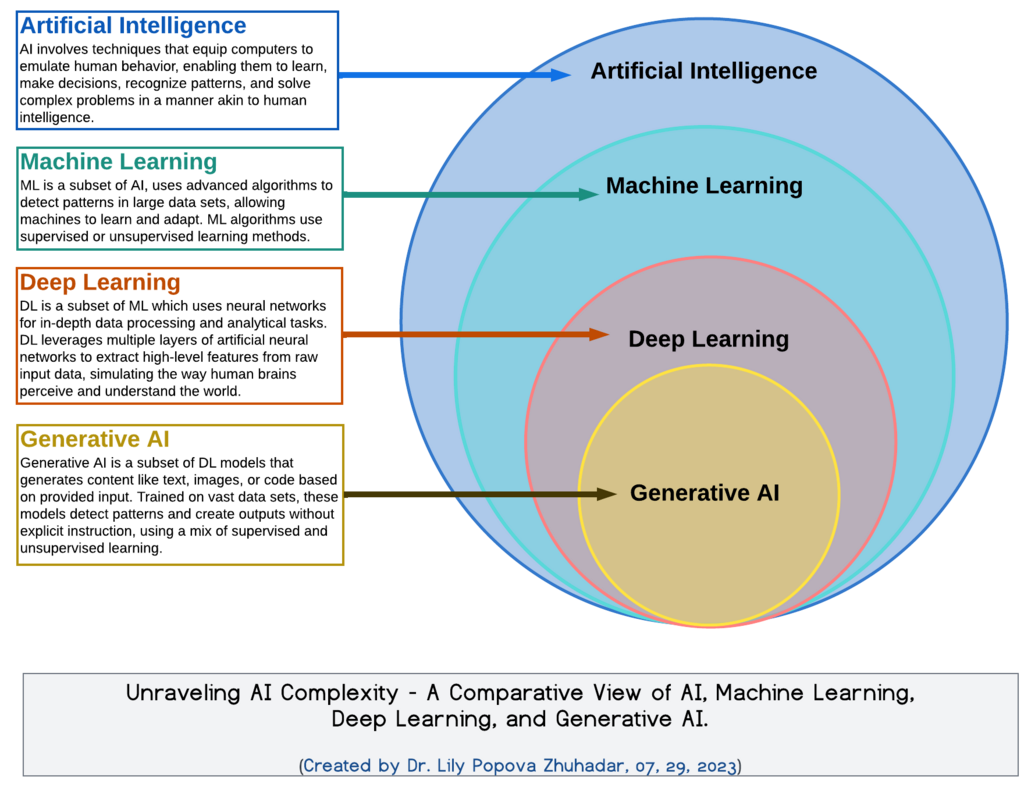
So how does a machine actually learn? It's not magic; it's math and data. The most common approach today is called Machine Learning (ML), which is a subfield of AI. Instead of being explicitly programmed with rules for every possible situation, an ML system learns patterns directly from data.
Machine Learning
noun
A type of artificial intelligence that enables systems to automatically learn and improve from experience without being explicitly programmed.
One powerful technique within machine learning is the use of neural networks. Inspired by the human brain, neural networks are systems of interconnected nodes, or "neurons," that process information in layers. When a neural network is trained on data, the connections between its neurons are adjusted, allowing it to recognize increasingly complex patterns.
A deeper form of this, called Deep Learning, uses neural networks with many layers to tackle very complex tasks, like understanding the nuances of human speech or generating realistic images.
Another major area is Natural Language Processing (NLP). This is the part of AI that helps computers understand, interpret, and generate human language. Every time you use a voice assistant, translate a webpage, or see a chatbot pop up, you're interacting with NLP.
AI in the Wild
AI isn't just a concept in a lab; it's already a part of daily life. The applications are everywhere, often working quietly in the background.
| Industry | Application of AI |
|---|---|
| Healthcare | Analyzing medical images (like X-rays) to detect diseases earlier. |
| Finance | Detecting fraudulent credit card transactions in real-time. |
| Transportation | Powering self-driving cars and optimizing traffic flow in cities. |
| Entertainment | Recommending movies, music, and shows based on your viewing history. |
| Retail | Managing inventory and personalizing shopping experiences for customers. |
These examples just scratch the surface. From farming to cybersecurity, AI is being used to find efficiencies, solve complex problems, and create new possibilities. As the technology continues to evolve, its impact on our world will only grow.
Ready to test your knowledge? Let's see what you've learned about the fundamentals of AI.
What is the primary goal of Artificial Intelligence (AI)?
Fill in the blanks: ______ is a subfield of AI where systems learn from data, and ______ is a further specialization of that subfield using neural networks with many layers.
Understanding these core concepts is the first step. AI is a broad and dynamic field built on these foundational ideas of learning from data and simulating intelligent behavior.