Introduction to AI Skills
Introduction to Artificial Intelligence
What Is Artificial Intelligence?
Artificial intelligence is the science of making machines that can think like humans. The goal is to create systems that can perform tasks that normally require human intelligence, like learning, reasoning, problem-solving, and understanding language.
Think of it this way: when you teach a dog to fetch, you're rewarding a certain behavior until it becomes second nature. AI works on a similar principle, but on a much grander scale. Instead of a dog, you have a computer program, and instead of a biscuit, you have vast amounts of data. The system learns by identifying patterns in that data, refining its understanding over time to make decisions or predictions.
At its core, AI is about creating machines that can interpret data, learn from it, and adapt to achieve specific goals.
A Quick Trip Through Time
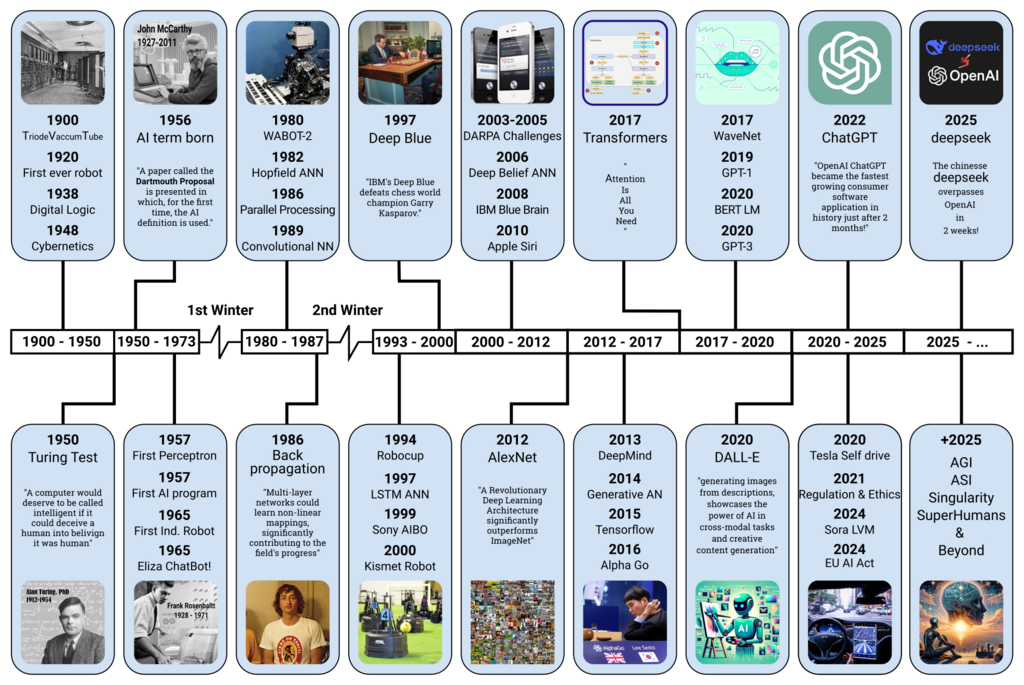
The dream of intelligent machines is ancient, but the formal study of AI began in the mid-20th century. The field's official birthday was in 1956 at a workshop at Dartmouth College, where the term "artificial intelligence" was first coined.
Early excitement was high, with researchers predicting that machines with human-level intelligence were just decades away. But progress was slower than expected. The complexity of creating true intelligence led to periods of reduced funding and interest, known as "AI winters."
A renaissance began in the late 1990s and early 2000s, driven by two key factors: more powerful computers and the availability of massive datasets, thanks to the internet. This combination allowed for the development of machine learning, a subfield of AI that has powered most of the advances we see today.
Narrow vs. General AI
Not all AI is created equal. Today, we categorize AI into two main types: Narrow AI and General AI. Understanding the difference is key to understanding where the technology is today and where it might go.
Artificial Narrow Intelligence (ANI), often called Weak AI, is designed to perform a single, specific task. It operates within a limited context and can't do much beyond its programming. While that might sound restrictive, Narrow AI is incredibly powerful and is all around us. Your phone's voice assistant, the recommendation engine on a streaming service, and the spam filter in your email are all examples of Narrow AI excelling at one job.
Artificial General Intelligence (AGI), or Strong AI, is the more futuristic concept. This is the type of AI you see in science fiction films — a machine with the ability to understand, learn, and apply its intelligence to solve any problem, much like a human being. It would possess consciousness and self-awareness. It's important to remember that AGI does not yet exist; it remains a theoretical goal for researchers.
AI in the Real World
Artificial intelligence has moved from the laboratory into our daily lives, transforming industries in the process. Its versatility allows it to be applied in countless ways.
- Healthcare: AI helps doctors analyze medical images like X-rays and MRIs to detect diseases earlier and more accurately. It also powers algorithms that can predict patient outcomes and personalize treatment plans.
- Finance: Banks use AI to detect fraudulent transactions in real-time, saving customers billions of dollars. It's also used in algorithmic trading, where systems make high-speed trading decisions based on market data.
- Entertainment: The personalized recommendations you get for movies, music, and books are driven by AI. In filmmaking, it's used for creating stunning visual effects and even for automating parts of the editing process.
- Transportation: While fully self-driving cars are still a work in progress, AI is already a key feature in modern vehicles. It powers navigation apps that find the fastest route by analyzing traffic in real-time, as well as safety features like automatic emergency braking.
Ready to check your understanding of these core concepts?
What is the primary goal of Artificial Intelligence?
The type of AI that can perform a wide variety of tasks and has consciousness, similar to a human, is known as:
From its early theoretical beginnings to its current place in our world, AI continues to be one of the most exciting and rapidly evolving fields in technology.