Introduction to AI Engineering
Introduction to AI Engineering
What Is AI Engineering?
Artificial intelligence engineering is the discipline of building and operationalizing AI systems. While a data scientist might create a powerful predictive model, an AI engineer's job is to take that model and integrate it into a real-world application that people can actually use.
Think of it like this: a data scientist designs a brilliant engine. An AI engineer builds the car around it, gets it on the road, and makes sure it runs reliably every day.
This field blends principles from software engineering, data science, and DevOps. It's not just about writing code; it's about creating robust, scalable, and maintainable systems that can deliver the value of AI models to end-users consistently. The focus is on the entire lifecycle of an AI solution, from the initial concept to long-term maintenance in a production environment.
AI engineering serves to create, build, and launch artificial intelligence solutions that resolve practical issues.
The Last Mile Problem
Creating an AI model that performs well in a lab setting is one thing. Getting it to work reliably in the real world is another challenge entirely. This gap is often called the "last mile problem" of AI. A model that's 99% accurate on a clean dataset might fail spectacularly when faced with messy, unpredictable live data.
AI engineers tackle several key challenges to bridge this gap:
- Scalability: How does the system handle thousands or even millions of requests per second?
- Reliability: What happens if a server crashes or the data feed is interrupted? The system needs to be resilient.
- Integration: How does the AI model fit into existing software, databases, and business processes?
- Maintainability: How can the model be updated, monitored, and retrained without causing downtime?
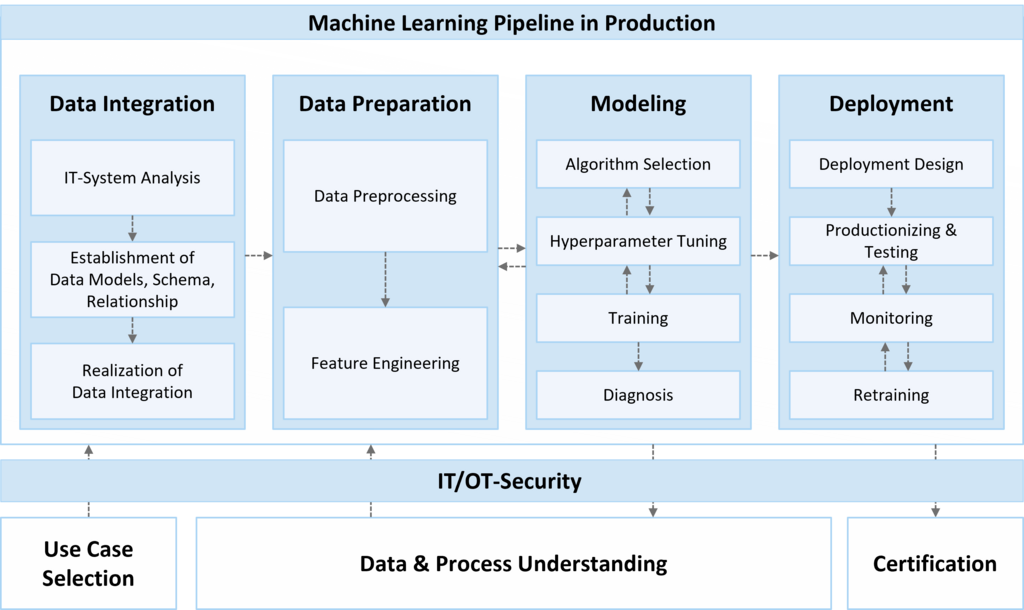
The AI Model Lifecycle
Unlike traditional software, AI systems aren't built and then forgotten. They exist in a continuous lifecycle, constantly evolving as new data becomes available. This cycle ensures that the models remain accurate and relevant over time.
The lifecycle can be broken down into several key stages. It starts with understanding the business need and collecting data, moves through model development and training, and continues into deployment and ongoing monitoring. It’s a loop, not a straight line, because the insights from a live model often feed back into the beginning of the process for the next version.
Introduction to MLOps
To manage the AI lifecycle effectively, a new set of practices has emerged: MLOps (Machine Learning Operations). MLOps is the key to industrializing AI. It applies the principles of automation and collaboration from DevOps to the unique challenges of machine learning.
If AI Engineering is the "what," then MLOps is the "how." It provides the framework and tools to build, deploy, and maintain AI models in a repeatable and reliable way.
The goal of MLOps is to streamline the entire process, making it faster and less error-prone. By automating tasks like testing, deployment, and monitoring, MLOps allows teams to release new model versions with confidence and ensure that the AI systems in production are always performing as expected. It's the operational backbone that makes scalable AI possible.
Time to review what we've covered.
What is the primary focus of an Artificial Intelligence (AI) engineer?
The challenge of making a model that performs well on a clean dataset also perform reliably with messy, live data is often called the __________.
Understanding these core concepts is the first step toward building AI systems that don't just work in theory, but deliver real value in practice.