Introduction to AI Automation
Introduction to AI
What Is Artificial Intelligence?
Artificial intelligence, or AI, is the science of making computers that can think and learn like humans. Instead of just following a rigid set of instructions, an AI system learns from experience, recognizes patterns, and makes decisions on its own.
Artificial Intelligence
noun
A field of computer science dedicated to creating systems that can perform tasks that typically require human intelligence, such as learning, reasoning, and problem-solving.
The idea isn't new. People have been dreaming of intelligent machines for centuries. But the modern field of AI truly began in the 1950s. A small group of scientists gathered at Dartmouth College and coined the term 'artificial intelligence.' They imagined a future where machines could use language, form concepts, and solve problems just like we do.
The Two Faces of AI
When people talk about AI, they're usually referring to one of two types: narrow or general.
Artificial Narrow Intelligence (ANI) is what we have today. It’s AI that is designed to perform a single, specific task. Think of the spam filter in your email, the recommendation engine on a streaming service, or a digital voice assistant. These systems are incredibly good at what they do, but they can't operate outside of their pre-defined functions. Your spam filter can't start recommending movies to you.
Artificial General Intelligence (AGI) is the stuff of science fiction. This is a type of AI that possesses the ability to understand, learn, and apply its intelligence to solve any problem, much like a human being. AGI doesn't exist yet, and creating it is one of the most significant challenges in computer science.
All current AI systems are forms of Narrow AI, specialized for specific tasks. General AI remains a theoretical goal.
How AI Learns
So how do we get a computer to learn? It's done through various techniques, with three of the most important being machine learning, deep learning, and natural language processing.
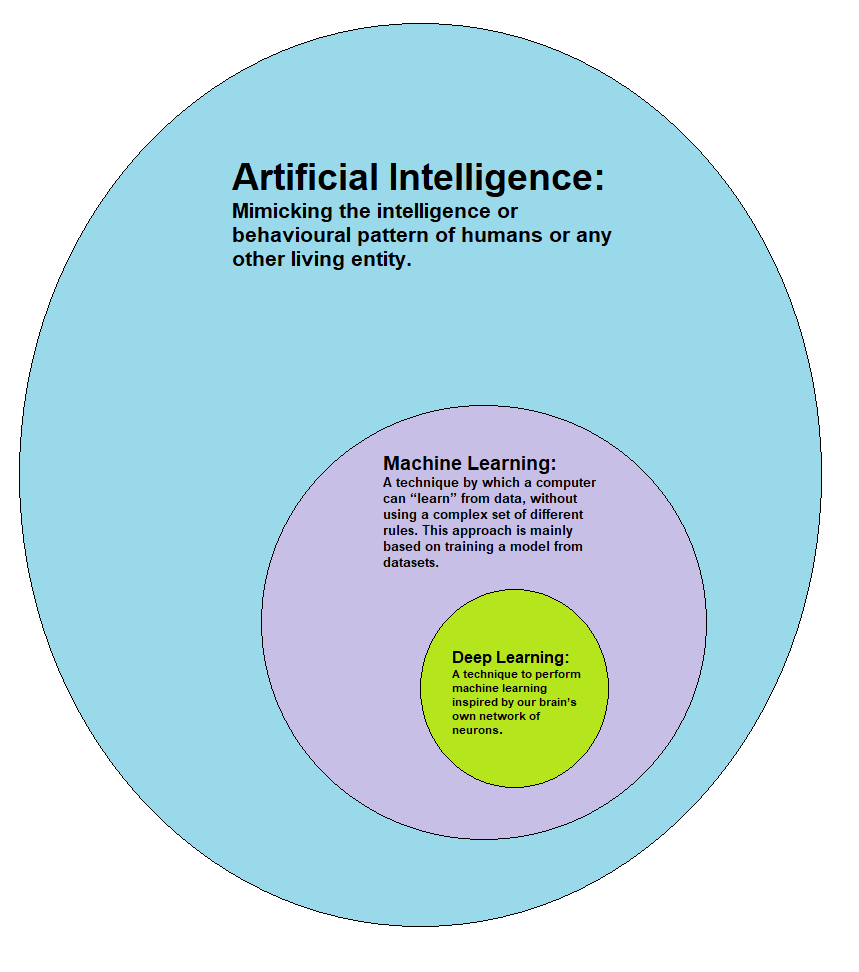
Machine Learning (ML) is the core concept that allows AI to learn from data without being explicitly programmed. Instead of writing code for every possible decision, developers create an algorithm and feed it vast amounts of data. The algorithm identifies patterns in the data and 'learns' how to make predictions or decisions. For example, by analyzing thousands of financial transactions, an ML model can learn to spot fraudulent activity.
Deep Learning (DL) is a more advanced type of machine learning. It uses complex structures called neural networks, which are inspired by the human brain. These networks have many layers, allowing them to learn from data in a more sophisticated way. Each layer builds on the output of the previous one to recognize more complex patterns. This is the technology behind facial recognition and self-driving cars, which need to process incredibly complex visual information.
Natural Language Processing (NLP) focuses on enabling computers to understand, interpret, and generate human language. It's the bridge between human communication and computer understanding. Every time you use a translation app, talk to a chatbot, or see your word processor suggest a correction, you're interacting with NLP.
Why AI Matters
AI is becoming a foundational part of modern technology because of its ability to process and find insights in amounts of data that are simply too large for humans to handle. It can detect subtle patterns in everything from medical scans to climate data, leading to breakthroughs in science, medicine, and business.
It isn't just one technology; it's a powerful tool that enhances human capabilities and drives innovation across nearly every industry. Understanding these basic principles is the first step to seeing how AI is reshaping our world.
What is the primary difference between Artificial Narrow Intelligence (ANI) and Artificial General Intelligence (AGI)?
Which AI technology is most directly responsible for a translation app converting your speech from one language to another?