Introduction to AI Agents
Agent Architectures
The Anatomy of an AI Agent
You've likely interacted with chatbots that answer questions based on a prompt. These systems are reactive; they take an input and produce an output in a single, self-contained turn. An AI agent is different. It’s an autonomous system designed not just to respond, but to achieve a goal over multiple steps. The secret to this capability lies in its architecture.
Instead of a simple input-output mechanism, an agent operates on a continuous loop. It perceives its environment, reasons about what to do next, and then takes action. This allows it to tackle complex, multi-step tasks that a reactive chatbot can't handle, turning it into a persistent digital worker rather than a one-shot answer machine.
The Perception-Reasoning-Action Loop
At the heart of every autonomous agent is the Perception-Reasoning-Action (PRA) loop. It’s the fundamental cycle that enables an agent to operate independently.
Let's break down each stage:
-
Perception: The agent takes in information about its current state and environment. This isn't just a user's prompt. It could be the response from a web search, the contents of a file, or data from a software tool. It's the agent's way of 'seeing' what's going on.
-
Reasoning: This is the agent's brain. Instead of just generating text, the Large Language Model (LLM) acts as a reasoning engine to interpret the goal, analyse the perceived information, and decide what to do next. It performs task decomposition, breaking a large objective into a series of smaller, manageable steps.
-
Action: The agent executes the step decided upon during the reasoning phase. This involves using a tool, which could be anything from running a piece of code, calling an API to fetch data, or sending an email. The result of this action then feeds back into the perception stage, starting the loop over again.
The Agent's Internal Blueprint
To function effectively, an agent relies on a few key internal components. Think of these as the pre-loaded instructions and capabilities that guide its behaviour within the PRA loop.
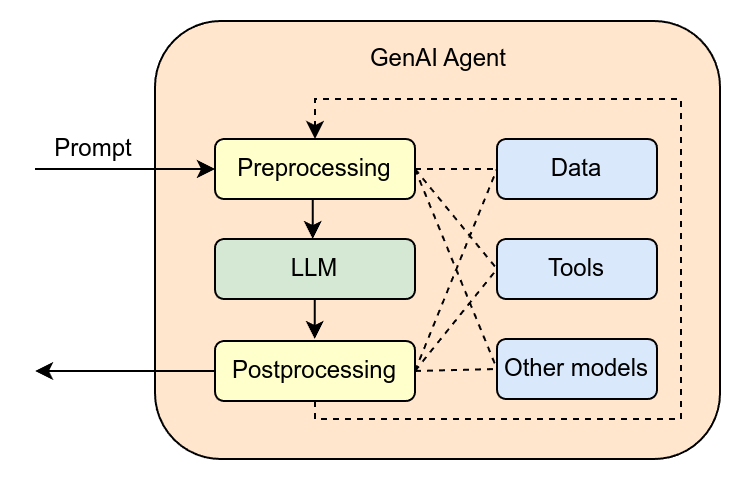
The most critical component is the Persona, which is defined by the system prompt. This is a special instruction, invisible to the end-user, that tells the agent who it is, what its purpose is, what rules it must follow, and what tools it has available. For example, a system prompt for a travel agent might instruct it to be friendly, always search for flights first, and never book a hotel without confirmation.
Next is the Planning Module. This is where the agent's ability to perform task decomposition lives. When given a complex goal like "Plan a weekend trip to Paris for me," this module, powered by the LLM's reasoning, creates a step-by-step plan: find flight dates, search for flights, search for hotels, present options, await confirmation, and then book.
Finally, the Action System gives the agent its hands. It's the set of tools, or 'actuators', the agent can use to interact with the world outside its own code. This could include a web browser for research, a code interpreter for calculations, or an API for booking a flight. Without an action system, the agent is just a thinker; with it, it becomes a doer.
By combining a guiding persona, a planning module, and a set of actions, the PRA loop transforms a simple LLM into a dynamic agent capable of pursuing goals autonomously. This architecture is the blueprint for creating sophisticated AI that can act as a true digital employee.
What is the primary difference between an AI agent and a reactive chatbot?
Which of the following correctly describes the stages of the fundamental cycle that enables an AI agent to operate autonomously?