Introduction to Agentic AI
Introduction to AI
What Is Artificial Intelligence?
Artificial intelligence is the science of making machines that can think like humans. This doesn't mean they feel emotions or have consciousness. It means they can perform tasks that typically require human intelligence, like recognizing patterns, understanding language, and making decisions based on data.
At its core, AI is about creating systems that can interpret data, learn from it, and use that knowledge to achieve specific goals.
The idea isn't new. Philosophers have long wondered if machines could think. But it wasn't until the mid-20th century that computer scientists really started building the foundations of modern AI. The journey has been a long one, with periods of rapid progress and quiet lulls.
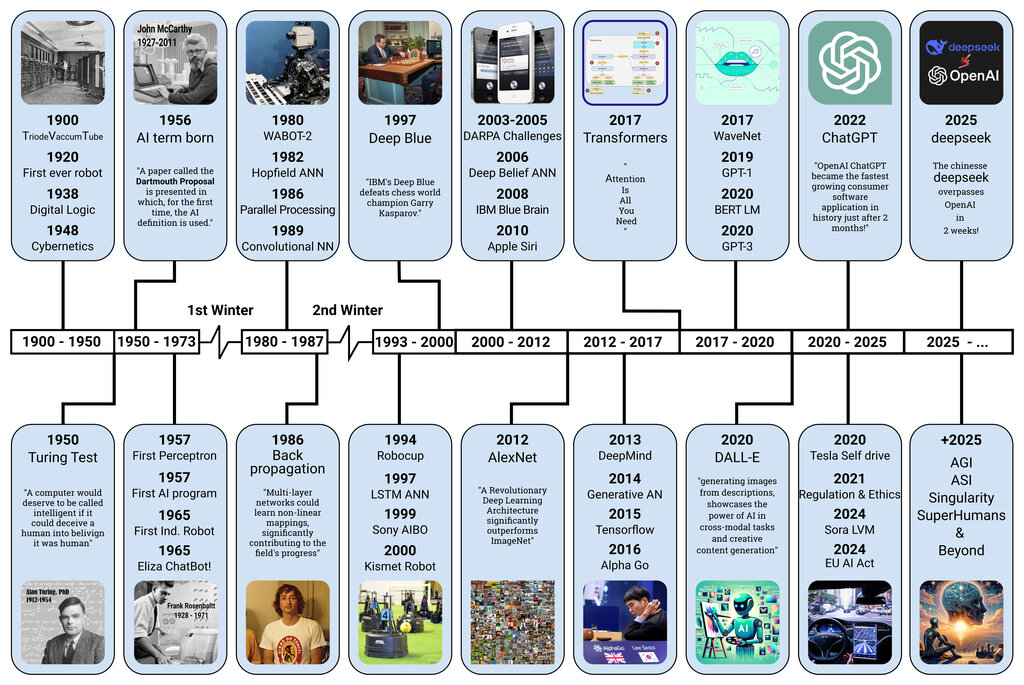
From Rules to Learning
Early AI systems were mostly "rule-based." Programmers would write explicit, step-by-step instructions for the machine to follow. Think of a simple spam filter from the 1990s. A programmer might tell it: "If an email contains the phrase 'free money,' mark it as spam."
This works, but it's brittle. What if the spammer writes 'fr33 m0ney'? The filter would miss it unless a programmer adds another rule. This approach required huge amounts of manual effort and couldn't handle unexpected situations.
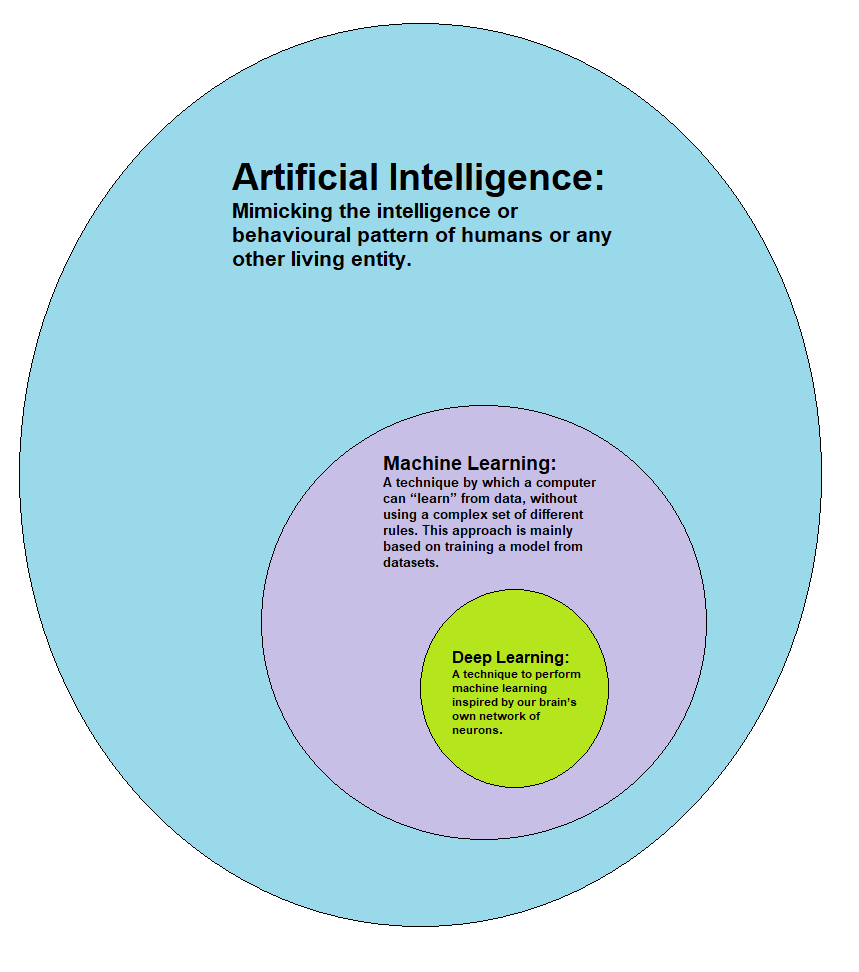
The game changed with the rise of Machine Learning (ML). Instead of giving the machine rules, we give it data and let it figure out the rules for itself. For our spam filter, we would feed it thousands of examples of spam and non-spam emails. The ML model would then learn the patterns associated with spam on its own.
This ability to learn from data is what powers most of the AI you interact with today. Machine Learning is a major subfield of AI, but not the only one. Other important areas include Natural Language Processing (NLP), which helps machines understand and generate human language, and Computer Vision, which allows them to interpret images and videos.
How Machines Learn
Machine learning itself has different styles. The two most common are supervised and unsupervised learning.
Supervised Learning
noun
The machine learns from data that has been labeled with the correct answers. It's like studying with flashcards.
In supervised learning, you provide the model with a dataset where each piece of data is tagged with the right output. For example, you might feed it a million pictures of animals, each labeled as 'cat,' 'dog,' or 'bird.' The model's job is to learn the relationship between the input (the image) and the output (the label) so it can correctly label new, unseen images.
Unsupervised Learning
noun
The machine learns from unlabeled data, finding hidden patterns or structures on its own. It's like finding categories in a messy room without being told what the categories are.
In unsupervised learning, the data has no labels. The goal is for the AI to discover interesting structures within the data. For instance, an e-commerce site might use unsupervised learning to group customers with similar buying habits, even if the company doesn't know what those habits are beforehand.
A key technology behind many of these learning models is the neural network. Inspired by the human brain, a neural network is made of layers of interconnected nodes, or 'neurons.' Each connection has a weight that gets adjusted as the network learns from data. When a network has many layers, it's called a 'deep neural network,' which is the basis for Deep Learning—the powerful technique behind recent breakthroughs like advanced image recognition and large language models.
Narrow vs. General AI
It's important to distinguish between the AI we have today and the AI you see in movies. All current AI systems are considered Artificial Narrow Intelligence (ANI). This means they are designed to perform a single specific task, like playing chess, translating languages, or driving a car. While they can perform that one task with superhuman ability, they can't do anything else. An AI that masters chess has no idea how to check the weather.
The ultimate goal for many researchers is Artificial General Intelligence (AGI). This is a hypothetical type of AI that would possess the ability to understand, learn, and apply its intelligence to solve any problem a human being can. An AGI could switch seamlessly between writing a poem, proving a mathematical theorem, and offering empathetic advice. We are still a long way from creating AGI, and it remains a topic of both excitement and serious debate.
Understanding these fundamentals—what AI is, how it evolved, and its different forms—is the first step to grasping the powerful tools being built today.
What is the primary characteristic of the Artificial Intelligence (AI) systems that exist today?
An email service wants to build a spam filter by feeding its algorithm thousands of emails that have already been manually marked as 'spam' or 'not spam'. What type of machine learning is this an example of?