Introduction to Agentic AI
Introduction to Agentic AI
Beyond the Prompt
Most of the AI we interact with daily is reactive. We type a question, and a chatbot gives an answer. We ask for a picture of a cat, and an image generator creates one. These tools are powerful, but they wait for our instructions. They don't take the next step on their own.
Agentic AI is different. It represents a shift from a reactive assistant to a proactive partner. These are AI systems designed to take initiative. They can perceive their digital environment, make plans, and execute tasks to achieve a goal you've set, all without needing you to guide every single step.
Agentic
adjective
Possessing the quality of agency; able to act independently and make choices.
Think of it like this: a standard AI is like a calculator. It's an incredible tool, but it only works when you press the buttons. An agentic AI is more like a personal accountant you hire to manage your finances. You give them the high-level goal, like "maximize my tax return," and they handle the details—gathering documents, filling out forms, and finding deductions. They might ask for clarification, but they're driving the process forward.
Agentic AI represents a fundamental evolution in AI; they are the systems that can reason, plan, and act autonomously to achieve specified goals.
The Importance of Autonomy
This ability to act independently is the core of what makes agentic systems so significant. Autonomy allows an AI to move beyond simple, one-off tasks and tackle complex, multi-step problems that change over time. It doesn't need a perfect, detailed set of instructions. It can start with a general objective and figure out the path forward on its own.
This is a crucial step for AI's role in the world. Instead of humans constantly directing and correcting AI tools, we can start delegating outcomes. This frees up human creativity and strategic thinking for higher-level challenges, while the AI handles the complex execution.
The diagram above shows the difference. A passive system follows a straight line from input to output. An agentic system operates in a continuous loop. It acts, observes the results of its actions, and then refines its plan. This cycle of perception, reasoning, and action is what allows it to navigate complexity and adapt to new information.
A New Layer of Technology
Agentic AI isn't just a new product; it's a new way of building and interacting with technology. It's becoming the coordinating layer that can manage other software, tools, and APIs.
Imagine an agent tasked with planning a trip. It wouldn't just give you a list of flights. It could interact with a flight booking API, a hotel reservation system, and a calendar app to find the best options, book them, and add the itinerary to your schedule. The agent acts as the conductor, orchestrating a set of specialized tools to achieve a complex goal.
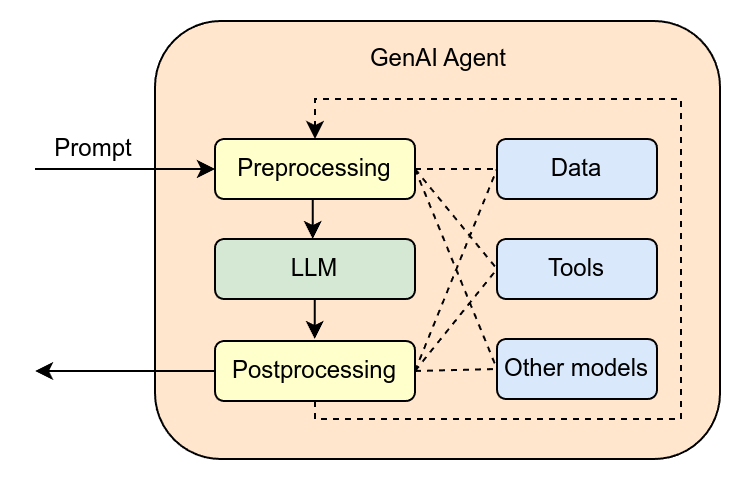
This capability is pushing AI into new territory. While we are still in the early stages, the potential is clear. Agentic systems could manage complex logistics, conduct scientific research by running simulations and analyzing data, or provide highly personalized tutoring by adapting to a student's progress in real-time. By giving AI the ability to act, we are fundamentally changing what we can ask it to do.
What is the primary characteristic that distinguishes agentic AI from reactive AI?
The provided text compares a standard, reactive AI to a calculator and an agentic AI to a personal accountant. What does this analogy highlight?
This is just the beginning of our exploration into agentic AI. Next, we'll look at the specific components that make these autonomous systems work.