Introduction to Agentic AI
Introduction to Agentic AI
Beyond Answering Questions
Most AI we interact with is reactive. You type a prompt, it gives a response. It's like a powerful calculator: it waits for your exact instructions and then executes them. But what if an AI could act more like a personal assistant? You give it a high-level goal, and it figures out the steps to get there on its own.
This is the core idea behind agentic AI. These are systems designed to be proactive agents, working autonomously to achieve objectives. Instead of just responding to a single command, an agentic AI can set its own sub-goals, create a plan, and take action over multiple steps to see a task through to completion.
Agentic AI refers to AI systems designed with autonomy, capable of reasoning, planning multi-step tasks, adapting to changing contexts, and acting toward defined goals without constant human prompting.
Think of it as the difference between asking a chatbot to define a term and asking an AI agent to plan your entire vacation. The chatbot gives you a definition and stops. The agent would research destinations, compare flight prices, check hotel availability, and maybe even book the reservations, all from your initial request to "plan a trip to Italy in May."
The Core Traits
What gives agentic AI this power? It comes down to a few key characteristics that set it apart from more traditional AI models. These traits allow an agent to operate independently and effectively in complex environments.
| Characteristic | Description |
|---|---|
| Autonomy | Operates with minimal human intervention. It can make its own decisions. |
| Goal-Directed | Focuses on achieving a specific outcome, not just executing a command. |
| Adaptability | Can adjust its plan based on new information or unexpected obstacles. |
| Modularity | Often built from smaller, specialized components or tools that can be combined. |
Autonomy is the most critical feature. An AI agent doesn't need to be micromanaged. It has the freedom to pursue a goal as it sees fit. This is paired with goal-directed behavior. The agent understands the why behind a task, which allows it to make smarter, context-aware decisions.
If the agent runs into a problem, its adaptability kicks in. A cancelled flight doesn't stop a travel agent; it finds another one. Similarly, an AI agent can pivot its strategy without needing a new set of instructions. Finally, modularity means an agent can use different tools, like accessing a web browser, running code, or connecting to an API, to get the job done.
A Spectrum of Agency
It's helpful to think of agency not as an on/off switch, but as a spectrum. A simple chatbot has very little agency. A complex system that can manage a company's logistics has a great deal of it. Traditional AI models are typically less agentic. They are trained to perform a specific, narrow task, like translating text or identifying objects in an image. They react to input but don't initiate actions on their own.
Agentic AI, on the other hand, is defined by its ability to act. It perceives its environment, makes a plan, and executes it. This shift from passive tool to active participant is what makes it so significant.
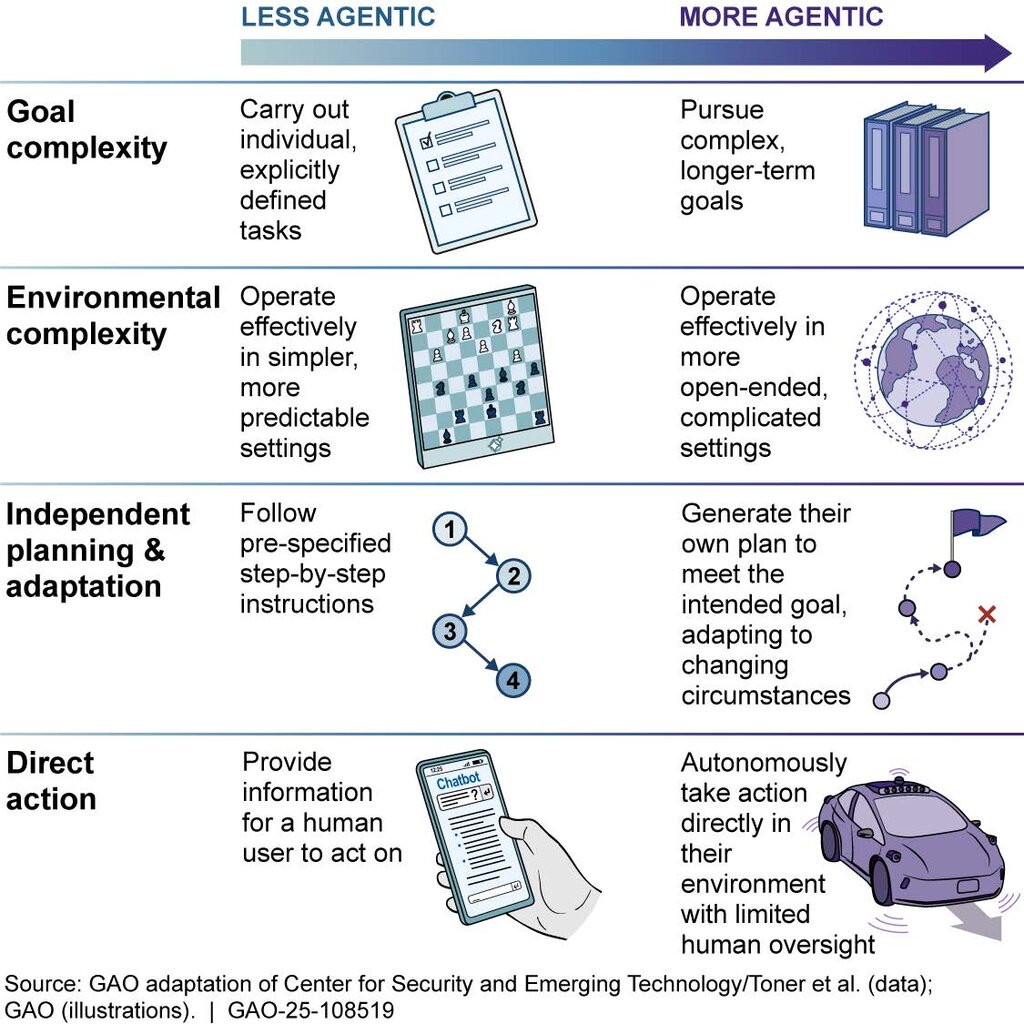
This evolution opens up new possibilities. Instead of humans breaking down complex problems into tiny, AI-manageable tasks, we can offload the entire problem-solving process. This has the potential to fundamentally change how we work with technology, automating not just simple tasks, but entire workflows and complex decision-making processes across industries like scientific research, software development, and personal assistance.
What is the primary difference between a reactive AI (like a standard chatbot) and an agentic AI?
An AI agent's ability to use different tools, such as a web browser or an API, is an example of its ______.