Introduction to Agentic AI
Introduction to Agentic AI
What is Agentic AI?
Most AI you interact with is like a very smart, very fast calculator. You give it a command, like 'write a poem about a robot,' and it does exactly that. It's powerful, but it's reactive. It waits for your instructions.
Agentic AI is different. It's more like a project manager than a calculator. You give it a high-level goal, and it figures out the steps to achieve it on its own. It has agency—the ability to act independently and make its own decisions to get a job done.
agent
noun
An entity that can perceive its environment, make decisions, and take actions to achieve specific goals.
This shift from reacting to prompts to proactively pursuing goals is a major leap. Instead of just answering a single question, an agentic system can handle complex, multi-step tasks that unfold over time.
Agentic AI is a branch of artificial intelligence focused on building autonomous, intelligent agents capable of making decisions, interacting with other agents and completing complex tasks with minimal human intervention.
Beyond Responding to Prompts
The generative AI tools we're used to, like chatbots, follow a fairly simple, linear path. A user provides a prompt, the AI processes it, and it generates an output. That's the end of the interaction until the next prompt arrives.
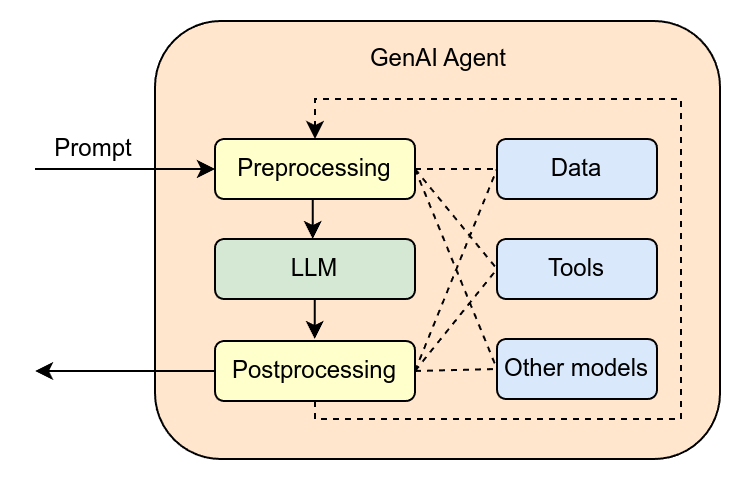
This model is incredibly useful, but it's fundamentally passive. It relies on a human to direct its every move.
Agentic AI breaks out of this one-and-done cycle. It operates in a continuous loop of perceiving, planning, and acting. It's designed to be proactive.
Imagine you ask a standard chatbot to plan a trip. It might give you a list of flights and hotels. An agentic AI, given the same goal, could check your calendar for available dates, research destinations based on your past travel, compare flight prices, book the best option, reserve a hotel, and add the itinerary to your calendar—all without you needing to issue each command separately.
The Core Components
So, what gives an AI agent its autonomy? It comes down to a few key components working together. While the technical details can get complex, the core ideas are straightforward.
Goal-Driven: An agentic AI starts with an objective. This could be simple ('summarize my unread emails') or complex ('grow my company's social media following by 10% this quarter'). This goal guides all of its subsequent decisions.
Perception & Planning: The agent perceives its environment. This could mean reading text, analyzing data, or observing changes in a system. Based on this perception and its goal, it creates a plan—a sequence of steps it believes will lead to success.
Action & Tools: The agent executes its plan by taking actions. Critically, this often involves using tools. An agent might use a web browser to search for information, an API to book a flight, or a code interpreter to analyze data.
Memory & Adaptation: The agent learns. It remembers the results of its past actions and uses that memory to adapt its strategy. If a particular plan fails, it can reflect on what went wrong and try a different approach next time. This ability to learn from experience is what makes agentic AI truly powerful and flexible.
This cycle of perceiving, planning, and acting allows the agent to navigate complex, changing environments without needing a human to guide every single step.
It's time for a quick check-in on these new concepts.
What is the primary difference between a standard AI chatbot and an agentic AI system?
An AI agent is tasked with planning a vacation. It first searches for flights, finds they are too expensive, and then decides to search for train tickets instead. This ability to change its plan based on new information is an example of which component?
Agentic AI marks a significant shift from reactive tools to proactive partners. By understanding its core principles of autonomy, planning, and adaptation, we can begin to see how it might reshape the way we interact with technology.