Intro to Programming Essentials
Introduction to Programming
What Is Programming?
Think of a computer as an incredibly powerful but very literal assistant. It can perform billions of calculations in a second, but it won’t do anything without specific instructions. Programming is the art of writing those instructions.
At its core, programming is simply a way to tell a computer what to do, how to do it, and when to do it. These instructions, bundled together, are called a program. Every app on your phone, every website you visit, and every game you play is a program that a person, or team of people, wrote.
Programming is the process of creating a set of instructions that tell a computer how to perform a task.
Talking to Computers
We can't just talk to a computer in English or Spanish. Human languages are full of ambiguity and nuance. If you say, "It's cool in here," you might mean the temperature is nice, or you might be complimenting the decor. A computer wouldn't know how to interpret that.
That's why we use programming languages. These are special, structured languages with strict rules of grammar, called syntax. Each instruction has one, and only one, meaning. This precision ensures the computer understands our commands exactly as we intend them. There are thousands of programming languages, like Python, Java, and C++, each with its own strengths, but they all share this common purpose: to be a clear and unambiguous bridge between human ideas and computer actions.
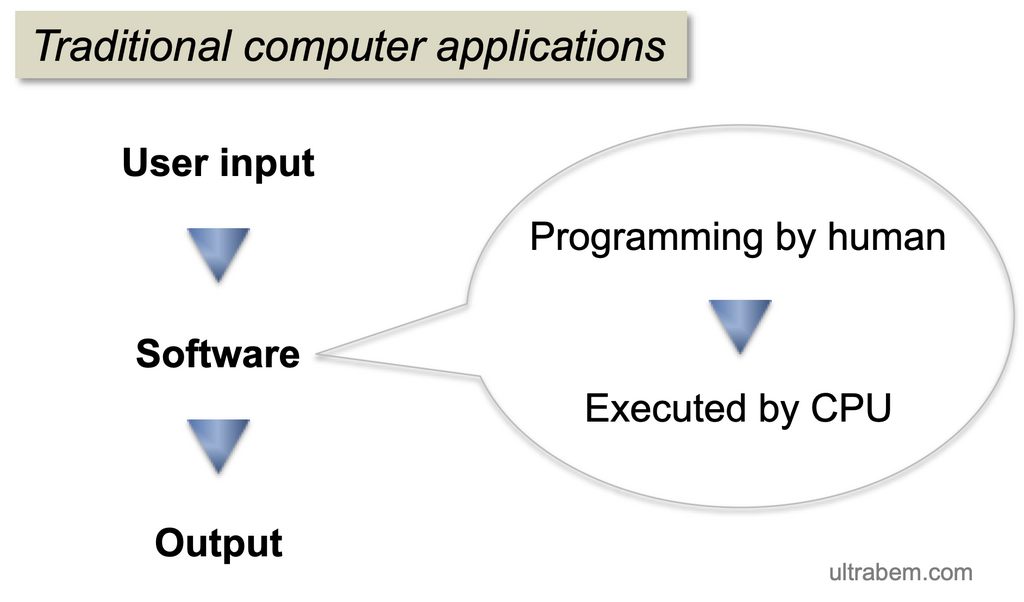
The Building Blocks of a Program
While programs can be incredibly complex, most follow a fundamental structure. Think of it like a recipe. A recipe has ingredients (input), a set of steps to transform them (processing), and a final dish (output).
Similarly, almost every program does three basic things:
- Input: It takes in data or information. This could be a keystroke from a keyboard, a click from a mouse, or data from a file.
- Processing: It performs operations on that input. This is where the main work happens—calculating numbers, sorting names, or making decisions based on the data.
- Output: It produces a result. This could be displaying a message on the screen, saving a new file, or playing a sound.
This input-process-output cycle is the foundation of all computing. From a simple calculator app to a complex operating system, every program follows this basic pattern to get its job done.
Now, let's test your understanding of these core concepts.
What is the primary purpose of a programming language?
A program is often compared to a recipe. If the ingredients are the 'input', what part of the recipe represents the 'processing' phase?
Understanding these fundamentals—what programming is, why we use languages, and the basic structure of a program—is the first step on your journey. Everything else builds from here.