Internet Fundamentals Explained
Client-Server Model
Requesters and Providers
Think about ordering a coffee. You (the customer) go to the counter and ask for a latte. The barista (the provider) takes your order, makes the drink, and gives it to you. The internet works in a very similar way, using a system called the client-server model.
In this model, your device, like your computer or phone, acts as the client. It's the one making a request. The powerful computer that holds the information or service you want is the server. It listens for requests, processes them, and serves back a response.
client
noun
A computer or application that requests information or services from a server.
server
noun
A powerful computer that provides data or services to other computers (clients) over a network.
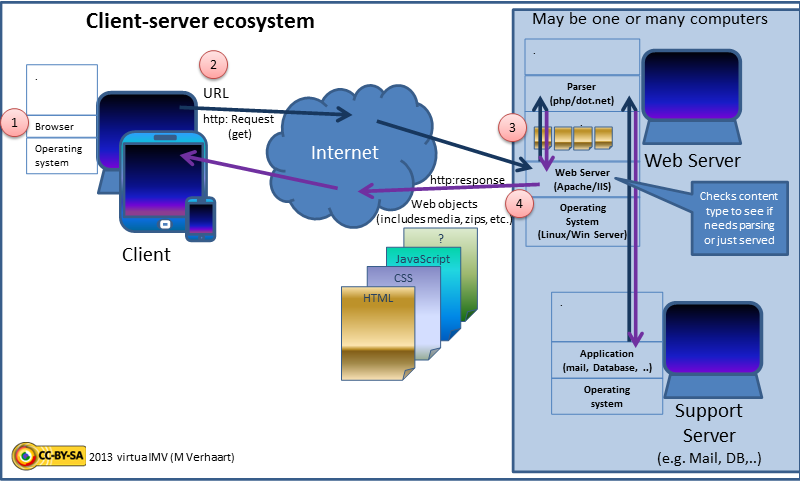
This interaction is a constant cycle of requests and responses. The client sends a request over a network, like the internet. The server receives the request, finds the requested information (like a webpage, an image, or your email inbox), and sends it back to the client. Your client device then displays the information for you to see. This whole exchange happens in fractions of a second.
The Model in Action
You use the client-server model constantly, even if you don't realize it. It's the backbone of most online activities.
When you type a web address into your browser, your browser (the client) sends a request to a web server. The server finds the files for that website and sends them back to your browser, which assembles them into the page you see.
Sending an email works the same way. Your email application (the client) sends your message to a mail server. The server then forwards it to the recipient's mail server, where it waits until their email client requests to see new messages.
Other examples include online gaming, where your console is a client connecting to a game server, or cloud storage, where your app is a client accessing files on a service like Google Drive or Dropbox.
Strengths and Weaknesses
This model is popular for a reason, but it isn't perfect. Its design comes with a clear set of pros and cons.
| Advantages | Disadvantages |
|---|---|
| Centralized Control | Single Point of Failure |
| Data is stored in one place, making it easier to manage, update, and secure. | If the central server fails, no clients can access the service. |
| Scalability | Server Overload |
| It's easy to add more clients. The server can also be upgraded to handle more traffic. | Too many requests at once can overwhelm the server, causing it to slow down or crash. |
| Accessibility | Cost |
| Clients can access data from anywhere as long as there's a network connection. | Building, running, and maintaining a powerful server can be expensive. |
Now that you understand the roles of clients and servers and how they interact, let's test your knowledge.
In the client-server model, what is the primary role of the client?
When you send an email using an application on your phone, your phone's email app is acting as the ______.
This fundamental relationship between requesters and providers powers much of the digital world we use every day. Understanding this simple back-and-forth is the first step to understanding how the internet works.