International Shipping Documents Explained
Document Functions
The Triple Role of Shipping Documents
In international trade, key transport documents like the CMR note, bill of lading (B/L), and airway bill (AWB) perform three critical functions. They act as a receipt for the goods, evidence of a contract for transport, and, in some cases, a document of title. However, not all documents fulfill these roles in the same way, and understanding the differences is crucial.
Function 1: Receipt of Goods
At its most basic level, a transport document is proof that the carrier has taken possession of the goods from the shipper. It's a formal acknowledgment of what was received, where, and when. This receipt function is fundamental to all three documents.
The document will detail the type of goods, their quantity (by weight, volume, or number of packages), and their apparent condition at the time of loading. This last point is vital. If the goods are received in good order, the carrier issues a "clean" document. If there's visible damage or a discrepancy, a note is made, resulting in a "claused" or "dirty" document. This has direct legal implications, as it shifts liability. A clean document implies the carrier is responsible for delivering the goods in the same condition they were received.
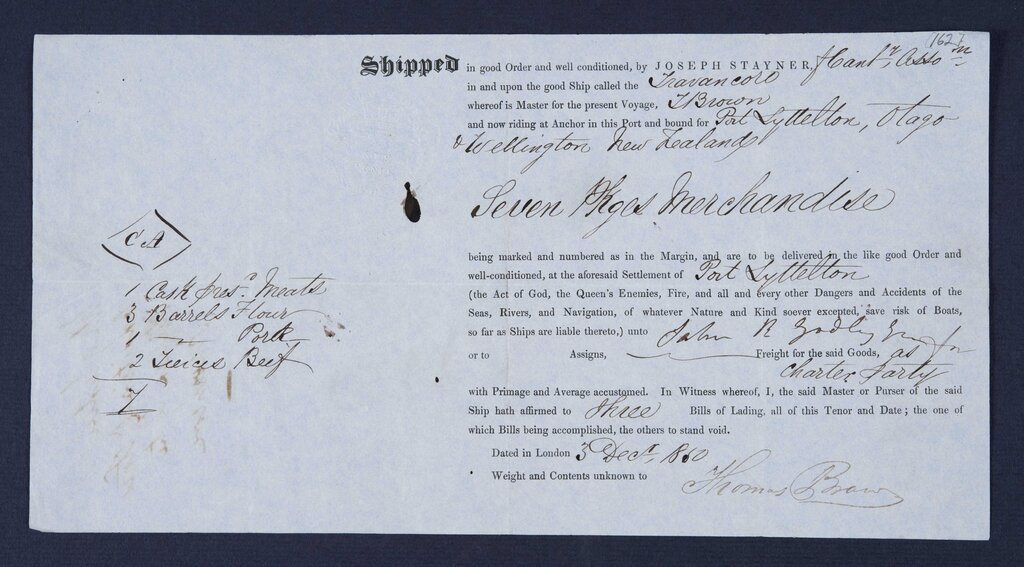
Function 2: Contract of Carriage
Beyond being a simple receipt, the transport document serves as strong evidence of the contract of carriage between the shipper and the carrier. While a more detailed contract may exist separately, the bill of lading, CMR note, or airway bill contains the essential terms of the transport agreement.
These terms include the names of the involved parties, the origin and destination points, a description of the cargo, and the freight charges. Importantly, it also incorporates by reference the carrier's standard terms and conditions and the governing international conventions. For example, a CMR note is governed by the CMR Convention for road transport, while an airway bill falls under the Warsaw or Montreal Conventions for air freight. These conventions establish the carrier's liabilities, limits of liability, and the responsibilities of each party.
A Bill of Lading serves as a loading receipt, a contract of carriage, and a document of title.
When a third party, such as the consignee (the receiver of the goods), accepts the document, they also accept the terms of this contract. This ensures that the rights and responsibilities outlined in the document are transferred along with the goods.
Function 3: Document of Title
This is where the major distinction between these documents lies. A document of title gives the holder the legal right to claim possession of the goods. It's a key that unlocks the cargo.
The bill of lading is unique in its ability to function as a fully negotiable document of title. When a B/L is issued "to order," it means the goods can be bought and sold while they are still in transit. Ownership is transferred by endorsing the original bill of lading and delivering it to the new owner. The carrier is legally obligated to release the cargo only to the party presenting the original, properly endorsed B/L at the destination.
In contrast, the CMR note and the airway bill are not documents of title. They are always made out to a named consignee and are non-negotiable. This means ownership of the goods cannot be transferred by simply handing over the document. The carrier's duty is to deliver the goods to the specific person or company named in the consignee field, after verifying their identity. This reflects the faster pace of road and air freight, where goods often arrive before the physical paperwork could be traded.
| Document | Serves as Receipt? | Evidence of Contract? | Document of Title? |
|---|---|---|---|
| Bill of Lading (B/L) | Yes | Yes | Yes (if negotiable) |
| Airway Bill (AWB) | Yes | Yes | No |
| CMR Note | Yes | Yes | No |
The legal implications are significant. The negotiability of a bill of lading is essential for trade finance, as banks often use it as collateral for letters of credit. Because the B/L represents title to the goods, a bank holding it has security. This is not possible with an AWB or CMR note, which only confirm the identity of the designated recipient.