International Law in the Digital Age
Sovereignty in Cyberspace
Sovereignty Enters the Digital Age
The United Nations Charter, the foundational treaty of international law, is built on the principle of sovereign equality. Every state is equal, and within its own territory, its authority is supreme. This idea works well for land, sea, and air—physical spaces with clear borders. But what happens when the territory isn't physical? The internet operates without regard for geographical boundaries, creating a fundamental tension between the borderless nature of digital communication and the bordered concept of state sovereignty.
Supreme authority over a territory—the foundational claim that a state can govern itself without external interference
This clash forces us to ask how traditional legal principles apply to a global, interconnected network. States want to maintain control over what happens within their jurisdictions, protecting their citizens, economy, and national security. At the same time, the internet's value comes from its openness and global reach. This conflict has led to two distinct philosophies on how to govern the digital world.
Two Competing Visions
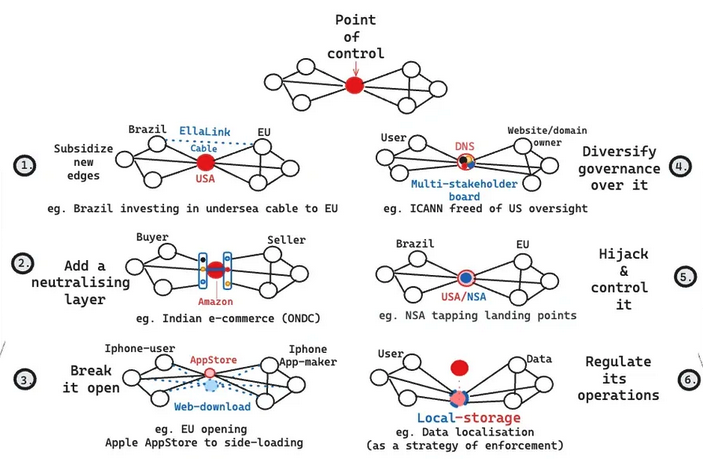
Two main models have emerged for how to handle sovereignty in cyberspace. The first is the 'cyber-sovereignty' model, most prominently advocated by countries like China and Russia. This approach seeks to apply traditional, Westphalian notions of sovereignty directly to the internet. In this view, the state has the right and the duty to control the digital infrastructure, data, and information flows within its territorial borders. The emphasis is on national security and maintaining political and social stability through state control.
The second is the 'open internet' or 'multi-stakeholder' model, generally favored by Western nations. This model argues that the internet is a global common good that should not be controlled by governments alone. Instead, governance should be shared among a wide range of actors, including private companies, technical experts, academics, and civil society organizations. The priority here is the free flow of information, innovation, and the protection of individual human rights online.
| Feature | Cyber-Sovereignty Model | Open Internet Model |
|---|---|---|
| Core Principle | State control over national cyberspace | Global free flow of information |
| Governance | Top-down, state-centric | Multi-stakeholder (governments, industry, civil society) |
| Data Flow | Data localization, restricted cross-border flow | Unrestricted cross-border data flow |
| Content | State-controlled filtering and censorship | Protection of free expression |
| Key Proponents | China, Russia | United States, European Union members |
The differences are not just philosophical; they have practical consequences for everything from e-commerce and social media to cybersecurity and human rights.
Drawing Lines in Cyberspace
When a cyber-attack originating in one country harms another, who is responsible? This is where the legal rubber meets the digital road. International law is adapting to address unauthorized network intrusions and the obligations of states.
The key precedent here comes from a surprising place: a 1949 maritime dispute. The Corfu Channel Case involved British warships damaged by mines in Albanian territorial waters. The International Court of Justice ruled that Albania was responsible, not because it laid the mines, but because it knew about them and did nothing to warn other states. The court established a core principle: every state has an obligation "not to allow knowingly its territory to be used for acts contrary to the rights of other States."
This ruling established the principle of 'due diligence' in international law. A state must take reasonable measures to prevent its territory from being used to harm another state.
This principle is now being applied to cyberspace. A state's 'territory' is interpreted to include its information and communication technology (ICT) infrastructure, such as servers and networks. If a state is aware that malicious cyber activity is originating from its territory—even if conducted by non-state actors like hackers or criminal groups—it has a 'due diligence' obligation to take feasible steps to stop it. This doesn't mean a state is automatically responsible for every cyber-attack launched from within its borders. The standard is awareness and the failure to act. This reinterpretation of the Corfu Channel principle is a cornerstone of applying state responsibility to the digital realm, holding nations accountable for the activity within their digital jurisdictions.
What fundamental tension arises from applying the principle of sovereign equality, designed for physical territories, to the internet?
A country that prioritizes state control over its national internet infrastructure and data flows to maintain social stability is most likely following which model of digital governance?