Intermediate Ukulele Mastery and Fingerstyle
Moveable Chord Shapes
Unlocking the Fretboard
You've likely mastered the basic open chords near the headstock of your ukulele. Chords like C, G, and Am are foundational, but they rely on open strings, which ties them to one specific spot. To play in any key and unlock the full potential of the instrument, we need to learn shapes that can move.
Moveable chords are self-contained shapes that don't use any open strings. Because every note is fretted, you can slide the entire shape up or down the neck to create new chords. The key is replacing the function of the ukulele's nut with your own finger. This technique is called a barre.
The Power of the Barre
A barre chord is created when you use one finger, usually your index finger, to press down multiple strings at a single fret. This finger acts as a moveable nut, allowing you to transpose a chord shape to any key. The trick is applying firm, even pressure across all the required strings to get a clean sound without any buzzing.
It takes practice to build finger strength, but it's the gateway to playing thousands of songs. Don't press too hard with your thumb on the back of the neck; think of it more as a pivot point, using the natural weight of your arm to create pressure.
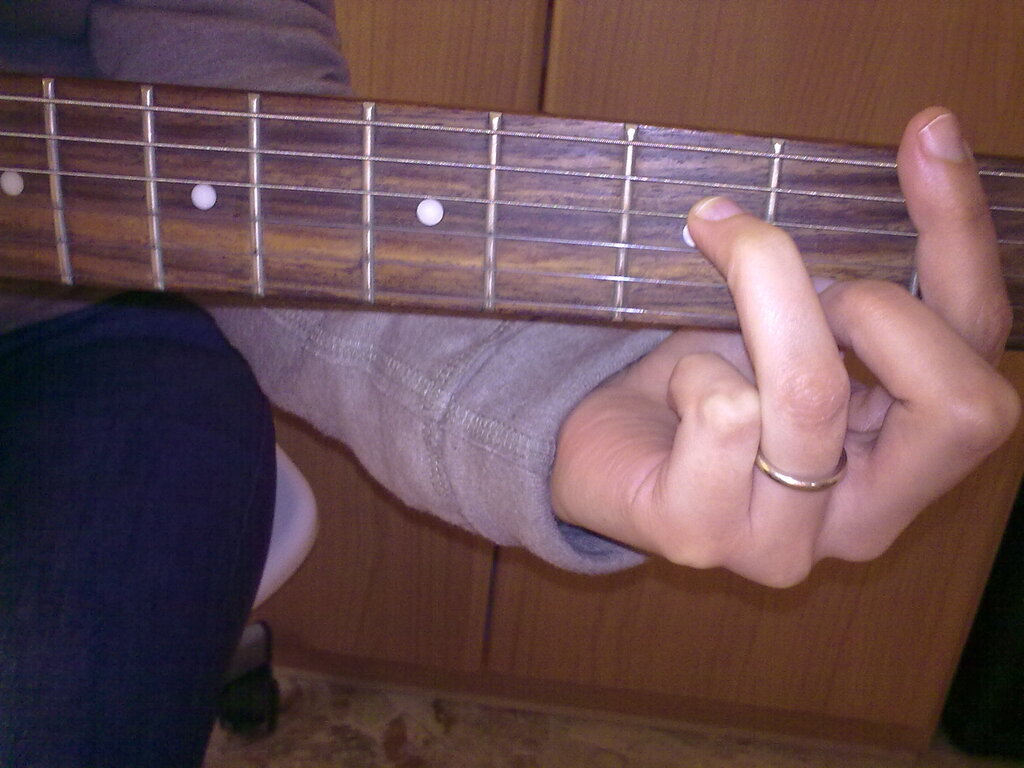
Let’s start with a common and useful shape. The Bb major chord is often one of the first barre chords ukulele players learn. To play it, you barre your index finger across the E and A strings at the first fret, place your middle finger on the C string at the second fret, and your ring finger on the G string at the third fret.
Bb Major Chord Shape: Your index finger barres the 1st fret (E & A strings), middle finger on the 2nd fret (C string), and ring finger on the 3rd fret (G string).
Now for the magic. If you slide this entire shape up one fret, you've created a B major chord. The relationship between your fingers stays exactly the same. The only thing that changes is the fret you start on. The note your middle finger plays on the C string determines the chord's root. In the Bb shape, that note is Bb. When you slide it up to the 3rd fret, your middle finger is now on C, making it a C major chord.
The Moveable Minor
This same principle applies to minor chords. The open A minor chord (Am) is played by placing your middle finger on the G string at the second fret. It's one of the simplest shapes to play.
To make it moveable, we need a way to barre the open strings. The most common way is to barre all four strings at a given fret with your index finger, then form a modified Am shape higher up the neck. However, a simpler version uses the same fingering as open Am (just one finger) but only on the G string, while using your index finger to barre the other three strings two frets below. This is less common but illustrates the idea.
A more standard and useful moveable minor shape is based on the B minor chord shape. To play Bm, barre the entire second fret with your index finger and place your ring finger on the G string at the fourth fret. Just like our major shape, this Am shape can be moved anywhere. If you slide it up one fret (barring the third fret), you get Cm. The root note is on the C string at the fret you are barring.
Navigating the fretboard becomes a game of finding your root note. The notes on the C string are a great guidepost. If you know the notes along that string, you can place your barre shape with confidence. Remember the musical alphabet: A, A#, B, C, C#, D, D#, E, F, F#, G, G#. Each fret is one step (a semitone) higher.
For example, to play an F major chord, you would find the F note on the C string (5th fret) and apply the moveable major shape there. The barre would be on the 3rd fret. Mastering this concept frees you from relying on a and opens up the entire instrument.
By fretting all the strings, these shapes can be shifted up or down the fretboard, creating new chords with higher or lower tones.
With these major and minor moveable shapes in your toolkit, you are no longer tied to the first few frets. You can now build any major or minor chord you need, anywhere on the neck. This is a huge step in your journey as a musician.