Intermediate Tabla Mastery and Rhythmic Logic
Bayan Nuance and Clarity
The Sliding Bass
The soul of the tabla's bass sound isn't just in the strike, but in the slide. We call this expressive slide 'Meend'. It's what gives the bayan its vocal, melodic quality, allowing it to sing rather than just thump. Mastering Meend is the difference between simply playing notes and making music. It all comes down to controlling the pressure your wrist and palm apply to the drum head, or pudi.
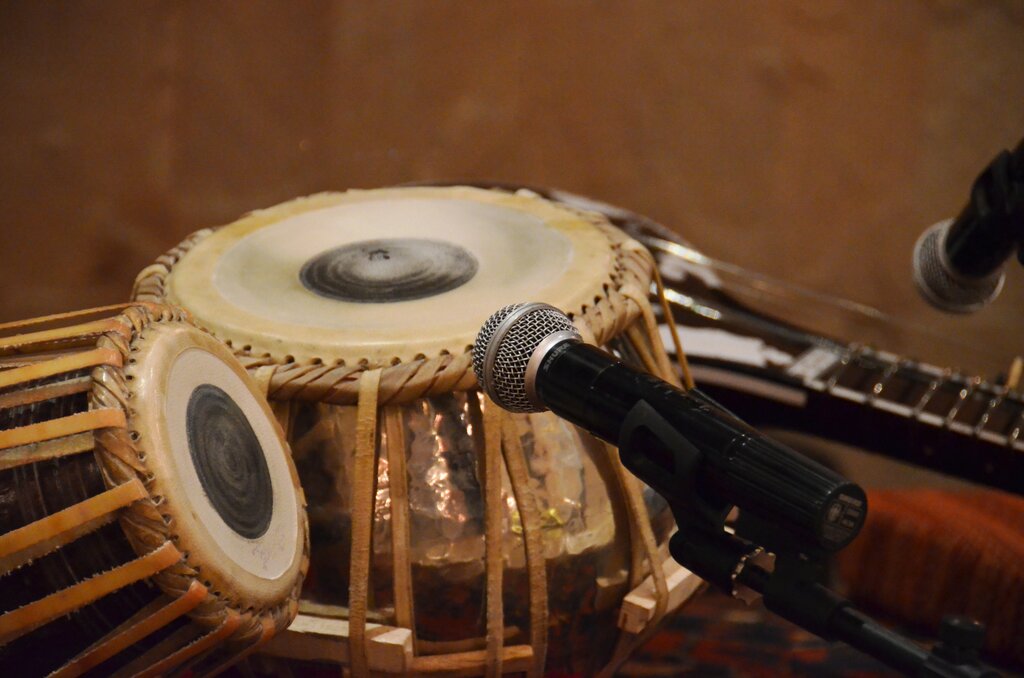
Think of the bayan's surface like a guitar string. When you press down on a fret, you shorten the string's vibrating length and raise the pitch. The bayan works on a similar principle, but with tension instead of length. By applying pressure with the heel of your hand, you increase the tension on the membrane. More tension means a higher frequency of vibration, which our ears perceive as a higher pitch. This is the fundamental physics behind the 'Ghe' and 'Ga' sounds.
The open bass stroke, 'Ghe', is produced with minimal pressure from the heel of your hand. It should create a deep, resonant tone. The sound should feel open and unforced. As you transition to 'Ga', you slide your wrist forward slightly, increasing the pressure. This movement is subtle and controlled. You're not slamming your hand down; you are gliding it to modulate the pitch upwards. The goal is a smooth, vocal-like transition, not two distinct, disconnected sounds.
Finding the Sweet Spot
One of the most common mistakes is 'choking' the sound. This happens when too much of the hand dampens the drum head, killing its vibration. The key is to find the pressure point sweet spot. Only the heel of your palm and the base of your wrist should be modulating the tension. Your fingers should be relaxed and hovering, ready to strike, but not resting on the surface.
Experiment with the position. If you place your hand too close to the rim, you'll have less control over the pitch. If you place it too close to the center syahi, you will muffle the drum. The optimal zone is the ring of white skin between the black center and the outer edge. This is where the membrane is most responsive to subtle changes in pressure, giving you the richest to work with.
Practice slowly. Play a long 'Ghe' and listen to the resonance. Then, smoothly slide into 'Ga' and hold it. Focus on making the transition seamless. The sound should rise in pitch without losing its volume or clarity.
This level of control is essential for playing intermediate compositions like Kaydas correctly. A Kayda is not just a sequence of strokes; it is a theme with variations. Your ability to apply Meend gives these compositions life, allowing the bassline to provide a melodic counterpoint to the rhythmic patterns of the dayan. Without clear and nuanced 'Ghe' and 'Ga' sounds, the Kayda will sound flat and mechanical.
Putting It into Practice
Let's try a simple exercise to build muscle memory for the Meend technique. This isn't about speed, but about control and listening. We'll use a basic four-beat pattern.
- Beat 1: Play 'Ghe'. Use your index or middle finger to strike the edge of the syahi while your wrist applies minimal pressure. Let the sound ring out.
- Beat 2: While the sound from 'Ghe' is still resonating, slide your wrist forward to raise the pitch to 'Ga'. Do not strike the drum again. This is purely a pitch-bend.
- Beat 3: Play 'Na' on the dayan (the smaller, right-hand drum).
- Beat 4: Play 'Tin' on the dayan.
Repeat this cycle, focusing entirely on the smooth transition between 'Ghe' and 'Ga' on beat 2. Your ear is your best guide. The goal is to create a 'whoop' sound that rises cleanly in pitch. Once you are comfortable, you can start incorporating this into simple rhythmic phrases.
As you practice, remember that resonance is your goal. A well-executed 'Ghe' or 'Ga' should feel like it's vibrating through the floor. If the sound is thin or dead, re-evaluate your hand pressure and position. Small adjustments can make a world of difference.
What is the term for the expressive slide in pitch on the bayan, which gives the tabla its vocal quality?
How does applying pressure with the heel of the hand on the bayan change its sound?