Intermediate Structural Drawing and Form
Advanced 3D Perspective
Beyond the Horizon
You’ve already mastered one-point and two-point perspective, which are perfect for creating scenes viewed straight-on. But what happens when you want to convey a sense of massive scale, looking up at a towering skyscraper or down from a dizzying height? For that, we need to add a third dimension of convergence, which brings us to three-point perspective.
Unlike its simpler cousins, three-point perspective introduces a third vanishing point. This point handles the convergence of vertical lines. In one and two-point perspective, all your verticals are perfectly parallel. Here, they recede either up or down, creating a dramatic sense of depth and scale.
When the third vanishing point is placed below the horizon line, you create a bird's-eye view, as if you're looking down on the scene. When it's placed above the horizon, you get a worm's-eye view—the classic shot of looking up at a towering hero or building.
The key is placement. Placing the third vanishing point too close to the object will create extreme, cartoonish distortion. For a more realistic look, place it far above or below the horizon line.
Rotating Objects in Space
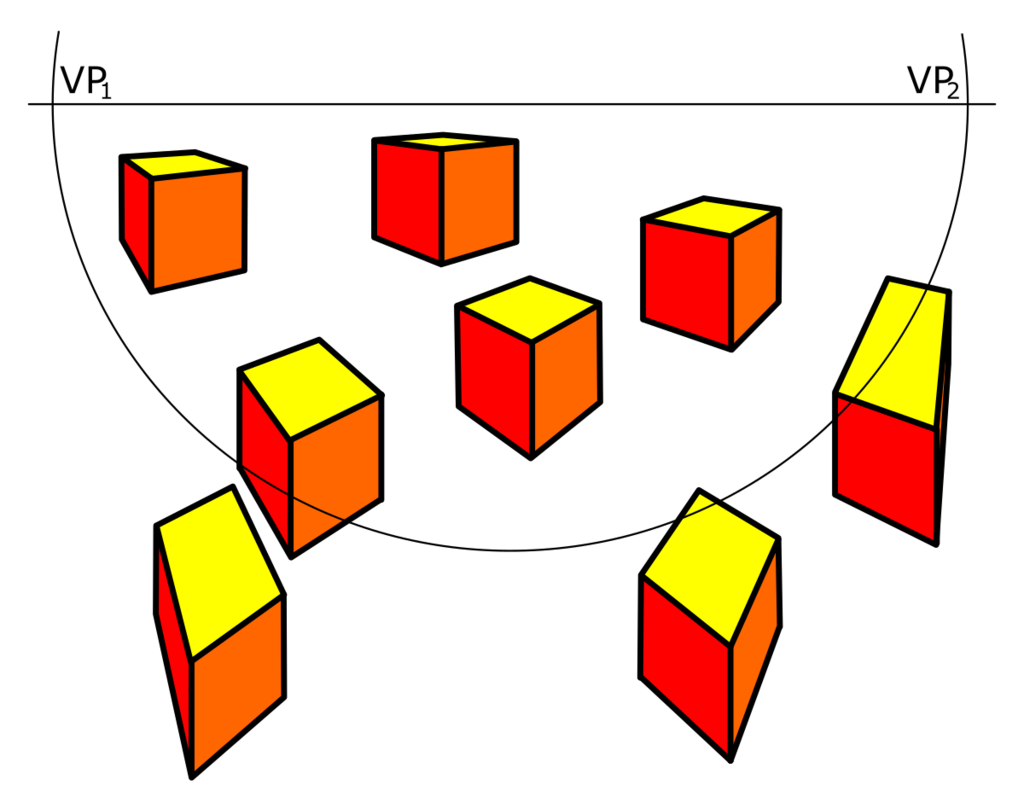
Drawing a static box in perspective is one thing. Making it feel like it can move and exist in a dynamic scene is another. To rotate an object, you don't change the object itself. Instead, you rotate its vanishing points around a central point of vision.
Imagine your two main vanishing points are on a wheel, with the center of the wheel being the point directly in front of the viewer's eyes. As you turn this wheel, the vanishing points move along its circumference. This rotates the object without distorting its proportions. A helpful method for maintaining proportions during rotation is the 'box-in' method—enclosing your complex object within a simple cube or rectangular prism. You then rotate the box, and the object inside conforms to its new orientation.
Handling Inclined Planes
Stairs, ramps, and hillsides are common in real-world scenes, but they break the simple rules of horizontal and vertical lines. These are called inclined planes, and they have their own special vanishing points. An inclined plane's vanishing points won't be on the main horizon line.
For a set of stairs going up, the parallel lines forming the angle of the stairs will converge at a vanishing point directly above the corresponding vanishing point on the horizon line. If the stairs were going down, they would converge at a point directly below it. Each unique slope in your scene requires its own set of these special vanishing points.
This principle is the foundation for creating complex architectural scenes. Once you can draw one set of stairs, you can draw anything from a simple ramp to the terraced levels of an ancient pyramid.
Buildings are the perfect subject for developing a better understanding of 3D and perspective drawing.
Drawing Organic Forms
The world isn't made of perfect boxes. Trees, people, and animals all have organic, irregular shapes. So how do you place them accurately in a scene governed by rigid perspective rules? The trick is to start with geometry and carve away.
Using the 'box-in' method mentioned earlier, you can construct a simple geometric cage—a prism, cylinder, or combination of shapes—that roughly matches your subject's volume and position. This cage follows all the rules of perspective perfectly. Once the cage is in place, you can use it as a guide to draw the organic contours of your subject inside it. This ensures that even a lumpy, irregular object like a boulder or a person will feel correctly grounded in the environment, with accurate foreshortening and proportion.
With these advanced techniques, you can move beyond simple sketches and create dynamic, structurally sound scenes from any viewpoint. You now have the tools to build worlds with convincing depth, scale, and complexity.
Time to test your understanding of these spatial concepts.
What is the primary function of the third vanishing point in three-point perspective?
To create a dramatic 'worm's-eye view' of a tall building, where should the third vanishing point be placed?
By mastering these systems, your ability to create believable worlds on a two-dimensional surface will grow immensely.