Intermediate Stock Market Strategies
Intrinsic Valuation Techniques
Finding a Company's Intrinsic Value
Market price tells you what a company's stock costs, but not what it's truly worth. To find that, we need to determine its intrinsic value. One of the most powerful tools for this is the Discounted Cash Flow (DCF) model. The core idea is simple: a business is worth the sum of all the cash it will generate in the future, with each of those future cash flows adjusted for the time value of money.
The Discounted Cash Flow (DCF) method is an intrinsic valuation approach that focuses on estimating the present value of a company’s future cash flows.
Think of it like this: would you rather have $100 today or $100 five years from now? You'd take it today, because you could invest it and earn a return. Money in the future is worth less than money in the hand. DCF analysis applies this logic to a company's earnings. We'll project a company's cash flow for a set period, usually 5-10 years, and then "discount" those future earnings back to what they're worth today.
Calculating Free Cash Flow
The specific type of cash flow we need is Unlevered Free Cash Flow (UFCF). This represents the cash a business generates before accounting for debt financing. It shows the pure earning power of the company's operations, making it useful for comparing companies with different capital structures. The calculation starts with Earnings Before Interest and Taxes, or EBIT().
EBIT
noun
A measure of a firm's profit that includes all expenses except interest and income tax expenses. It is the difference between operating revenues and operating expenses.
First, we calculate the after-tax operating profit, often called Net Operating Profit After Tax (NOPAT). We take EBIT and multiply it by (1 - Tax Rate). This shows us the profit from core operations if the company had no debt.
Next, we adjust for non-cash expenses and investments. We add back Depreciation & Amortization (D&A) because it's an accounting expense, not a real cash outlay. Then, we subtract Capital Expenditures (CapEx), which is the money spent on physical assets like buildings and machinery. Finally, we subtract the change in Net Working Capital (NWC), which is the cash needed to fund short-term operations.
Discounting the Future
Now that we have our projected UFCF for the next five years, we need to discount it. The discount rate we use is the (WACC). WACC represents the blended cost of a company's financing from both equity (shares) and debt (loans). It's the average rate of return a company must pay to its investors. A higher WACC implies higher risk, which makes future cash flows less valuable today.
But what about the value a company creates after our 5-year forecast? A healthy company doesn't just stop existing in year six. To capture this, we calculate a Terminal Value.
| Method | How it Works | Best For |
|---|---|---|
| Perpetuity Growth | Assumes the company's cash flow will grow at a slow, constant rate forever (e.g., the rate of inflation). | Mature, stable companies with predictable growth. |
| Exit Multiple | Assumes the company is sold at the end of the forecast period, valued at a multiple of its final year's EBIT or EBITDA. | Younger, high-growth companies or when a comparable transaction is likely. |
Once calculated, the Terminal Value is also discounted back to its present value, just like the individual UFCF figures.
From Enterprise Value to Share Price
By summing the present values of all projected UFCFs and the Terminal Value, we arrive at the company's (EV). This represents the total value of the company's core business operations to all stakeholders, both debt and equity holders.
To find the value available to just the shareholders, we need to calculate the Equity Value. We do this by taking the Enterprise Value, subtracting debt, and adding back any cash and cash equivalents on the balance sheet.
Equity Value = Enterprise Value - Total Debt + Cash
The final step is to divide the Equity Value by the total number of diluted shares outstanding. The result is the implied share price according to our DCF model. This is the moment of truth. We can now compare our calculated intrinsic value per share to the current market price.
If our implied price is significantly higher than the market price, the stock may be undervalued. If it's lower, the stock could be overvalued.
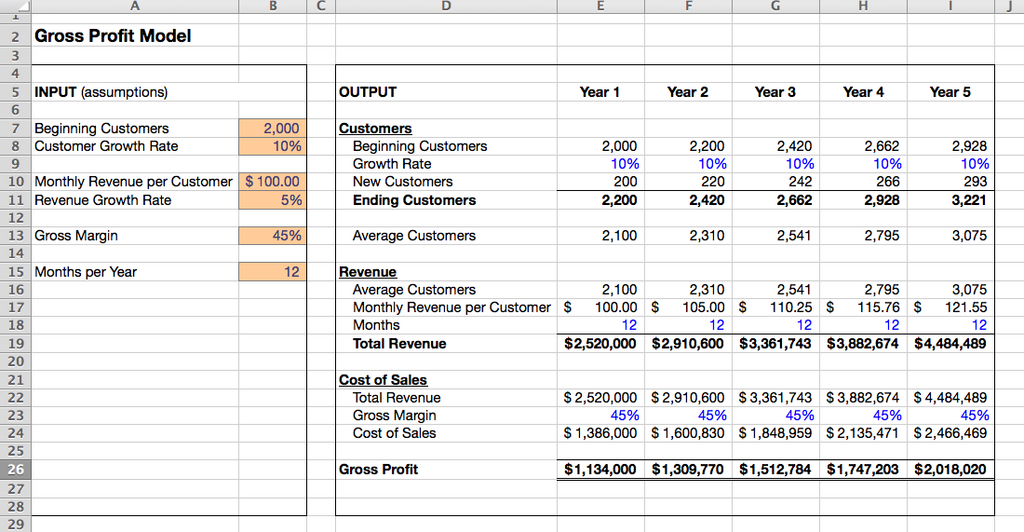
Of course, a DCF model is only as good as its assumptions. The output is highly sensitive to the growth rates, WACC, and terminal value method you choose. That's why it's a tool for analysis, not a crystal ball.
Now that you understand the mechanics, let's test your knowledge.
What is the fundamental principle of the Discounted Cash Flow (DCF) valuation method?
In a DCF model, what does the Weighted Average Cost of Capital (WACC) represent?