Intermediate Quantum Formalism
Hilbert Space Operators
From Functions to Vectors
In quantum mechanics, the state of a system isn't described by a position and a velocity, but by a mathematical object that contains all the information about it. We've previously seen this object as a wave function, , which gives the probability of finding a particle at a certain position. But there's a more abstract and powerful way to think about it: as a vector.
This isn't a vector like an arrow in 3D space. It's a vector in a special kind of space called a Hilbert space an infinite-dimensional, complex vector space. The state of a quantum system is represented by a state vector, often written using bra-ket notation developed by Paul Dirac as . This notation is elegant and simplifies many calculations.
Just like regular vectors, we can define an inner product between two state vectors, written as . This operation takes two vectors and produces a complex number. The inner product of a vector with itself, , gives the squared length of the vector. For a valid quantum state, we require this length to be 1, which is the normalization condition.
If the inner product of two different vectors is zero, , they are said to be orthogonal. This is the quantum mechanical equivalent of two vectors being perpendicular.
Operators as Observables
How do we get physical information, like momentum or energy, out of a state vector ? We use operators. An operator is a mathematical rule that transforms one vector into another. In quantum mechanics, every measurable physical quantity, or observable, corresponds to a specific type of operator.
An operator acts on a state vector to produce a new state vector : .
The operators that correspond to observables have a special property: they are Hermitian An operator is Hermitian if it is equal to its own adjoint, denoted . The adjoint of an operator is found by taking its transpose and then its complex conjugate.
This property isn't just a mathematical curiosity. It ensures that the results of any physical measurement are real numbers, which they must be. After all, you can't measure an energy of $3+2i$ Joules.
Eigenvalues and Completeness
When we make a measurement of an observable represented by the operator , the system is forced into a special state called an eigenvector of that operator. The result of the measurement will be the corresponding eigenvalue.
An eigenvector of an operator is a vector that, when acted upon by the operator, is only scaled by a constant factor. That factor is the eigenvalue. For an eigenvector with eigenvalue , the relationship is:
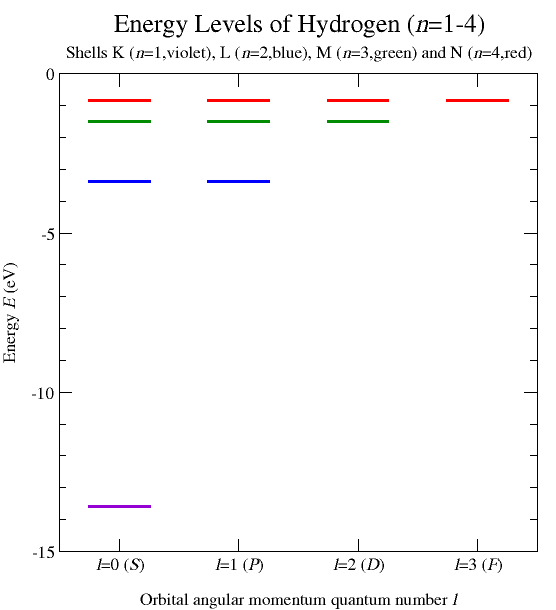
The eigenvalues of a Hermitian operator represent all the possible outcomes of measuring the corresponding physical quantity. For example, the eigenvalues of the Hamiltonian operator (the energy operator) are the possible energy levels of the system.
A crucial property of Hermitian operators is that their eigenvectors form a complete, orthonormal basis. This means two things:
- Orthonormal: Any two eigenvectors with different eigenvalues are orthogonal. We can also normalize them to have a length of 1.
- Complete: Any arbitrary state vector in the Hilbert space can be written as a linear combination of these eigenvectors.
The coefficient can be found using the inner product: . The probability of measuring the eigenvalue is given by the squared magnitude of this coefficient, . This is a cornerstone of quantum mechanics, linking the state vector directly to measurement probabilities.
This framework, built on vectors and operators in Hilbert space, provides a complete and consistent language for describing the quantum world.
Who developed the elegant bra-ket notation () used to represent quantum states?
A quantum state is represented by a state vector. In which mathematical space do these vectors exist?