Intermediate Psychological Science
Biological Psychology Interactions
The Brain That Remodels Itself
Your brain is not a fixed piece of hardware. It's more like a living city, constantly rerouting traffic, demolishing old buildings, and constructing new ones based on the demands of its inhabitants. This remarkable ability to change its own structure and function in response to experience is called neuroplasticity.
Think of it this way: learning a new skill, like playing the guitar, physically changes your brain. The neural pathways involved in finger dexterity and auditory processing become stronger and more efficient, like well-traveled roads.
This isn't just a metaphor. Studies on London taxi drivers famously showed they have significantly larger hippocampi, a brain region crucial for spatial memory, compared to the general public. Why? They spent years memorizing the city's labyrinthine streets. Their brains physically adapted to the intense cognitive demand.
Conversely, an impoverished or unstimulating environment can limit neural growth. This principle highlights a bidirectional relationship: our brains shape our experiences, but our experiences, in turn, physically reshape our brains.
The Body's Stress Circuit
When faced with a threat, your body has a sophisticated, ancient alarm system. It's called the Hypothalamic-Pituitary-Adrenal axis, or the HPA axis for short. This network connects your brain to your endocrine system to manage your response to stress.
When your brain perceives a stressor, the hypothalamus releases a hormone. This signals the pituitary gland to release another hormone into the bloodstream. This second hormone travels down to the adrenal glands, which then pump out cortisol, the primary stress hormone.
Cortisol mobilizes energy by increasing blood sugar, helping you handle the immediate threat. In the short term, this system is life-saving. However, when stress becomes chronic—from work pressure, difficult relationships, or financial strain—the HPA axis can get stuck in the "on" position. Prolonged exposure to high cortisol levels can disrupt nearly all your body's processes, contributing to anxiety, depression, and physical health problems.
Genes on a Dimmer Switch
You inherited your genes from your parents, but your life experiences can determine which of those genes get expressed. This is the central idea of epigenetics—the study of changes in gene activity that do not involve alterations to the genetic code itself. It’s not about changing your DNA, but about adding tags that tell your body which genes to read and which to ignore.
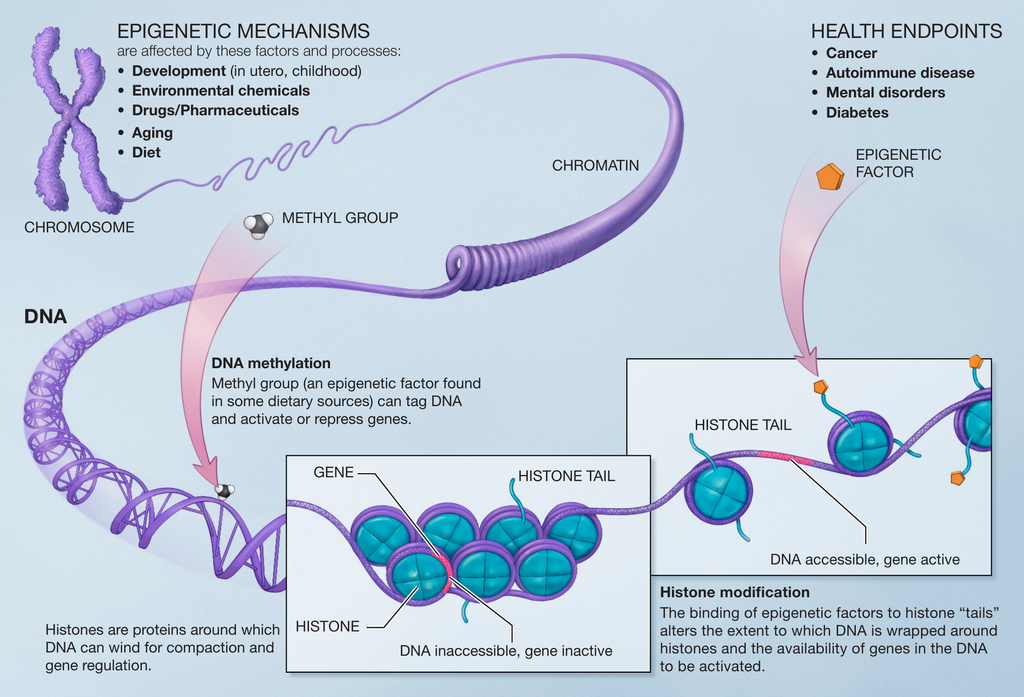
Think of your genome as a massive library of cookbooks. Epigenetics is like the librarian who places sticky notes on certain recipes, marking them as "use often" or "for emergencies only." A stressful childhood, for example, can place epigenetic marks on genes involved in the HPA axis, making an individual more reactive to stress later in life. These marks can be long-lasting, effectively programming a person's biological response based on their early social environment.
Brain Chemistry and Behavior
Your mood, focus, and actions are profoundly influenced by chemical messengers called neurotransmitters. These molecules transmit signals between neurons. While we once thought of disorders like depression as simply a "chemical imbalance," the reality is far more complex. It's less about having too little of one chemical and more about the regulation and sensitivity of entire systems.
Two key systems are serotonin and dopamine. The serotonin system is heavily involved in regulating mood, sleep, and appetite. Disruptions in this system are closely linked to depression and anxiety. Many antidepressants, known as SSRIs, work by increasing the amount of available serotonin in the synapse, improving communication between neurons.
The is central to motivation, pleasure, and motor control. It's the brain's reward circuit. When you achieve a goal or experience something enjoyable, a surge of dopamine reinforces that behavior. However, this system can be hijacked by drugs of abuse, leading to addiction. It is also implicated in conditions like Parkinson's disease (caused by the death of dopamine-producing cells) and schizophrenia.
Finally, the endocrine system doesn't just manage stress; it shapes our social lives through hormones. For instance, oxytocin, often called the "love hormone," plays a crucial role in social bonding, trust, and maternal behavior. It is released during positive social interactions, like hugging, and helps solidify relationships.
Testosterone is another powerful hormone influencing social behavior, often associated with competition, dominance, and aggression. However, its effects are highly context-dependent, interacting with an individual's personality and the social situation. These chemicals provide a powerful link between our biology and our complex social worlds.
Based on the principle of neuroplasticity, what is the most likely long-term outcome for an individual who dedicates years to learning a complex new skill, like a musical instrument?
Which of the following correctly describes the sequence of events in the HPA axis when responding to stress?