Intermediate Pool Mastery
Mastering English
The Physics of English
In billiards, a good shot isn't just about sinking a ball. It's about controlling where the cue ball goes next. This is where spin, or "English," comes in. By hitting the cue ball off-center, you can manipulate its path after it strikes an object ball or a rail. It's the difference between a lucky shot and a planned sequence.
Think of the cue ball as having two primary axes for spin: vertical and horizontal. Hitting the ball above or below its equator creates vertical spin, while hitting it to the left or right creates horizontal spin.
Cue ball control is what separates casual players from consistent winners.
Let's start with the vertical axis. Hitting the cue ball above its center point imparts topspin, also known as a "follow" shot. When a cue ball with topspin hits an object ball, it continues rolling forward after contact. This is useful when you want to follow the object ball towards the pocket or move the cue ball further up the table.
Conversely, hitting below the center point creates backspin, or a "draw" shot. A cue ball with backspin will reverse its direction after hitting the object ball, pulling it back towards you. The more backspin you apply, and the harder you hit, the more dramatic the draw.
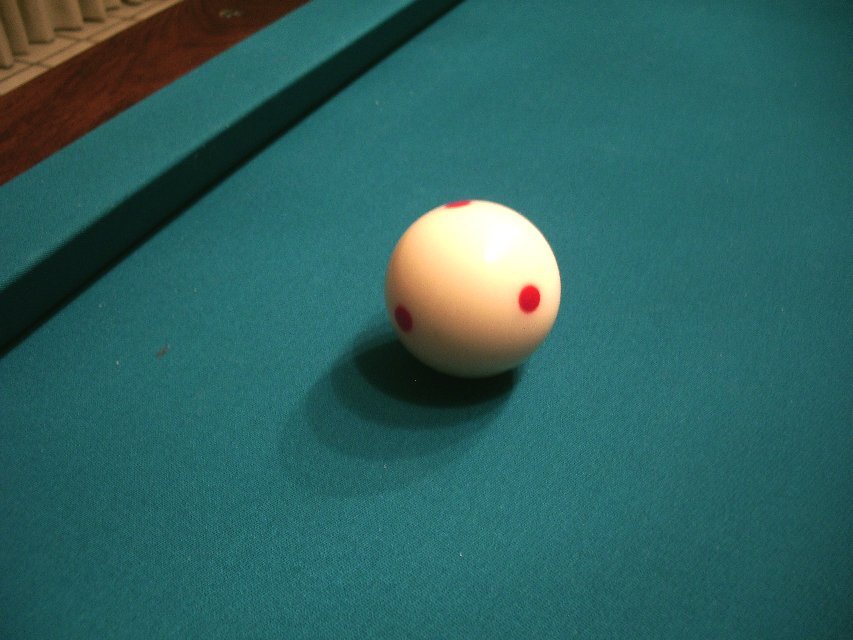
Horizontal spin, or side English, is where things get more complex. Hitting the cue ball to the right of its vertical axis gives it right English, and hitting to the left gives it left English. This type of spin primarily affects how the cue ball rebounds off the rails. For example, a cue ball with right English will bounce off a rail at a wider, more open angle than a ball with no spin. Left English will cause it to rebound at a tighter, shorter angle.
This control is essential for navigating around other balls and setting up your next shot across the table.
The Clock System
To apply spin consistently, players use a mental model called the "clock system." Imagine the face of a clock superimposed on the back of the cue ball. The center is the neutral point for a straight shot. Hitting at 12 o'clock applies pure follow (topspin). Hitting at 6 o'clock applies pure draw (backspin).
Hitting at 3 o'clock gives you pure right English, and 9 o'clock gives pure left English. You can also combine them. A shot at 1 o'clock will have both topspin and right English, while a shot at 7 o'clock will have backspin and left English. The distance from the center is measured in "tips." One tip of English means you aim one cue tip's width away from the center. Two tips is double that distance.
This system provides a reliable way to measure and repeat the amount of spin you put on the ball. The farther from the center you hit, the more spin is imparted, but it also increases the risk of a miscue.
Compensating for Spin Effects
Applying side English isn't as simple as just hitting off-center. It introduces two side effects you must account for: deflection and throw.
(or "squirt") is the effect of the cue stick pushing the cue ball slightly off the intended line of aim. When you strike the cue ball on the right side, the ball deflects slightly to the left. Hit it on the left, and it deflects to the right. The amount of deflection depends on your cue stick's properties, especially the shaft's stiffness, and how far off-center you hit. To compensate, you must aim slightly into the spin. For right English, aim a little to the right of your target point on the object ball.
is a different phenomenon that happens at the moment of impact between the cue ball and the object ball. When a spinning cue ball hits an object ball, the friction between them "throws" the object ball slightly in the opposite direction of the cue ball's spin. If you hit the object ball with a cue ball spinning with right English, the object ball will be thrown slightly to the left of its expected path. Left English throws the object ball to the right.
Throw is most noticeable on slower, softer shots where the balls are in contact for a longer fraction of a second. To compensate for throw, you need to adjust your aim on the object ball. For a shot with right English (which throws the object ball left), you'll need to hit the object ball slightly thinner, or more to the right, than you normally would.
To compensate for deflection, aim with the spin. To compensate for throw, aim against the spin.
Mastering English requires balancing these opposing effects. A common technique for cut shots is to use "spin-induced throw," where you apply a small amount of English that pushes the object ball more directly into the pocket, effectively making the pocket seem larger. For example, on a cut to the right, using left English will throw the object ball to the right, helping it find the heart of the pocket.
Ultimately, developing a feel for how much spin to use, and how to adjust your aim for deflection and throw, comes from practice. It transforms the game from a series of individual shots into a fluid dance of positioning and control.
What is the primary purpose of applying "English" (spin) to the cue ball in billiards?
If you want the cue ball to reverse direction after striking an object ball, what type of spin should you apply?