Intermediate Piano Mastery
Advanced Chord Voicings
Beyond the Seventh
You've mastered triads and seventh chords. Now it's time to add more color and complexity to your harmony. Extended chords are built by continuing to stack thirds on top of a seventh chord, introducing notes like the ninth, eleventh, and thirteenth. These additions create richer, more sophisticated sounds that are staples in jazz, R&B, and even modern classical music.
Think of extensions as the spices in your harmonic kitchen. They add unique flavors that can transform a simple progression into something truly memorable.
Playing all the notes of a dense extended chord, like a thirteenth, can sound muddy and is often impractical. This is where voicings come in. A chord voicing is simply the way you arrange and space the notes of a chord. By selectively choosing which notes to play and where to place them, you can control the texture and clarity of your harmony.
Crafting Your Voicings
A good voicing makes a complex chord sound clear and intentional. For extended chords, this often means omitting certain notes. The root is frequently left to the bass player, and the fifth can often be dropped without losing the chord's essential character. The third and seventh, however, are almost always included because they define the chord's quality (major, minor, dominant).
Let's look at a C13 chord. The full chord contains seven notes: C, E, G, B♭, D, F, A. Playing all of these at once is a handful. A more practical piano voicing might be:
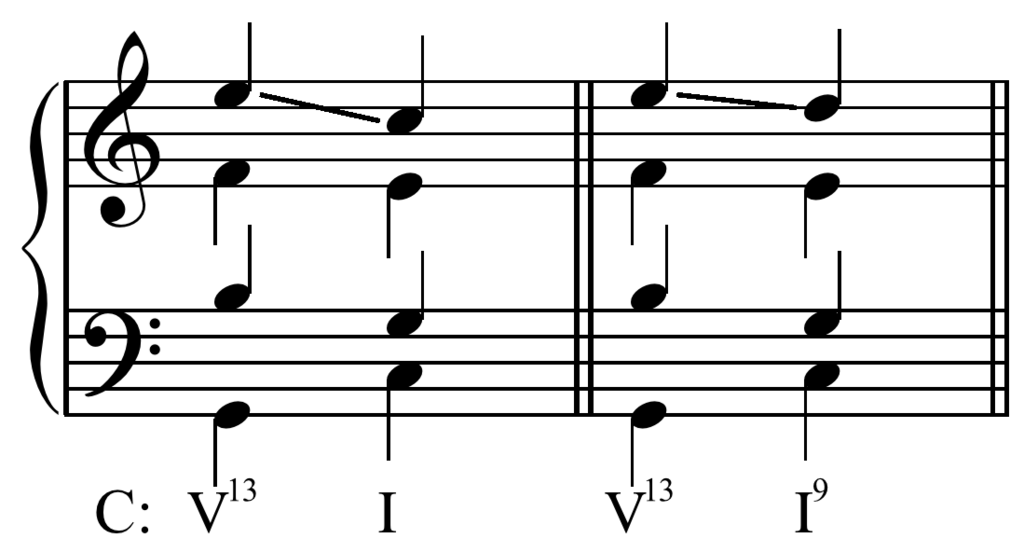
This example shows how a complex dominant thirteenth chord leads smoothly to the tonic. Notice how the notes in the V¹³ are voiced to create a clear sound that feels like it needs to resolve.
Substitution and Reharmonization
Once you're comfortable with extended voicings, you can start substituting chords to add harmonic interest to a progression. Substitution is the art of replacing a chord with a different one that serves a similar function but adds a new flavor.
Tritone
noun
An interval spanning six semitones, such as C to F♯. It's considered one of the most dissonant intervals.
One of the most powerful substitution techniques is the tritone substitution. It involves replacing a dominant 7th chord with another dominant 7th chord whose root is a tritone away.
For example, in a ii-V-I progression in C major (Dm7 – G7 – Cmaj7), you can substitute the G7 chord. The note a tritone away from G is D♭. Therefore, you can replace G7 with a D♭7 chord.
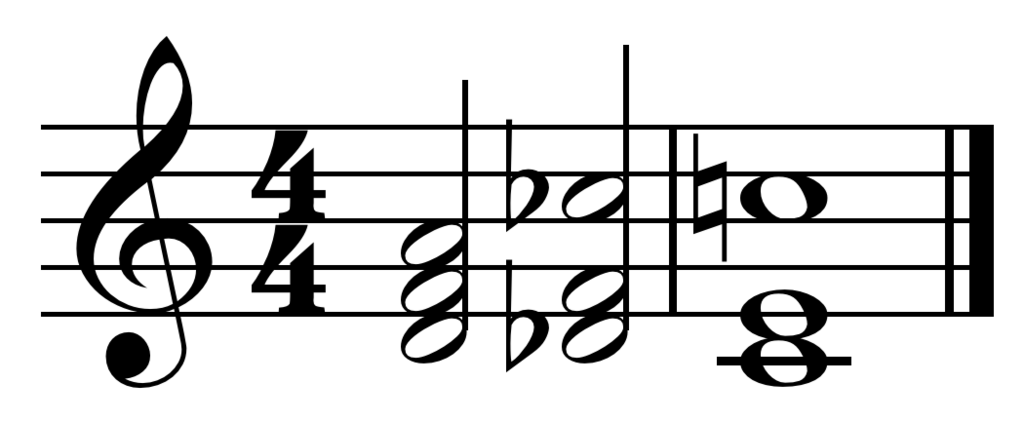
Why does this work? Because G7 (G-B-D-F) and D♭7 (D♭-F-A♭-C♭) share the same tritone: the notes B and F are enharmonically equivalent to F and C♭. This shared tension allows them to function interchangeably, but the D♭7 adds a chromatic bass line (D – D♭ – C) that creates a smoother, more sophisticated resolution.
Reharmonization takes this a step further. It's the process of completely rewriting the chords of a melody. This can be as simple as using a few substitutions or as complex as creating an entirely new harmonic landscape. It’s a creative way to breathe new life into a familiar tune.
How are extended chords, such as ninths, elevenths, and thirteenths, constructed?
When creating a voicing for a complex extended chord, which notes are most often omitted to avoid a 'muddy' sound?
Mastering these advanced voicings and techniques will open up a new world of harmonic possibilities in your music.