Intermediate Mastery of Modern Standard Arabic
Mastering the Root System
The Secret Code of Arabic Words
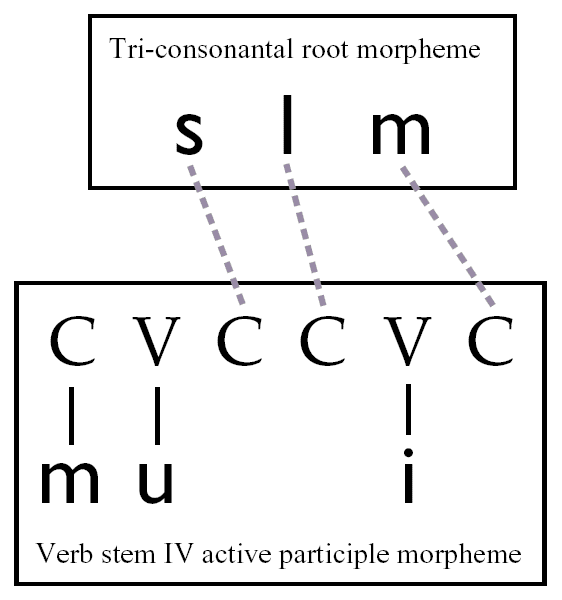
At the heart of most Arabic words lies a three-consonant skeleton. This is the word’s root, or Jadhr (جذر). Think of it as the DNA of a word, carrying its core meaning. All the different words related to a concept—verbs, nouns, adjectives—are built from this same root. The system is elegant and surprisingly logical. Once you learn to see the root, you start to see connections everywhere.
Your goal is to become a word detective. Your mission: find the three root letters (the Jadhr) hidden inside a longer word.
Let's take a famous root: ك-ت-ب (K-T-B). This root carries the core meaning of 'writing'. Watch how it transforms:
- كَتَبَ (kataba) - he wrote
- كِتاب (kitāb) - a book
- مَكْتَب (maktab) - a desk or office
- كاتِب (kātib) - a writer
See the pattern? The letters K, T, and B appear in the same order in every word. The letters added around them change the specific meaning, but the essence of 'writing' remains.
Finding the Root
If finding the root was always as simple as in the K-T-B example, this would be a very short article. Often, the root is disguised by extra letters, known as Huroof al-Ziyadah (حروف الزيادة), or 'the augmented letters'. These are letters added to the root to create new meanings and grammatical forms. There are ten of them, which can be remembered with the mnemonic phrase أليوم تنساه (al-yawma tansāhu), meaning 'Today, you forget it'.
| Letter | Transliteration | Mnemonic Phrase Letters |
|---|---|---|
| ا | Alif | أليوم تنساه |
| ل | Laam | اليوم تنساه |
| ي | Yaa | اليوم تنساه |
| و | Waaw | اليوم تنساه |
| م | Meem | اليوم تنساه |
| ت | Taa | اليوم تنساه |
| ن | Noon | اليوم تنساه |
| س | Seen | اليوم تنساه |
| ه | Haa | اليوم تنساه |
| ء | Hamza | أليوم تنساه |
When you encounter an unfamiliar word, your first step is to spot and mentally remove these augmented letters to reveal the three-consonant root. For example, in the word إستِعلام (istiʻlām), meaning 'inquiry', we can spot an alif, a seen, and a taa at the beginning, and another alif in the middle. Removing them reveals the root ع-ل-م (ʻ-L-M), which relates to 'knowing' or 'knowledge'.
Unlocking the Dictionary
This skill is more than just a party trick; it's the key to using a proper Arabic dictionary. Most Arabic dictionaries, like the famous Hans Wehr Dictionary of Modern Written Arabic, are organised by root, not alphabetically by word. You don't look up kitāb under 'K'. You find the root K-T-B, and under that entry, you'll find kitāb along with maktab, kātib, and all its other relatives.
Let's practise with two more common roots. See if you can sense the shared 'semantic field' or family of meaning in each group.
Root: د-ر-س (D-R-S) - 'studying'
- دَرَسَ (darasa) - he studied
- مَدرَسة (madrasah) - school
- دِراسة (dirāsah) - a study (e.g., a research study)
- مُدَرِّس (mudarris) - a teacher
Root: س-ل-م (S-L-M) - 'peace' or 'safety'
- سَلام (salām) - peace
- إسلام (islām) - submission (to God), Islam
- مُسلِم (muslim) - one who submits, a Muslim
- تَسليم (taslīm) - a delivery or surrender
By identifying the root, you can make an educated guess about a new word's meaning even before you reach for the dictionary. This analytical approach is what separates intermediate learners from beginners.
Time to test your new detective skills.
What is the three-consonant skeleton at the core of most Arabic words known as?
The root ك-ت-ب (K-T-B) relates to the concept of 'writing'. Which of the following words does NOT belong to this root family?
Mastering this system takes practice, but it's a true turning point. It transforms Arabic from a list of words to memorise into a logical, interconnected web of meaning.