Intermediate Martial Arts Systems
Combat Biomechanics
The Physics of Fighting
At its heart, combat is a conversation about force. Whether you're throwing a punch or executing a takedown, you're applying physics to another person's body. The two main languages of this conversation are striking and grappling, and they use entirely different physical principles to achieve their goals.
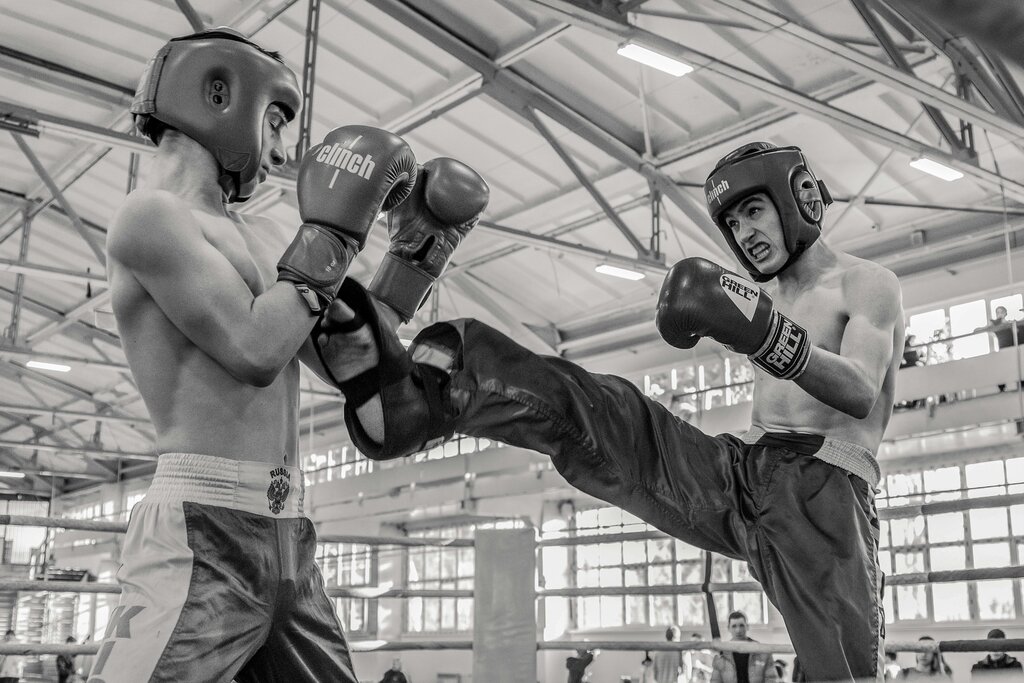
Striking is all about impact. It’s the science of generating and transferring as much kinetic energy as possible in a short burst. The classic physics equation for force, (Force = Mass × Acceleration), is the striker's bible. To hit hard, you need to maximize both the mass behind the strike and the speed at which it travels.
Think of it this way: a fast punch is good, but a fast punch backed by your entire body weight is devastating. This is why technique trumps raw arm strength.
Power in striking isn't generated in the arm or leg. It starts from the ground up, in a sequence called the kinetic chain . Your feet push off the floor, that energy travels up through your legs, rotates through your hips and core, whips through your shoulder, and finally accelerates your fist towards the target. Each link in this chain adds momentum and mass to the final impact. A breakdown anywhere in this chain bleeds power. This is why a boxer's footwork and a karateka's stance are so crucial; they are the foundation of the entire power-generating structure.
The Science of Leverage
Grappling plays by a different set of rules. While a striker wants to create impact, a grappler wants to control an opponent's body. Instead of explosive force, the dominant concepts are leverage, fulcrums, and the manipulation of an opponent's centre of gravity.
Imagine trying to lift a heavy boulder. You wouldn't just use your back. You'd find a long, sturdy pole, wedge it under the rock, and use a smaller stone as a pivot point. The pole is your lever, the small stone is the fulcrum. With this setup, you can move something far heavier than you could lift directly. This is the essence of grappling arts like Judo and Brazilian Jiu-Jitsu (BJJ).
In a judo throw, your hip becomes the fulcrum. Your arms and body become the lever. By positioning your centre of gravity lower than your opponent's and getting your hip underneath them, you can use their own weight and momentum to send them to the mat with surprisingly little effort. In BJJ, an armbar works the same way: your opponent's elbow is the fulcrum, and you apply pressure on the lever (their forearm) to hyperextend the joint.
Core Principles
Whether striking or grappling, all power is transferred through the core. Your abdominal and lower back muscles act as the transmission of the body. They stabilize your spine and hips, allowing the force generated by your legs to be seamlessly channelled to your upper body. A weak core is like a drive shaft made of rubber; the engine might be roaring, but the power never reaches the wheels.
This leads to an inherent biomechanical trade-off: speed vs. stability. Striking often requires a more mobile, fluid stance to generate speed and evade attacks. Think of a boxer, light on their feet. Grappling, however, demands a lower, wider, and more stable base. A wrestler's stance is all about preventing takedowns and controlling their own centre of gravity. You can't be optimally stable and optimally mobile at the same time. The art is in knowing when to shift between the two.
Leverage: Utilizing the body’s levers (bones and joints) effectively can enhance the power of strikes and throws.
Now that you understand the core physics, let's test your knowledge.
According to the physics of striking, which formula is most fundamental?
What is the primary role of the core muscles in both striking and grappling?
Understanding these biomechanical differences is key to mastering any combat sport. It's the 'why' behind the 'how', transforming rote movements into efficient, powerful techniques.