Intermediate Linear Algebra and its Applications
Geometric Transformations
Matrices as Movement
A matrix is more than just a grid of numbers. It's a machine for transforming space. Think of it as a function that takes in a vector—an arrow pointing from the origin to a coordinate—and spits out a new vector. This process is called a because it follows two strict rules: lines remain lines (they don't get curved), and the origin stays put.
How does this work? The key is to watch what happens to the basis vectors. In two dimensions, these are the fundamental unit vectors that define our coordinate system: (the vector ) and (the vector ). Any vector in the plane can be described as a combination of these two.
A transformation matrix tells us exactly where these basis vectors land. The first column of the matrix is the new coordinate for , and the second column is the new coordinate for .
Once we know where the basis vectors go, we know where every other vector goes. The entire grid of space stretches, squishes, and rotates along with them. For example, applying a rotation matrix moves and but keeps them the same length and at a 90-degree angle to each other.
Measuring the Stretch
So, a transformation changes space. But by how much? The of a matrix gives us a precise answer. It's a single number that tells us the scaling factor of the area (in 2D) or volume (in 3D) that results from the transformation.
Imagine a 1x1 square defined by the basis vectors and . After a transformation, this square becomes a parallelogram defined by the transformed basis vectors. The area of this new parallelogram is the absolute value of the determinant of the transformation matrix.
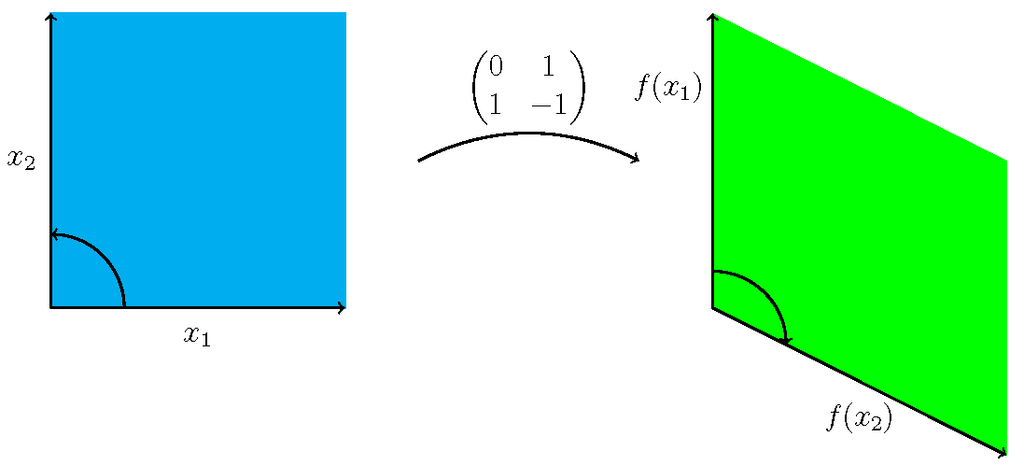
For a 2x2 matrix, the calculation is straightforward.
If the determinant is 3, the area of any shape in the plane gets multiplied by 3. If it's 0.5, the area is halved. A negative determinant, like -2, means the area is scaled by a factor of 2, but the orientation of space is flipped. This is like looking at the plane in a mirror.
When Space Collapses
What happens when the determinant is zero? This is a special and important case. A determinant of zero means the area has been scaled to zero. Geometrically, this signifies that the transformation has squished the entire 2D plane into a single line or even a single point. This is called a because it loses a dimension.
This collapse occurs when the transformed basis vectors become collinear—they lie on the same line. If both and are mapped to vectors pointing in the same (or opposite) direction, they no longer span a plane. They only span a line.
A matrix is singular (non-invertible) if and only if its determinant is zero.
Combining Transformations
Often, we want to apply several transformations in a row. For instance, we might want to rotate an object and then scale it. The combined effect of these two operations is itself a single linear transformation.
Always remember that multiplying two matrices like this has the geometric meaning of applying one transformation after another.
This is where matrix multiplication comes in. If we have a transformation followed by another transformation , the combined transformation is represented by the matrix product . The order matters! Matrix multiplication is read from right to left. The transformation on the right () is applied first, to the original vector.
This gives a powerful geometric meaning to matrix multiplication. It isn't just a random set of rules for combining numbers; it's the algebraic representation of composing functions that transform space.
What are the two fundamental rules that a transformation must follow to be considered a 'linear transformation'?
In a 2x2 matrix that represents a linear transformation, what do the two columns specify?
Understanding transformations visually provides the foundation for more advanced topics like eigenvalues and eigenvectors, which describe the vectors that don't change direction during a transformation.