Intermediate Kung Fu Mastery
Dynamic Stance Transitions
The Art of the Shift
A static stance is a source of potential energy, but it's the transition between stances that unleashes kinetic force. Moving from a stable Horse Stance (Ma Bu) to an offensive Bow Stance (Gong Bu) isn't just a step; it's a precisely coordinated transfer of weight that transforms potential into power. The key is understanding how to manage your center of gravity, which in martial arts is often referred to as the Dan Tien located a few inches below your navel.
The transition from Ma Bu (Horse Stance) to Gong Bu (Bow Stance) focuses on the interconnected elements of Qi (vital energy), power generation, speed, and the use of sound (vocalisation) to enhance movement.
When you initiate a shift, you're not just moving your feet. You're consciously sinking your weight into the ground and then using the resulting ground-reaction force to propel your body. Imagine pushing off a solid wall. The wall doesn't move, but you do. The ground acts as that wall. By pressing down through your legs, you receive an equal and opposite force that you can direct forward, backward, or sideways into your next movement. This is the foundation of kinetic linking: a chain reaction of energy transfer that starts from the ground, travels through your legs and hips, and culminates in a strike or block.
Managing Your Center
Maintaining structural integrity during a rapid shift is all about keeping your center of gravity (your Dan Tien) aligned and in control. As you transition from one stance to another, your center of gravity follows a path. The goal is to make this path as smooth and efficient as possible, avoiding jerky or unnecessary vertical movements which waste energy and create openings for an opponent.
A common mistake is to rise up before sinking into the next stance. A more effective method is to maintain a relatively level height, allowing your hips to drive the motion. This creates a powerful pivot. When you turn, you're not just spinning on your feet; you're rotating your entire structure around your central axis. This generates angular momentum, which can dramatically increase the force of a circular technique like a hook punch or a sweeping block.
This principle holds true for all transitions. Shifting from a rooted stance like Horse or Bow into a light, mobile Cat Stance involves lifting the front foot so that only the toe touches the ground. Your weight shifts almost entirely to the back leg, around 90%. While it seems defensive, this is a potent bridge for counter-attacks. Because the front leg is unweighted, it is free to execute a swift kick or quickly step into a new angle to evade and strike.
Connecting the Dots
Advanced Kung Fu is not a sequence of poses, but a continuous, flowing river of motion. The secret is to never fully stop. Even when you arrive in a stance, you are already preparing for the next transition. Each movement should seamlessly link into the next, creating a chain where the end of one technique provides the kinetic energy for the beginning of another.
Think of it like a whip. The handle moves a short distance, but that energy is amplified as it travels down the length, resulting in a loud crack at the tip. In the same way, a subtle shift of your hips (the handle) can be channeled through your body (the whip) to deliver a powerful strike (the crack). Practicing smooth, controlled transitions between Bow, Horse, and Cat stances is how you learn to become the whip.
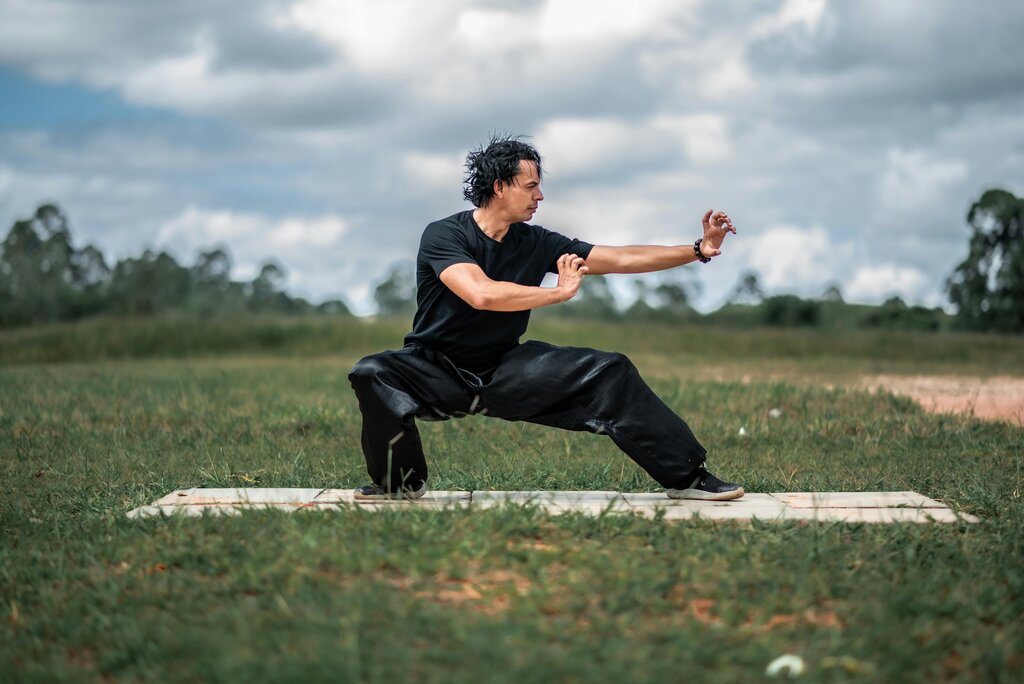
Mastering these dynamic shifts transforms your stances from static positions into powerful engines for movement, defense, and attack.