Intermediate Karate Technical Mastery
Advanced Kihon Mechanics
Forging Power from the Ground Up
In karate, true power isn't about brute strength. It's about efficiency. A powerful strike, whether a punch or a kick, begins not with the limb itself, but with your connection to the floor. Think of your body as a whip. The handle is your feet, and the tip is your fist or foot. To make the tip snap, you start the motion at the handle. This is the essence of the kinetic chain a sequence of movements that transfers energy from the ground, up through your body, and into your target.
This chain reaction starts with ground reaction force. By pushing off the ground with your rear foot, you initiate a wave of energy. This energy travels up your legs to your hips, which are the engine of your technique. A sharp, explosive hip rotation amplifies this force and channels it into your torso, shoulders, and finally, your striking limb. Without this connection, a punch is just an arm movement; with it, it's a full-body strike.
The Engine Room: Hips and Hands
For a Gyaku-Zuki (reverse punch), the power comes from a sharp rotation of the hips, not just a shove. Imagine a coiled spring in your core. As you initiate the punch, you're not just turning; you're 'vibrating' your hips. This is a quick, snapping motion that occurs in the last moments before impact, creating a final burst of acceleration. The rotation should be so committed that your torso and shoulders are pulled along for the ride, not leading the charge.
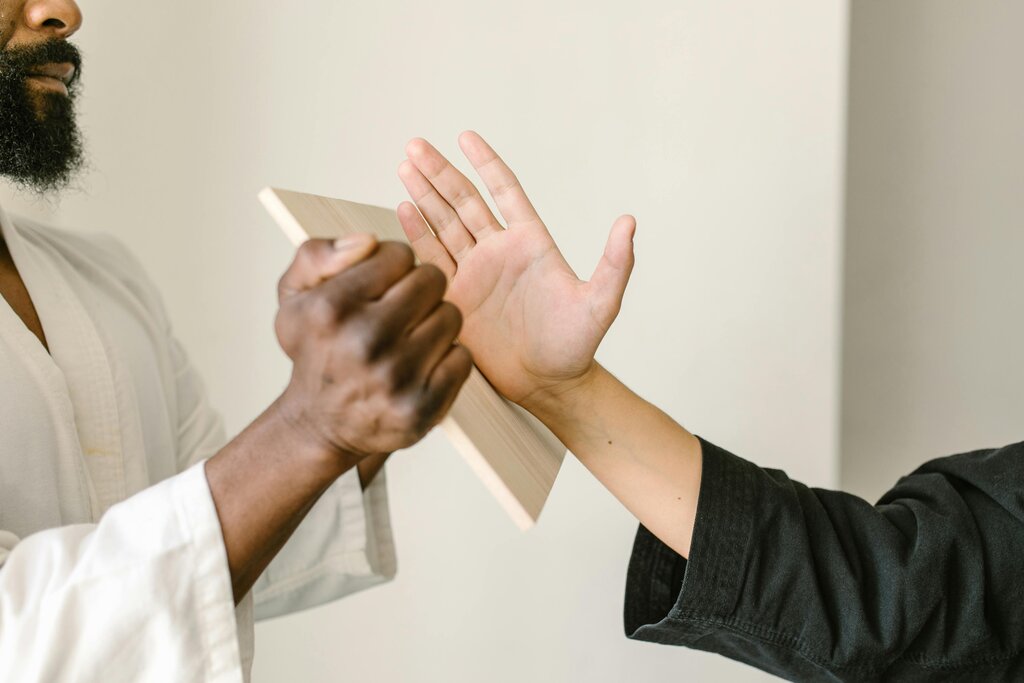
Simultaneously, the non-punching hand, the hikite (pulling hand), plays a crucial role. It's not passive. As you punch forward, the hikite snaps back to your hip with equal and opposite force. This isn't just about resetting for the next move; it's an active part of the power equation. This pulling action helps rotate the hips and torso, adding torque and stability to your strike. A lazy hikite results in a weak punch.
Mastering Stance and Balance
Powerful movements require a stable platform. Your stances, like Zenkutsu-dachi (front stance) and Kokutsu-dachi (back stance), are not just static poses. They are dynamic platforms for generating and absorbing force. Transitioning between them smoothly is key to maintaining balance while delivering powerful techniques.
When moving from a front stance to a back stance, for instance, your center of gravity must shift smoothly and deliberately. Don't just step back and fall into position. Instead, feel your weight transfer from your front leg to your back leg, keeping your hips low and level. This controlled shift ensures you remain balanced and ready to either attack or defend without a moment of vulnerability. A wobbly transition telegraphs your intentions and leaves you open.
The final piece of the puzzle is alignment. For a punch, the wrist must be straight, forming a solid line from your elbow to your fist. Impact should be made with the [{
}] (the first two knuckles). Any deviation in the wrist risks buckling on impact, leading to sprains or fractures. A powerful punch with poor alignment is a recipe for injury, not victory. Proper structure protects your body and ensures that all the force you've generated is delivered directly to the target. This principle holds true for all strikes, not just punches. Correct alignment is non-negotiable. This is what we mean by technical precision.
Now let's check your understanding of these advanced mechanics.
What is the primary source of power in a traditional karate strike, according to the principle of the kinetic chain?
In a Gyaku-Zuki (reverse punch), the sharp, 'vibrating' hip rotation is most effective when it occurs: