Intermediate Karate Precision and Power
Advanced Hip Mechanics
The Engine of Power
You've already mastered the foundational stance, Zenkutsu-dachi. You know how to ground yourself and create a stable base. But a strong stance is just the car's frame; it's not the engine. The real source of power in karate comes from the explosive and precise rotation of the hips, a concept known as (腰の回転).
Think of your hips as the central transmission for your body. Pushing off the floor with your legs generates the initial force, but it's the hips that convert that raw energy into focused, devastating power for your strikes and blocks. Without proper hip rotation, even a technically perfect punch is just an arm movement. With it, a simple technique carries the force of your entire body.
Two Paths to Power
Not all hip rotation is the same. Different styles of karate have evolved distinct methods for generating power, each with its own feeling and application. Two of the most prominent are the 'vibration' method of Shotokan and the 'circular' compression of Goju-ryu.
The Shotokan method emphasizes a rapid, snapping rotation. Imagine cracking a whip. The hips rotate sharply and then immediately snap back, creating a vibration that travels through the body and into the striking limb. This generates incredible speed and percussive impact, ideal for long-range engagements.
In contrast, the Goju-ryu method uses a heavier, more circular and grinding motion. The rotation feels more like coiling and uncoiling a powerful spring. This technique focuses on continuous pressure and driving force, absorbing the opponent's energy while delivering powerful, rooting strikes. It's particularly effective in close-quarters combat where there's less room for large, fast movements.
From Floor to Fist
The power of your techniques originates from the ground. This transfer of energy up through the body is called the or kinetic linking. It’s a sequence of activation: your feet push against the floor, that force travels up your legs, and your hips rotate to multiply it. This rotation then turns your torso and shoulders, which finally accelerates your arm into the strike.
To make this work, you must learn to decouple your upper body from your lower body. Your shoulders should not initiate the movement. They are the last link in the chain, not the first. Try this: stand in a natural stance and throw a punch using only your arm and shoulder. Now, try again, but start by driving off your back foot and rotating your hips forcefully, letting your arm follow through. The difference in power is undeniable.
A stable pelvis is crucial for this process. Proper pelvic tilt—keeping your pelvis neutral or slightly tucked—engages your core and provides a solid platform for the hips to rotate around. If your pelvis is tilted too far forward or back, you create an energy leak, losing power and compromising your balance.
Practitioners master the art of generating maximum force in their strikes by utilising proper body mechanics, hip rotation, and weight transfer.
Positioning for Impact
How you orient your hips relative to your opponent is just as important as the rotation itself. This is managed through two key postures: Hanmi (半身) and Shomen (正面).
Hanmi, or a half-facing position, is your 'loaded' state. Your hips are bladed, turned away from the target. This posture minimizes your exposed target area, increases your reach, and coils the muscles of your core like a spring, ready to unleash a powerful rotation.
Shomen, or a front-facing position, is the 'unloaded' or impact state. Your hips are square to the target. This is the point of maximum power delivery, where all the rotational energy generated from your stance is driven directly forward into the opponent.
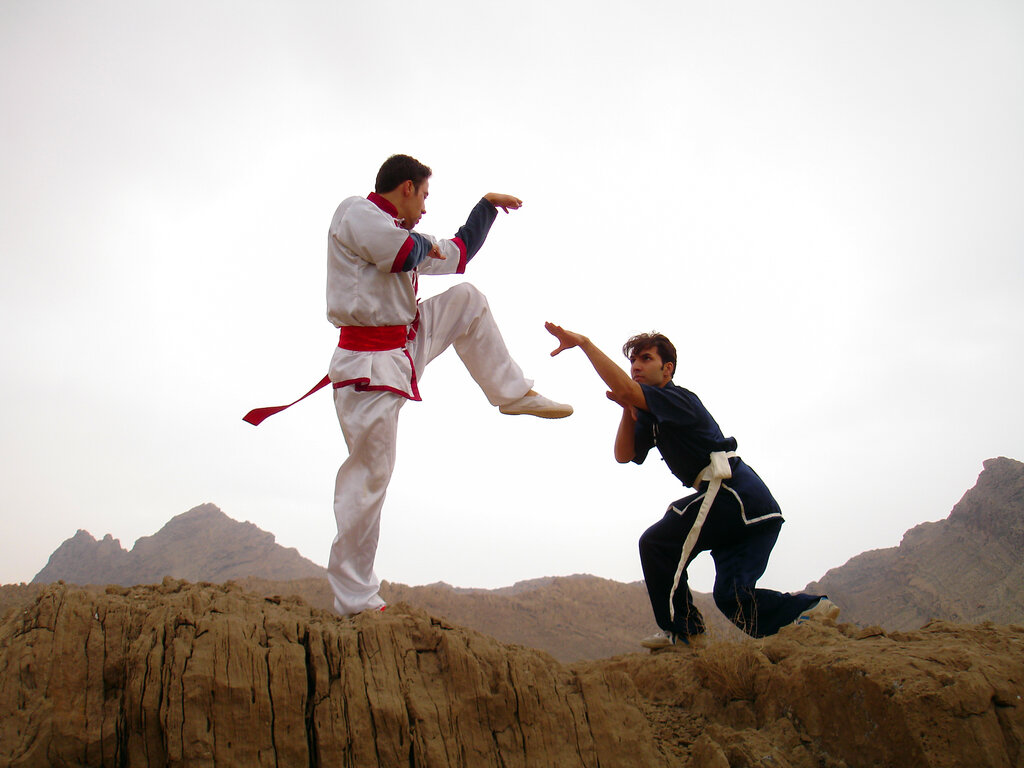
The reverse punch, or Gyaku-zuki, is a perfect example of this transition. You begin in Hanmi, chambering your striking hand. As you execute the punch, your hips rotate explosively, moving from Hanmi to Shomen at the precise moment your fist makes contact. The same principle applies to blocks. An Uchi-uke (inside block) is not just an arm movement; it's driven by a powerful hip rotation from Hanmi to deflect an incoming attack and set up your counter.
Now, let's test your understanding of these advanced hip mechanics.
The Japanese term for the explosive and precise rotation of the hips, which is the source of power in karate, is known as...
Which statement best describes the Goju-ryu method of hip rotation?
Mastering these concepts transforms your karate from a series of movements into a connected system of power generation. Focus on the feeling of driving from the floor and rotating from your center, and you'll unlock a new level of strength and efficiency in your techniques.