Intermediate Guitar Technique and Application
Barre Chord Mechanics
From Open Shapes to Movable Chords
You already know how to play open chords like E major and A major. The magic of barre chords is that they let you take those familiar shapes and move them anywhere on the fretboard. This unlocks the ability to play any major or minor chord you can think of, just by shifting your hand.
One of the most important concepts to grasp, is that the barre chord is just an open chord + a barre performed by your index finger.
Think of your index finger as a movable nut. In an open E chord, the open strings are stopped by the nut at the top of the neck. When you play an F major barre chord, your index finger presses down on all six strings at the first fret, creating a new 'nut'. Your other three fingers then form the familiar E major shape, just one fret higher than the barre.
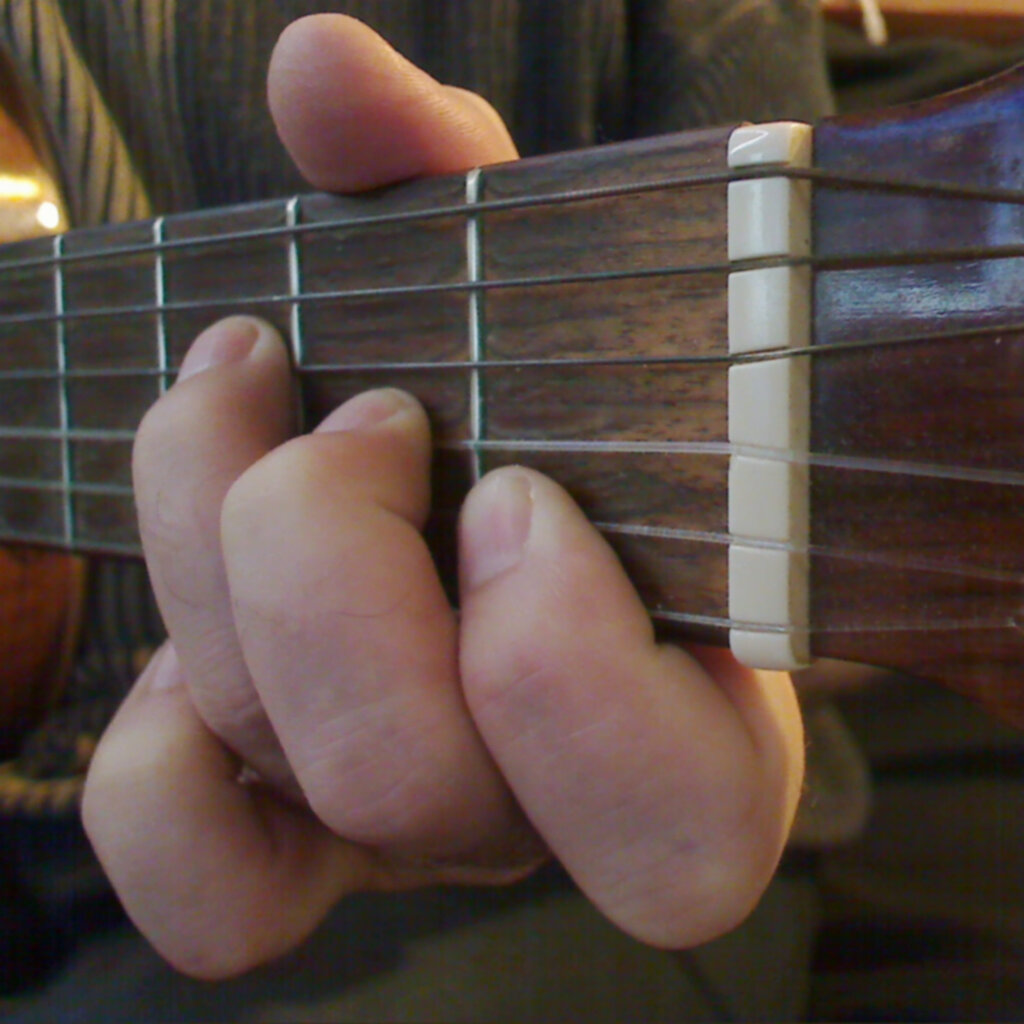
The same principle applies to the A-shape. An open A major chord can be transformed into a B-flat major barre chord by barring the first fret with your index finger and forming an A-shape with your other fingers. Suddenly, that tricky B♭ chord from a songbook is just an A-shape in a different spot.
The Physics of the Barre
Getting a clean sound from a barre chord is the biggest hurdle for most players. It’s not about brute strength; it's about technique. The goal is to apply even pressure across the strings without straining your hand. A common mistake is trying to clamp down with just your thumb and index finger. Instead, think of using the weight of your arm to help apply pressure. Your thumb should be placed flat on the back of the neck, roughly behind your middle finger. This provides leverage and support, acting as a fulcrum.
If you hear buzzing, especially from the G and B strings, try rolling your index finger back slightly, so you’re using the harder, bonier side of your finger rather than the fleshy pad. This creates a firmer contact point. Also, make sure your barring finger is as close to the fret as possible without being on top of it. This reduces the amount of pressure needed.
Finding Your Root Notes
The true power of barre chords comes from knowing your root notes. The root note is the note that gives the chord its name. For , the root note is always the note your index finger is playing on the low E (6th) string. If you barre the 5th fret, your index finger is on an A note, so you're playing an A major or A minor chord. If you barre the 8th fret, you're on a C note, giving you a C major or C minor chord.
To switch from major to minor with an E-shape barre chord, simply lift your middle finger. That's it. This changes the major third to a minor third.
For , the root note is on the A (5th) string. If you barre the 3rd fret and make an A-shape, your index finger is on a C note, so you're playing a C major or C minor chord. The low E string is typically muted or not played in this shape. Knowing the notes on your 5th and 6th strings is the key that unlocks the entire fretboard.
| Shape | Root String | Example (G Major) | Example (C Major) |
|---|---|---|---|
| E-Shape | 6th (Low E) | Barre on 3rd fret | Barre on 8th fret |
| A-Shape | 5th (A) | Barre on 10th fret | Barre on 3rd fret |
Now, let's test your understanding of these essential shapes.
What is the primary function of your index finger when playing a barre chord?
If you want to play a B major chord using an E-shape barre chord, which fret should you place your barre on?
Mastering barre chords is a gateway to playing thousands of songs. It takes patience, but with the right technique, you'll build the muscle memory and strength required to play them cleanly and confidently.