Intermediate Guitar Performance Skills
Barre Chord Mechanics
Beyond Open Chords
You've mastered the basic open chords, but a huge part of the fretboard remains untouched. The key to unlocking it is the barre chord. Think of a barre chord as a movable version of an open chord you already know. Instead of relying on the guitar's nut to provide an open string, your index finger acts as a movable nut that can be placed on any fret.
This single technique allows you to play any major or minor chord on the neck using just a few core shapes.
The secret isn't brute strength. It's about leverage and proper technique. Your thumb should be placed flat on the back of the neck, roughly opposite your middle finger. This creates a 'pinch' or clamp-like pressure. Instead of pressing the index finger flat, try rolling it slightly onto its side, using the harder, bonier edge to press down the strings. This requires less muscle and results in a cleaner sound.
The E Shape
The first fundamental shape comes from the open E major chord. To turn it into a barre chord, you'll free up your index finger by using your middle, ring, and pinky fingers to form the familiar E shape. Now, slide that shape up the neck and place your index finger across all six strings one fret behind it.
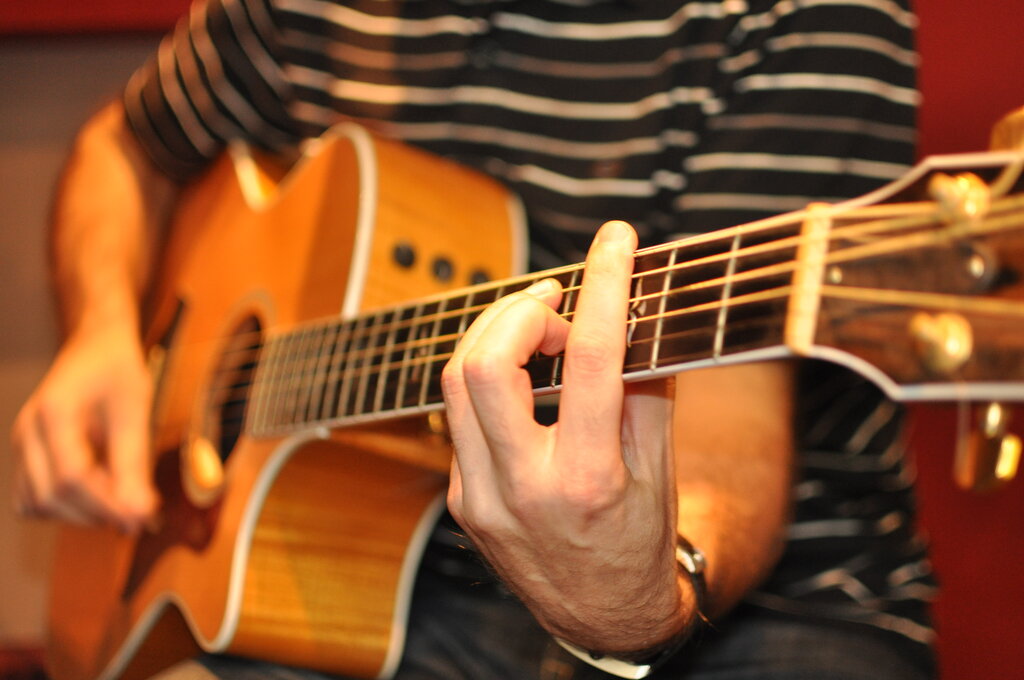
For example, if you barre the first fret and place the E shape at the second fret, you're playing an F major chord. If you slide the whole structure up to the third fret, it becomes a G major. The root note of the chord, the one that gives it its name, is always the note your index finger is pressing on the low E string (the thickest one).
To play the minor version, you simply lift your middle finger, just as you would to change from an open E major to an E minor. This E minor shape, when used with a barre, can be moved anywhere to create any minor chord.
The A Shape
The other foundational shape comes from the open A major chord. The principle is the same, but the mechanics are slightly different. The A shape uses strings one through five, so your barre only needs to cover those five strings. The low E string (the sixth string) is not played.
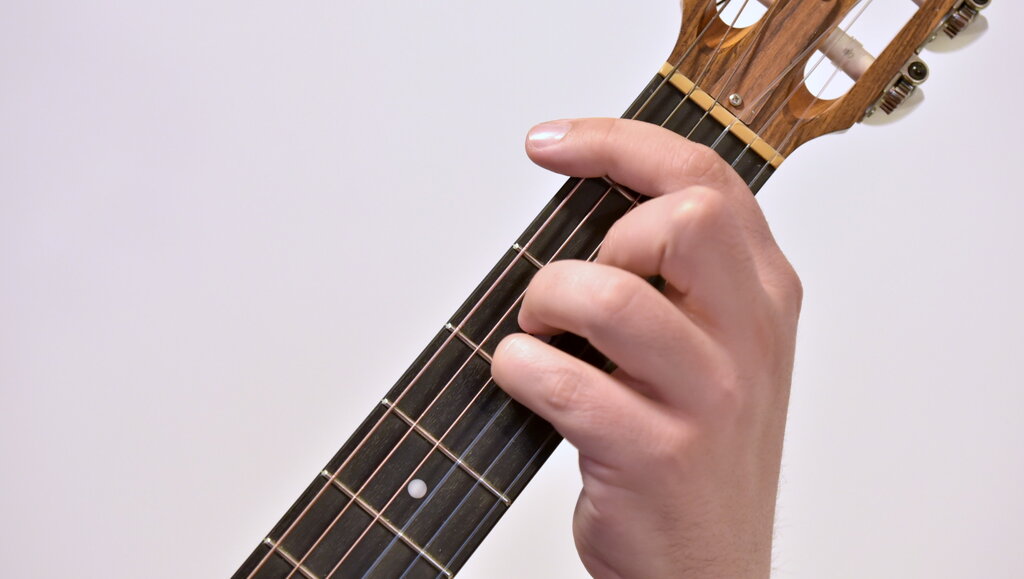
To form the A major barre shape, you'll need to fret the notes on the D, G, and B strings two frets higher than your barre. Some guitarists use their ring finger to barre these three notes, while others use their middle, ring, and pinky fingers. Experiment to see what's most comfortable. For an A minor shape, you'll use the A minor fingering two frets up from your barre.
With A-shape barre chords, the root note is on the A string (the fifth string). Finding your note on this string tells you which chord you're playing.
Putting It Together
Knowing the notes on the low E and A strings is the final piece of the puzzle. Once you do, you can play any chord you need. For example, to play a B major chord, you can either find the B note on the 7th fret of the low E string and use an E shape, or find the B note on the 2nd fret of the A string and use an A shape.
Let's try a common progression like G-C-D. In open chords, this is straightforward. With barre chords, you have options. You could play it using E shapes: G (3rd fret), C (8th fret), D (10th fret). Or you could mix and match shapes: G (E shape, 3rd fret), C (A shape, 3rd fret), and D (A shape, 5th fret). This second option keeps your hand in one area of the neck, making changes much smoother.
Now, let's test your understanding of these essential movable shapes.
In a barre chord, what does your index finger effectively become?
What is a key to achieving a clean barre chord sound with less effort?
Mastering barre chords takes patience, but it's a gateway skill. It opens up the entire fretboard and gives you the freedom to play any song in any key.