Intermediate Guitar Mastery Techniques
Mastering Barre Chords
Your Finger is the New Nut
You've likely spent a good amount of time with open chords like G, C, and D. They sound great, but they are tied to a specific spot on the neck because they rely on open strings. To break free and play any chord anywhere on the fretboard, you need a new technique: the barre.
A barre chord uses your index finger to press down multiple strings at once, acting like a movable nut. This concept turns familiar open chord shapes into movable patterns that can be shifted up and down the neck to create different chords. The two most fundamental patterns are based on the open E and A chords.
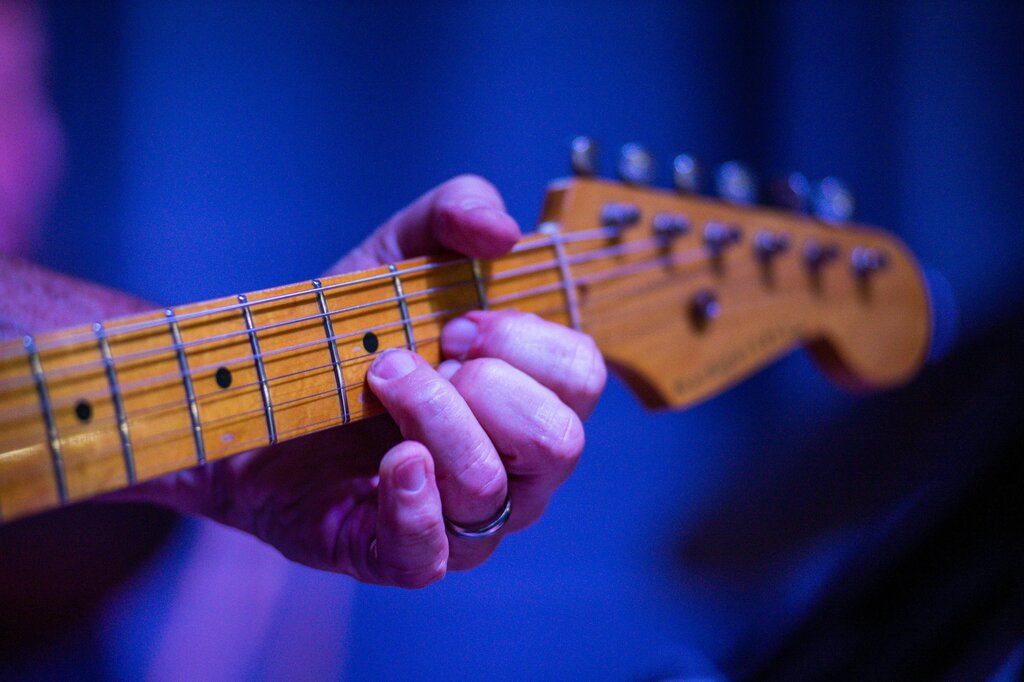
The E-Shaped Barre Chord
Let's start with the E major shape. You know this chord. Now, instead of playing it open, slide the entire shape up the neck. To make it work, your index finger must now press down, or 'barre', all six strings behind the shape. The note your index finger plays on the thickest string (the low E string) becomes the new root note of the chord.
For example, to play a G major chord, you find the note G on the low E string, which is at the 3rd fret. You then place your barre across the 3rd fret and form the rest of the E major shape with your other fingers. The same logic applies to the E minor shape. By barring a fret and using the E minor shape, you create a movable minor chord.
The A-Shaped Barre Chord
The same principle applies to the open A major and A minor shapes. This time, the root note is found on the second-thickest string (the A string). Your index finger barres five strings from the A string down, while your other fingers form the familiar A shape. The low E string is typically muted or not played.
To play a C major chord, you find C on the A string (3rd fret). You then lay your barre on the 3rd fret from the A string down and form the A major shape starting on the 5th fret. It can feel like a stretch at first. Many players use their ring finger to barre the D, G, and B strings to make it more comfortable.
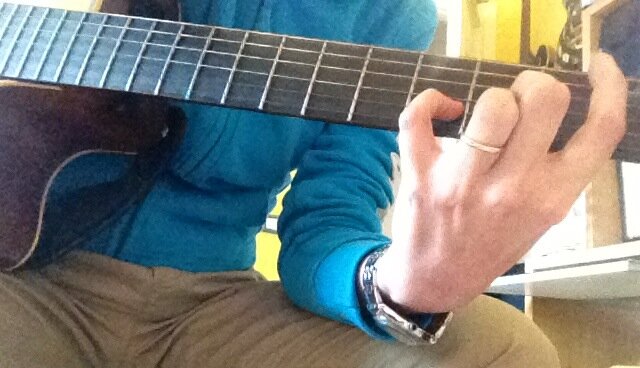
These E-shaped and A-shaped patterns are the most common barre chords and are the first two shapes of the famous , a method for visualizing the fretboard. Mastering them unlocks hundreds of chord possibilities.
Finding Your Way
The key to using barre chords effectively is knowing where to put them. This means you must memorize the notes on the low E (6th) and A (5th) strings. These are your reference points. If you know where G is on the low E string, you can play a G major or G minor barre chord instantly. If you know where C is on the A string, you can play a C major or C minor barre chord.
Here are the notes on the first 12 frets. Remember that the pattern repeats after the 12th fret.
| Fret | Low E (6th) String | A (5th) String |
|---|---|---|
| 0 (Open) | E | A |
| 1 | F | A# / Bb |
| 2 | F# / Gb | B |
| 3 | G | C |
| 4 | G# / Ab | C# / Db |
| 5 | A | D |
| 6 | A# / Bb | D# / Eb |
| 7 | B | E |
| 8 | C | F |
| 9 | C# / Db | F# / Gb |
| 10 | D | G |
| 11 | D# / Eb | G# / Ab |
| 12 | E (Octave) | A (Octave) |
Try this: find an F major chord using the E-shape (hint: 1st fret). Now find a D major chord using the A-shape (hint: 5th fret). Getting quick at this is all about practice.
Technique and Efficiency
Barre chords are tough at first. Your hand will get tired. Don't worry, this is normal. The secret isn't a death grip, but smart technique.
- Thumb Placement: Your is critical. Keep it on the back of the neck, roughly opposite your middle finger. This creates a stable pivot point and provides leverage without unnecessary squeezing.
- Use Your Arm: Don't rely solely on finger strength. Use the natural weight of your arm to help hold the strings down. Pull back slightly with your whole arm, not just by clamping your hand.
- Finger Position: Place your barring index finger right behind the fret, where you need the least amount of pressure. Roll it back slightly so you're using the harder, bony side of your finger, not the soft, fleshy part.
Full six-string barre chords aren't always necessary. In many contexts, especially when playing with a band, you can use smaller, more efficient chord fragments. For example, instead of a full E-shaped barre chord, you might only play the notes on the top three or four strings. This is less physically demanding and can create a clearer, less muddy sound in a mix.
Experiment with these smaller shapes. They can be easier to fret and allow for faster changes.
By converting each of the five CAGED shapes into barre or movable forms, you have exponentially increased your chord vocabulary.
Now that you understand the mechanics, let's test your knowledge.
What is the primary function of the index finger when playing a barre chord?
If you want to play a G major barre chord using the E major shape, on which fret should you place your barre?
Mastering barre chords is a rite of passage for every guitarist. It takes patience and consistent practice, but it's the gateway to playing all over the neck with confidence and freedom.