Intermediate Guitar Mastery and Practical Theory
Barre Chord Mechanics
From Open Shapes to Moveable Chords
You already know the basic open E and A chords. The good news is you've already done most of the work for learning dozens of new chords. The secret is to transform those familiar shapes into moveable forms using your index finger as a portable capo. This is the essence of barre chords.
By converting each of the five CAGED shapes into barre or movable forms, you have exponentially increased your chord vocabulary.
Let's start with the E shape. Form an open E major chord. Now, instead of using your first, second, and third fingers, try forming that same shape using your second, third, and fourth fingers. It might feel awkward at first. This frees up your index finger to act as the 'barre'.
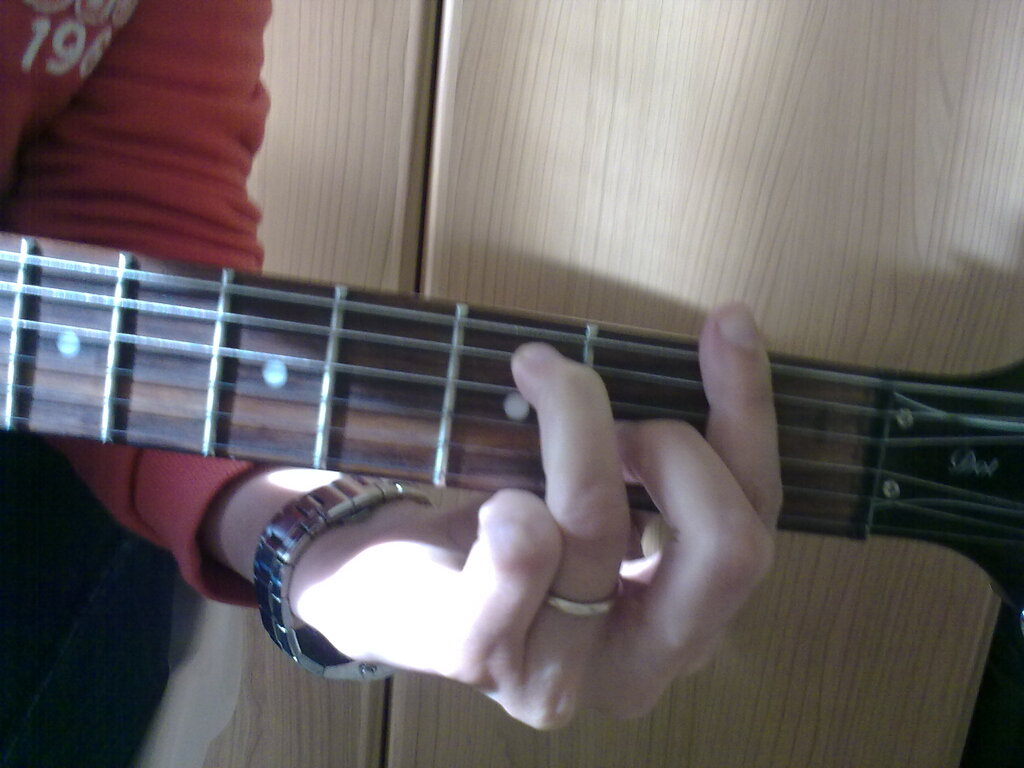
Slide this new E shape up one fret. Now, lay your index finger flat across all six strings at the first fret. You're now playing an F major chord. The note on the low E string (your 6th string) determines the chord's root. Since the first fret on the 6th string is an F, you're playing an F major chord. If you slide this whole shape up to the third fret, where the root note is G, you're playing a G major chord.
Mastering the Barre Technique
The biggest hurdle is getting every string to ring out clearly. Don't just press down hard with the flat part of your index finger. Instead, slightly roll your finger back towards the headstock, using the harder, bonier side. Think of it as a hinge. This applies more focused pressure without needing a death grip.
Your thumb is your anchor. Place it on the back of the neck, roughly opposite your middle finger. This creates a pincer-like grip, giving you the leverage you need without tensing up your whole hand. If your wrist is bent at an extreme angle, you're doing it wrong. Keep it relatively straight to avoid strain.
The A-Shape and Shell Voicings
The same principle applies to the open A major chord. To make it moveable, you'll typically flatten one finger—often the ring finger—across the D, G, and B strings. This is a compact shape. Your index finger then lays the barre behind it.
The root note for A-shape barre chords is found on the A string (the 5th string). If you play an A shape at the third fret, with your index finger barring the first fret, you get a B♭ major chord. The root note is B♭ on the first fret of the A string.
Full six-string barre chords can be tiring to hold and slow to change between. A practical alternative is using , which are smaller, stripped-down versions of the chord. For an E-shape barre chord, you might only play the lowest three or four strings. This captures the harmonic essence of the chord (root, third, fifth) while being much easier on your hands and quicker to move around the neck.
| Shape | Root String | Example (3rd Fret Root) | Notes |
|---|---|---|---|
| E-Shape | 6th (Low E) | G Major | The root note is on the 3rd fret of the 6th string. |
| A-Shape | 5th (A) | C Major | The root note is on the 3rd fret of the 5th string. |
Knowing the notes on your 5th and 6th strings is the key to unlocking the entire fretboard. It's your map for finding any major or minor barre chord you need, simply by locating the root and applying the correct E or A shape.
Let's check your understanding of these core concepts.
What is the primary function of your index finger when playing a barre chord?
When you form a barre chord using the open E major shape, which string determines the chord's root note?
Practice these shapes slowly, focusing on clean notes rather than speed. Your hand will build the necessary strength over time.