Intermediate Guitar Mastery and Fretboard Navigation
Barre Chord Mechanics
The Moveable Chord
You already know your open chords. Now, let's unlock the rest of the fretboard. Barre chords transform the open shapes you're familiar with into moveable forms that can be played anywhere on the neck. The concept is simple: your index finger acts as a moveable capo, or "nut," while your other fingers form a chord shape you already know.
By learning just two basic shapes, the E shape and the A shape, you can play any major or minor chord that exists. This is the key to moving beyond campfire strumming and truly navigating the guitar.
The E Shape Barre Chord
Let's start with the open E major chord. You know the shape. Now, instead of playing it open, shift every finger up one fret. Your middle finger will be on the 2nd fret of the G string, your ring finger on the 3rd fret of the A string, and your pinky on the 3rd fret of the D string. To complete the chord, lay your index finger flat across all six strings at the 1st fret. You're now playing an F major chord.
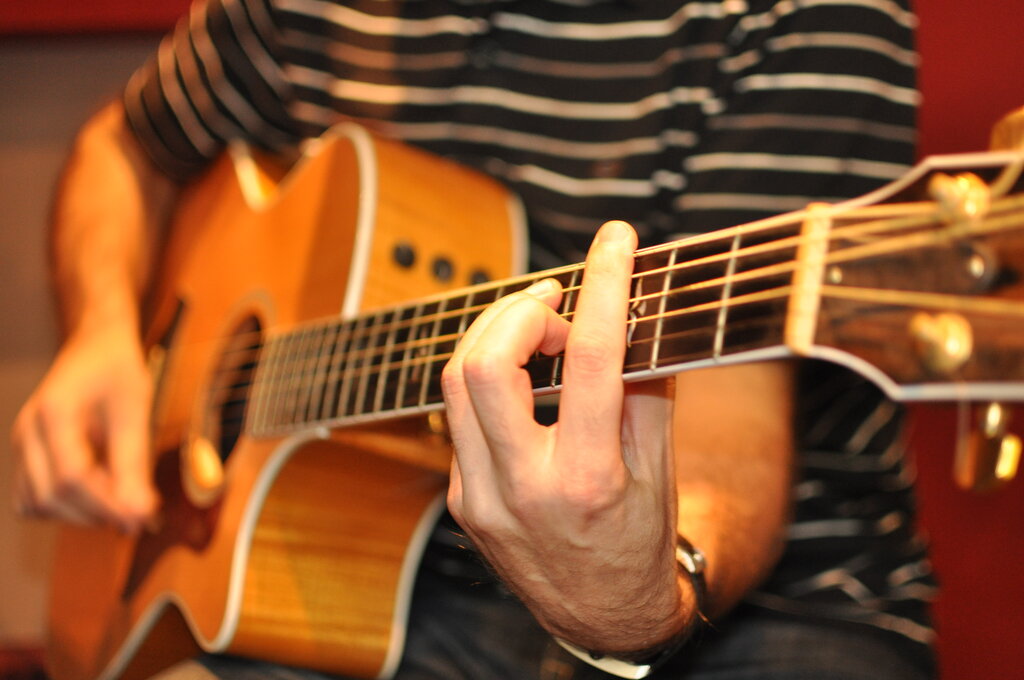
The trick is applying just enough pressure. Your thumb should be on the back of the neck, roughly behind your middle finger, creating a gentle pinching motion. Don't use a death grip. Arch your fingers to press down with the tips, ensuring they don't accidentally touch and mute the strings below them.
Think of your index finger as a capo that you can place on any fret. The shape your other fingers make determines the chord's quality (major or minor).
So how do you know which chord you're playing? You find the on the 6th (low E) string. The note your index finger presses on this string gives the chord its name. If you bar the 3rd fret, your index finger is on a G note, so you're playing a G major chord. If you slide up to the 5th fret, you're on an A, making an A major chord.
| Fret | Note on 6th String | E-Shape Barre Chord |
|---|---|---|
| 1 | F | F major |
| 3 | G | G major |
| 5 | A | A major |
| 7 | B | B major |
To play an E-shape minor barre chord, simply lift your middle finger. That's it. The F major at the 1st fret becomes F minor. The G major at the 3rd fret becomes G minor. This simple change from major to minor works on any fret.
The A Shape Barre Chord
The same principle applies to the A major shape. Start with an open A major chord. Now, imagine sliding it up two frets to the 2nd fret to play a B major. To do this, you'll bar the 2nd fret with your index finger from the A string down. You do not play the low E string. Then, you need to form the A shape on the 4th fret with your other fingers.
This can be tricky. Many players find it easiest to use their ring finger to bar the D, G, and B strings at the 4th fret. Others prefer to cram their middle, ring, and pinky fingers in there. Experiment to see what feels most comfortable for you.
With the A shape, your root note is on the 5th (A) string. To play a C major chord, you find the C note on the A string, which is at the 3rd fret. You place your barre there and form the rest of the shape. To play a D major, you slide up to the 5th fret.
| Fret | Note on 5th String | A-Shape Barre Chord |
|---|---|---|
| 2 | B | B major |
| 3 | C | C major |
| 5 | D | D major |
| 7 | E | E major |
Just like the E shape, modifying the A shape to a minor chord is simple. From the A major barre chord shape, just lift your middle finger (or whichever finger is fretting the note on the B string) back by one fret. For a C minor chord, your index finger bars the 3rd fret, your ring and pinky are on the 5th fret (A and D strings), and your middle finger is on the 4th fret of the B string.
Putting It Into Practice
Barre chords are a physical challenge at first. Your hand will get tired. The key is consistent, short practice sessions, focusing on clean technique, not brute force. Proper is crucial; you should be using the weight of your arm to help hold down the strings, not just squeezing with your thumb and fingers.
A useful trick is to practice barre chords higher up the neck first, around the 5th or 7th fret. The frets are closer together there, requiring less of a stretch.
If you're struggling to get all six strings to ring out clearly, don't worry. Start smaller. Practice playing just two notes at a time within the chord shape. These are called . For example, in a G major barre chord (E shape at 3rd fret), try playing just the low E and A strings together. Then the A and D strings. This builds finger independence and strength without the frustration of the full chord.
Learning barre chords is a rite of passage for every guitarist. They're a gateway to playing thousands of songs and understanding how the fretboard is laid out. Be patient, focus on your form, and you'll build the strength and muscle memory needed to play them cleanly.
When playing a barre chord using the E shape, what determines the name of the chord (e.g., F, G, A)?
To change an E-shape major barre chord into an E-shape minor barre chord, what is the only thing you need to do?