Intermediate Guitar Mastery and Fretboard Logic
Barre Chord Fundamentals
Unlocking the Fretboard
You've mastered open chords, but most of the guitar neck remains untouched territory. Barre chords are the key to unlocking it. Think of your index finger as a movable nut. By pressing it down across all the strings at a specific fret—creating a 'bar'—you can play any chord, anywhere on the neck.
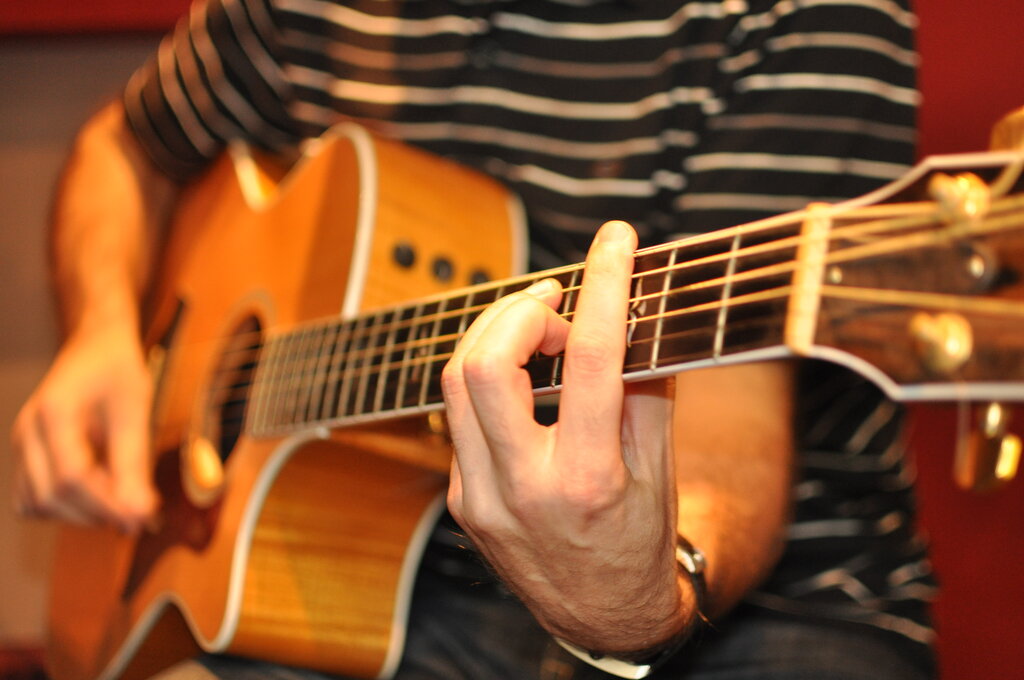
This technique allows you to take the familiar shapes of open chords and slide them up the fretboard. We'll start with the two most common and useful shapes, which are based on the open E and A chords you already know.
The E Shape
Let's start with an open E major chord. Your fingers are on the G, A, and D strings, and the nut holds down the open E, B, and high E strings. To turn this into a barre chord, you replace the function of the nut with your index finger.
First, shift the fingers you use for the E major shape. Instead of your first, second, and third fingers, use your second (middle), third (ring), and fourth (pinky) fingers to form the same shape. This frees up your index finger.
Now, slide that entire shape up one fret. Place your index finger firmly across all six strings at the first fret. You're now playing an F major chord. Slide it up two more frets to the third fret, and you have a G major. The shape is the same; only the position changes.
The key is the on the 6th string (the thickest one). The note your index finger presses on this string names the chord. If your barre is on the 3rd fret, you're pressing a G on the 6th string, making it a G major chord. If you slide up to the 5th fret, that's an A, making an A major chord. This is how you transpose.
| Barre Fret | Note on 6th String | E Shape Major Chord |
|---|---|---|
| 1st | F | F major |
| 3rd | G | G major |
| 5th | A | A major |
| 7th | B | B major |
| 8th | C | C major |
To play an E-shape minor barre chord, simply lift your middle finger off the G string. That's it. This one change transforms the chord's quality from major to minor. An F major becomes an F minor. A G major becomes a G minor.
The A Shape
The same principle applies to the A major shape, but with a twist. The root note for this shape is on the 5th string (the A string). The open A major chord uses three fingers cramped together on the second fret. This isn't practical for a movable shape.
Instead, most players form the A shape by laying their ring finger flat across the D, G, and B strings at one fret. This is called a mini-barre. It frees up your index finger to create the main barre. For an A shape, your index finger barres strings 1 through 5. The 6th string (low E) is not played.
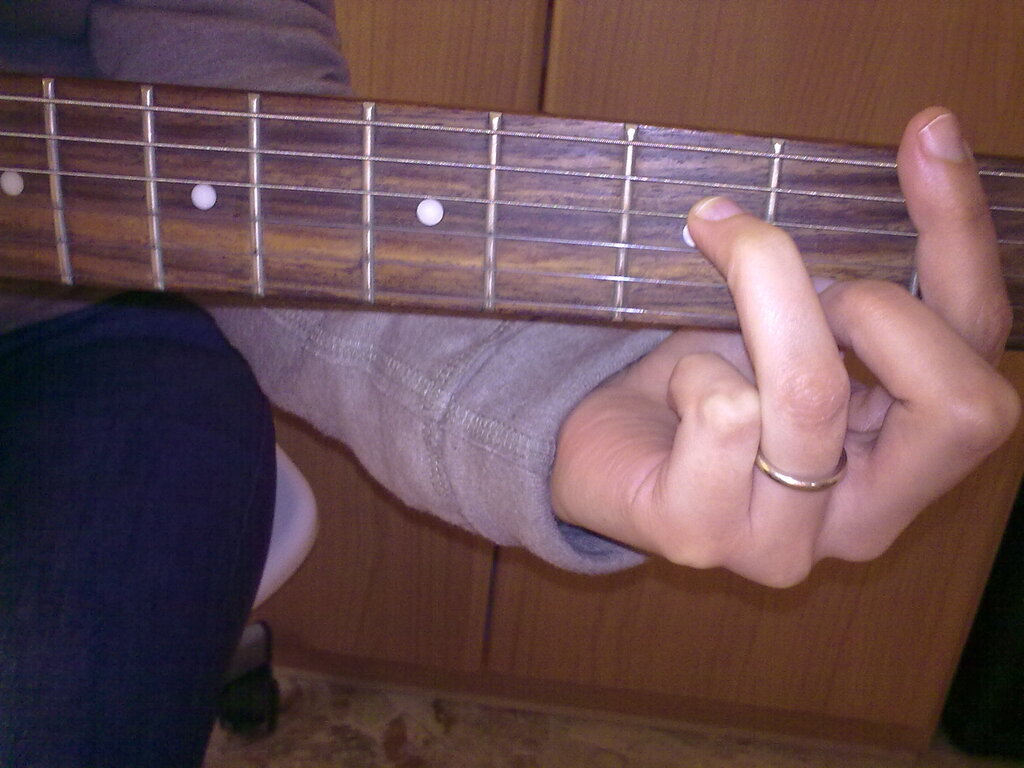
To play a B major chord, for example, you would place your index finger barre on the 2nd fret (from the A string down) and form the A major shape with your other fingers at the 4th fret. The note on the 5th string, 2nd fret is B, so you're playing a B major chord.
To make the A-shape barre chord minor, you use a more familiar fingering. Barre the 5th string down with your index finger. Then, place your ring finger two frets higher on the D string and your pinky two frets higher on the G string. Your middle finger goes one fret higher on the B string. This creates the movable A minor shape.
| Barre Fret | Note on 5th String | A Shape Major Chord |
|---|---|---|
| 1st | A♯/B♭ | A♯/B♭ major |
| 3rd | C | C major |
| 5th | D | D major |
| 7th | E | E major |
| 8th | F | F major |
Getting a clean sound from barre chords takes practice. Start by placing your index finger close to the fret wire. Roll it back slightly so you're using the bonier side of your finger, not the fleshy pad. Apply pressure from your thumb on the back of the neck, creating a clamp-like grip.
Now, let's test your knowledge of these new shapes.
What is the primary function of your index finger when playing a barre chord?
If you use the E major barre chord shape and place your index finger barre on the 3rd fret, what chord are you playing?