Intermediate Geometric Principles and Applications
Coordinate Pythagorean Applications
From Triangles to Grids
The Pythagorean theorem, , is perfect for finding the side lengths of right triangles. But what about finding the distance between two points on a map or a blueprint? Most of the time, that distance isn't a neat horizontal or vertical line. It's a diagonal.
This is where the becomes incredibly useful. By plotting two points on a grid, we can create a right triangle where the distance between the points is the hypotenuse. The legs of this triangle are the horizontal and vertical distances, which are easy to find.
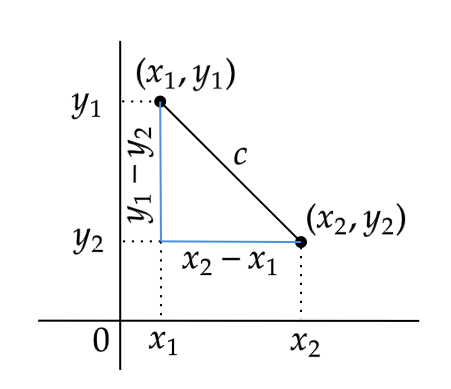
Let's say we have two points, at and at .
The horizontal distance between them (our triangle's base, 'a') is the difference in their x-coordinates: . The vertical distance (the height, 'b') is the difference in their y-coordinates: .
Now, we just plug these into the Pythagorean theorem. If we call the distance 'd', then . Taking the square root of both sides gives us the distance formula.
The distance formula is just the Pythagorean theorem dressed up for the coordinate plane.
Finding the Middle Ground
Besides distance, we often need to find the exact center of a line segment. This is called the midpoint. On a coordinate plane, the midpoint is simply the average of the x-coordinates and the average of the y-coordinates.
Imagine the line segment is the hypotenuse of our right triangle. The midpoint of the hypotenuse will align perfectly with the midpoints of the two legs. This makes the calculation straightforward.
Mapping Real-World Spaces
These formulas are essential tools in fields like architecture, engineering, and . A surveyor mapping a plot of land might place stakes at its corners. By assigning coordinates to each stake, they can calculate the exact length of each property line using the distance formula.
For an irregularly shaped piece of land, they can find the total perimeter by calculating the length of each side and adding them all together. They can also find property midpoints for placing fences or other features. This turns a complex, real-world space into a manageable geometry problem.
By applying the distance formula to each segment of a polygon on a grid, you can find its perimeter. This method works for any polygon, no matter how many sides it has or how irregular it looks. It's a powerful way to bridge the gap between a visual sketch and precise, quantifiable measurements.
The distance formula, , is a direct application of which fundamental geometric theorem?
What is the distance between point A at (2, 3) and point B at (5, 7)?