Intermediate English Language Mastery
Complex Sentence Mechanics
Building Sophisticated Sentences
You already know how to build simple and compound sentences. Now it's time to construct sentences that can carry more weight. A compound-complex sentence allows you to connect multiple sophisticated ideas in a clear, logical flow. These sentences are the workhorses of professional and academic writing.
At its core, a compound-complex sentence has at least two independent clauses (which could stand alone as sentences) and at least one dependent clause (which can't). Think of it like building with LEGOs. The independent clauses are your sturdy base pieces, and the dependent clauses are the smaller, specialised pieces you add for detail and nuance.
Example: Although I prefer to work in the morning, I often stay late at the office, and I usually take work home with me.
Let's break that down:
- Dependent Clause: "Although I prefer to work in the morning"
- Independent Clause 1: "I often stay late at the office"
- Independent Clause 2: "I usually take work home with me"
See how they all connect to build a more detailed picture? The magic lies in the words that join them together.
The Art of Connection
The words that link your clauses are crucial. You're familiar with coordinating conjunctions (For, And, Nor, But, Or, Yet, So) which link equal, independent clauses. But to create complex sentences, you need These little words are powerful because they show the relationship between the clauses. They signal cause, contrast, time, or condition.
Choosing the right one adds precision. Saying "The project was successful because we worked hard" is very different from "The project was successful, although we faced many challenges." The first shows a reason, the second a contrast. This is how you move from simply stating facts to building an argument.
| Relationship | Conjunctions |
|---|---|
| Cause / Effect | because, since, as, so that |
| Contrast / Concession | although, though, while, whereas |
| Time | after, before, when, while, since, until |
| Condition | if, unless, provided that, in case |
Adding Detail with Relative Clauses
Another way to add detail is with relative clauses. These are a type of dependent clause that acts like an adjective, modifying a noun. They usually start with a relative pronoun like who, whom, whose, which, or that.
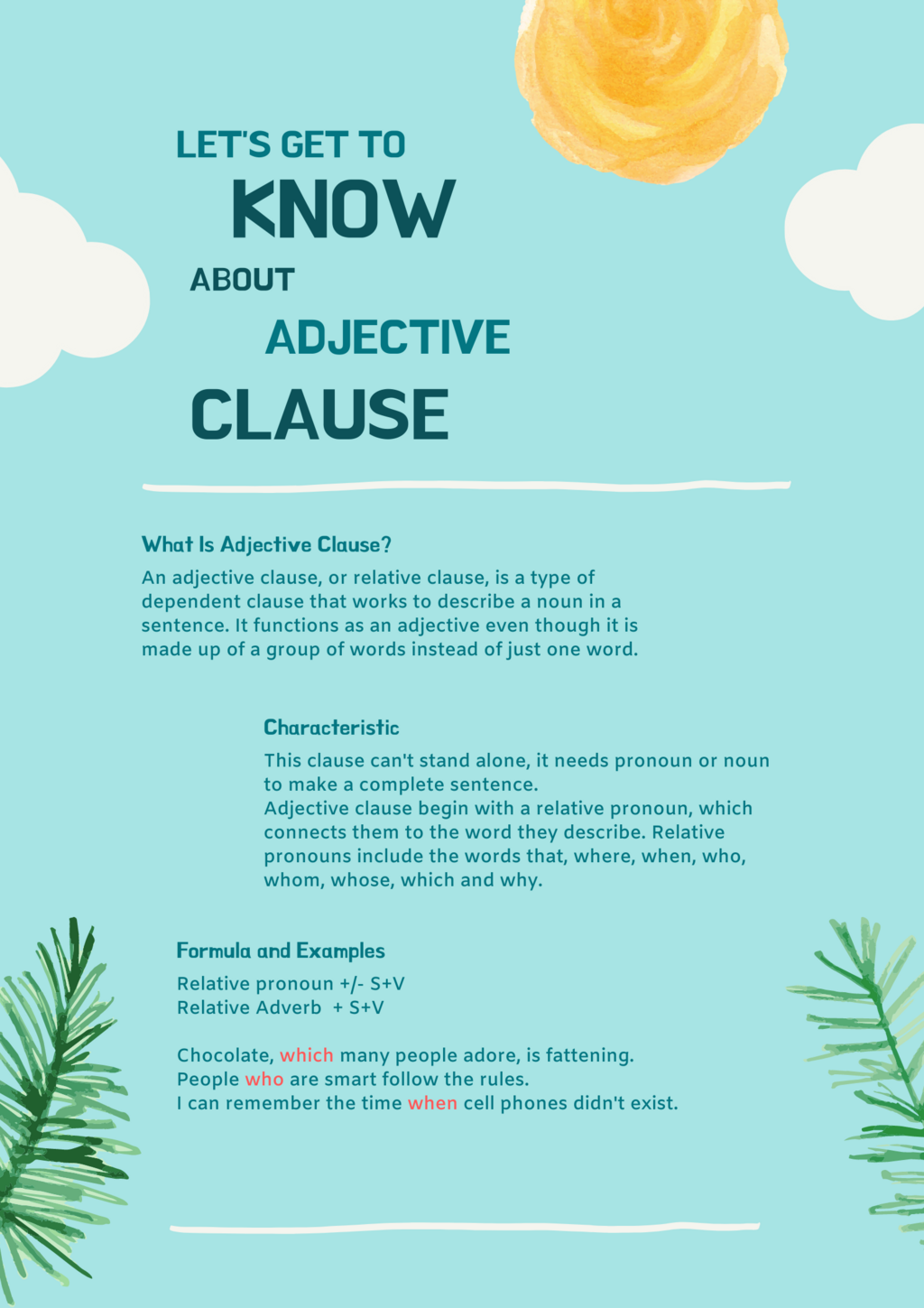
Relative clauses come in two flavours: defining and non-defining.
Defining clauses provide essential information. If you remove the clause, the sentence's core meaning becomes unclear. They are never separated by commas.
- Example: "The employee who got the promotion has been here for ten years." (The clause tells us which employee.)
provide extra, non-essential information. The sentence still makes perfect sense without them. You must use commas to separate a non-defining clause from the rest of the sentence.
- Example: "The CEO, who is an avid marathon runner, will give the opening speech." (We already know who the CEO is; their hobby is just an interesting detail.)
Avoiding Common Pitfalls
As sentences get more complex, it's easier to make mistakes. Two of the most common are run-on sentences and comma splices.
A improperly joins two or more independent clauses without any punctuation or conjunction. It feels breathless and confusing.
- Incorrect: "The meeting was productive we decided on a new strategy."
A comma splice is a specific type of run-on where two independent clauses are joined only by a comma, which isn't strong enough for the job.
- Incorrect: "The report is due tomorrow, I have not started it yet."
Fixing these errors is straightforward. You have three main options:
- Use a Period: Split the clauses into two separate sentences.
- Use a Semicolon: Join two closely related independent clauses.
- Use a Conjunction: Add a coordinating or subordinating conjunction to show the relationship.
Let's fix our comma splice example:
- Correct (Period): "The report is due tomorrow. I have not started it yet."
- Correct (Semicolon): "The report is due tomorrow; I have not started it yet."
- Correct (Conjunction): "The report is due tomorrow, and I have not started it yet."
Mastering these corrections will make your writing significantly more professional and clear.
What is the minimum structure required for a sentence to be classified as compound-complex?
Which of the following is a compound-complex sentence?
By combining different types of clauses and connecting them correctly, you can express complex relationships between ideas with precision and style.