Intermediate Economic Analysis
Advanced Market Mechanics
Finding the Sweet Spot
In a market, the equilibrium price and quantity aren't just abstract ideas; they are precise points we can calculate. This happens where the quantity that consumers want to buy (quantity demanded, ) is exactly equal to the quantity that producers want to sell (quantity supplied, ).
Let's imagine a simplified market for a basic component, like a standard microchip. Suppose the demand for these chips is represented by the equation , where is the price. The supply is given by . To find the equilibrium, we just set them equal to each other.
So, the equilibrium price is $20. To find the equilibrium quantity, we plug this price back into either the supply or demand equation. Let's use the demand equation:
.
At a price of $20, 60 million microchips are bought and sold. This is the market's natural resting point, where buyers and sellers agree on a price and quantity without any leftover supply or unmet demand.
When the Market Moves
Markets rarely stay still. External events constantly shift either the supply or demand curve, forcing the market to find a new equilibrium. This analysis of how equilibrium changes is called —we compare one static equilibrium point to another.
A clear recent example is the disruption in global supply chains seen between 2024 and 2025. Take the semiconductor industry. The ability to produce more chips quickly is limited by factory capacity and complex manufacturing processes. This creates what economists call a "sticky supply"—it can't expand easily in the short term, resulting in a very steep supply curve.
When a new technology (like a popular gaming console or AI hardware) suddenly increases demand for these chips, the demand curve shifts to the right. Because supply is so inflexible, producers can't just make more chips overnight. The primary way the market adjusts is through price. A relatively small increase in demand can lead to a massive price hike because buyers are competing for a limited number of available chips.
This shows a crucial principle: the slope of the supply and demand curves determines how a market shock affects price versus quantity. A steep (inelastic) curve means quantity is not very responsive to price changes, so price has to do most of the adjusting. A flatter (elastic) curve means quantity is very responsive, so price changes will be smaller.
Measuring Market Gains
Market equilibrium isn't just efficient; it maximizes the value created for both consumers and producers. We can measure this value using the concepts of consumer surplus and producer surplus.
is the benefit buyers receive when they pay a price lower than the maximum they were willing to pay. Think about buying a ticket for a concert. If you were willing to pay up to $100 but got it for the market price of $70, you gained $30 in value. That $30 is your consumer surplus.
is the flip side. It's the benefit sellers receive when they get a price higher than the minimum they were willing to accept. If the concert promoter would have been willing to sell the ticket for as little as $40 but sold it for $70, they gained $30 in producer surplus. Total economic surplus is simply the sum of the two.
The Cost of Imbalance
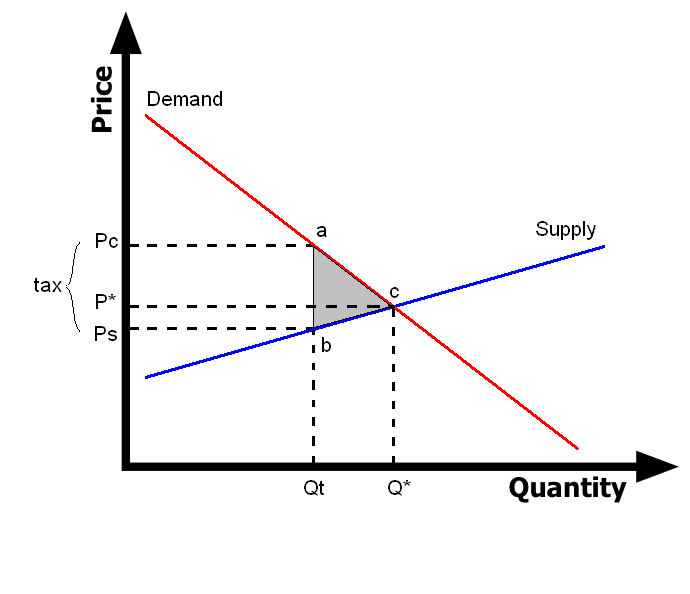
When a market is prevented from reaching its equilibrium, some of this potential value is lost forever. This lost economic efficiency is called It represents transactions that would have benefited both a buyer and a seller but didn't happen.
Sources of deadweight loss are varied. Taxes create a wedge between the price consumers pay and the price producers receive, reducing the quantity traded. Price ceilings (like rent control) or price floors (like minimum wage) can also prevent the market from clearing.
The supply chain disruptions we discussed also create a form of deadweight loss. When a factory can't produce enough chips to meet demand, willing buyers can't find sellers, even at a high price. The potential surplus from those unmade sales simply vanishes.
Understanding these mechanics—how to calculate equilibrium, how it shifts, and how to measure the welfare effects—is the key to analysing almost any market, from local farmers' markets to the global financial system.
In a market for widgets, the demand is given by the equation and the supply is given by . What is the equilibrium price?
When a new, highly popular video game is released, the demand for high-performance microchips suddenly increases. If the supply of these chips is very inelastic (a steep supply curve), what is the most likely immediate outcome in the market?