Intermediate Economic Analysis
Market Structures
The Logic of Profit
Every business, from a local bakery to a multinational tech giant, faces the same fundamental question: how much should we produce? The answer lies in a simple but powerful rule: produce up to the point where marginal revenue equals marginal cost. Let's break that down.
Marginal Revenue (MR) is the extra income from selling one more unit of a product. If a coffee shop sells a latte for £3, the marginal revenue for that latte is £3. Marginal Cost (MC) is the extra cost of producing that one additional unit. This includes ingredients, labour, and electricity. For our coffee shop, maybe the first few lattes cost £1 each to make. But as the shop gets busier, baristas might work less efficiently or need overtime, pushing the marginal cost of later lattes up to £1.50.
A firm maximises its profit when it produces at the level of output where the revenue from the last unit sold is exactly equal to the cost of producing it.
As long as the revenue from one more latte (MR) is greater than its cost (MC), the shop makes a profit on that unit and should keep producing. The moment the cost to make one more latte equals or exceeds the revenue it brings in, it's time to stop. This MR = MC rule is universal, but how it plays out depends entirely on the market structure a firm operates in.
A Spectrum of Competition
Market structure describes the competitive environment of an industry. It's defined by factors like the number of firms, the similarity of products, and the ease of entry for new competitors. We can think of it as a spectrum, from perfect competition at one end to monopoly at the other.
Perfect Competition: Imagine a farmers' market where hundreds of stalls sell identical potatoes. No single farmer can influence the market price. If one tries to charge more, customers simply walk to the next stall. In this scenario, the firm is a 'price taker'. The demand curve it faces is perfectly flat—it can sell as much as it wants at the market price. Here, Marginal Revenue is simply the price of the product ().
Monopoly: This is the opposite extreme. One firm controls the entire market for a product with no close substitutes, like a patented drug or a local water utility. The monopolist is a 'price maker'. To sell more, it must lower its price. This means its demand curve slopes downwards, and its marginal revenue is always less than the price (). Why? Because to sell one extra unit, it must lower the price on all the units it sells, not just the last one.
Monopolistic Competition: This is a blend of the two. Think of the restaurant industry. There are many firms, but each offers a slightly different product—Italian, Thai, French, etc. This product differentiation gives each restaurant a mini-monopoly. They have some power to set their prices because of their unique offering, so their demand curve slopes downwards. However, entry into the market is relatively easy, which keeps long-run profits in check.
Oligopoly: This market is dominated by a few large firms, like the mobile network industry or major airlines. The key feature here is strategic interdependence. Each firm's decisions on price and output directly affect its rivals, and vice-versa. This can lead to complex behaviours like price wars, collusion, or where one dominant firm sets a price and others follow suit.
Profit, Loss, and When to Quit
Making a profit isn't as simple as revenue minus costs. Economists distinguish between two types of profit.
Accounting Profit is what you'd see on a company's financial statement. It's the total revenue minus all the explicit, out-of-pocket costs. For example, if a baker's revenue is £50,000 and the cost of flour, sugar, and rent is £30,000, the accounting profit is £20,000.
Economic Profit takes it a step further. It's total revenue minus all costs, both explicit and implicit. An is the opportunity cost of resources the owner already possesses. If our baker could have earned £25,000 working for another company instead of running their own shop, that £25,000 is an implicit cost.
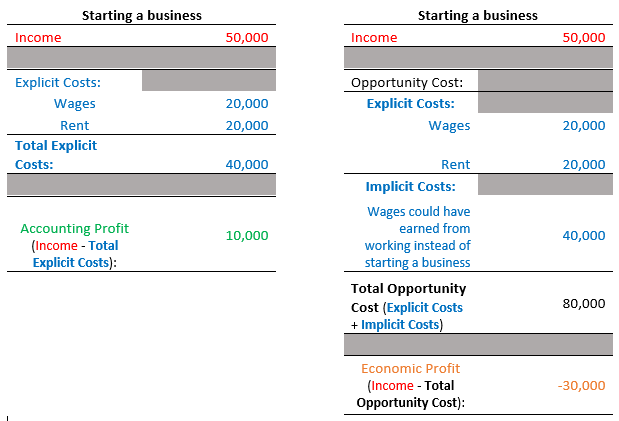
So, the baker's economic profit would be: £50,000 (Revenue) - £30,000 (Explicit Costs) - £25,000 (Implicit Cost) = -£5,000. Even with an accounting profit, the baker is making an economic loss. They would have been financially better off taking the other job. A firm is said to be at its breakeven point when its economic profit is zero. This means it's earning exactly enough to cover all its costs, including the opportunity cost of what its resources could have earned elsewhere.
What if a firm is losing money? Does it shut down immediately? Not necessarily. In the short run, a firm has fixed costs (like rent) that it must pay whether it produces anything or not. The decision to stay open hinges on variable costs (like raw materials).
This leads to the shutdown rule: A firm should continue to operate in the short run if the price per unit is greater than its average variable cost (). By staying open, the revenue it earns covers all its variable costs and at least some of its fixed costs. Shutting down would mean losing all of its fixed costs. However, if the price drops below average variable cost (), the firm is losing money on every single unit it produces. In this case, it minimises its losses by shutting down immediately and only paying its fixed costs.
In the long run, all costs are variable. If a firm cannot cover all its costs and make at least zero economic profit, it will exit the market.
This distinction is crucial. Shutting down is a short-term decision to stop production temporarily. Exiting is a long-term decision to leave the industry for good. The barriers that prevent firms from easily entering a market (like patents, high start-up costs, or government licenses) are the same forces that give existing firms market power and allow them to earn sustained economic profits in the long run.
According to economic principles, a firm maximises its profit by producing up to the point where:
In which market structure does a firm face a perfectly flat (horizontal) demand curve, meaning it is a 'price taker'?
Understanding these structures helps us see why some industries are highly innovative while others are stable, and why prices for similar goods can vary so much.