Intermediate Cybersecurity Strategy and Implementation
Risk Framework Architecture
Building a Risk Management Machine
Managing risk isn't just about making a list of bad things that could happen. It's about building a repeatable, defensible process for making decisions under uncertainty. A good risk management framework (RMF) acts like an engine for your security program. It takes in information about threats, vulnerabilities, and business needs, and outputs consistent, well-informed decisions. This moves risk management from a reactive, checklist-driven activity to a core part of your organization's strategy and system development lifecycle (SDLC).
The NIST RMF Lifecycle
The National Institute of Standards and Technology (NIST) provides one of the most widely adopted frameworks in the U.S. federal government and beyond. Their Special Publication 800-37 outlines a seven-step Risk Management Framework. Think of it not as a linear checklist, but as a continuous cycle that lives alongside a system from conception to retirement.
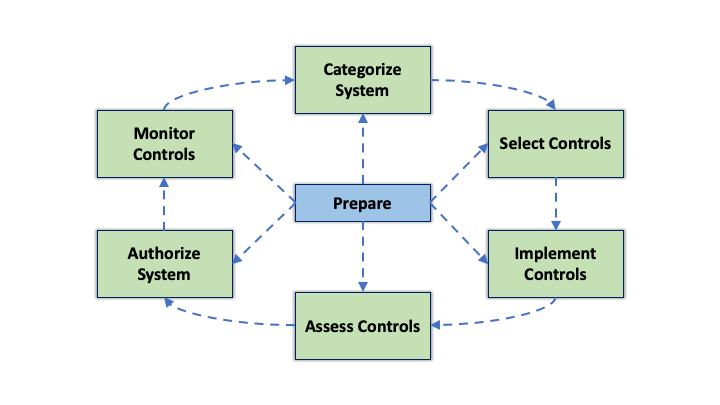
Let's walk through the cycle:
-
Prepare: This first step sets the stage at the organizational level. It involves establishing a risk management strategy, identifying key roles, and determining which common controls can be inherited by multiple systems. It's about getting your house in order before you start assessing individual systems.
-
Categorize: Here, you classify the information system based on the potential impact if its information or the system itself were compromised. Following FIPS 199, you determine the impact level (Low, Moderate, or High) for the loss of confidentiality, integrity, and availability.
-
Select: Based on the system's category, you select an initial set of security controls from a comprehensive catalog, like NIST SP 800-53. This isn't a random grab bag. The framework provides a baseline of controls appropriate for the system's impact level. You then tailor this set, adding or removing controls based on specific system needs and environmental factors.
-
Implement: This is where the plans become reality. The selected security controls are implemented, and their configuration is documented.
-
Assess: You can't just assume the controls work. This step involves using assessment procedures to determine if the controls are implemented correctly, operating as intended, and producing the desired outcome.
-
Authorize: This is the formal go/no-go decision. An Authorizing Official (AO), a senior manager with the authority to accept risk, reviews the assessment results and determines whether the remaining residual risk is acceptable. If it is, the system receives an Authorization to Operate (ATO).
-
Monitor: The work isn't done after authorization. This final step involves continuously monitoring the security controls, assessing their effectiveness over time, and keeping an eye on changes to the system and its environment. If significant changes occur, you may need to cycle back through the RMF steps.
Alternative Lenses: ISO/IEC 27005
While NIST provides a detailed, control-driven process, other frameworks offer different perspectives. The ISO/IEC 27005:2022 standard provides guidance for information security risk management that is less prescriptive about specific controls and more focused on establishing a flexible process.
The ISO process begins with "Context Establishment," which involves understanding the organization's internal and external environment, identifying stakeholders, and defining the risk criteria (how risk will be measured and evaluated). This sets the scope and rules of the game before assessment even begins. The core of the process revolves around risk assessment (identification, analysis, evaluation) and risk treatment.
ISO 27005 is flexible on how you identify risks, generally supporting two main approaches:
- Asset-based: You start by identifying what you care about—the assets. These can be data, hardware, software, or even reputation. Then, you identify the threats that could harm those assets and the vulnerabilities that those threats could exploit. This is a very methodical, bottom-up approach.
- Event-based (or Scenario-based): Instead of starting with assets, you start with a potential harmful event. For example, you might start with the scenario "An attacker executes a successful ransomware attack against our customer database." From there, you work backward to understand the causes (threats and vulnerabilities) and forward to understand the consequences (impacts). This approach can be more intuitive for business leaders.
From Scores to Dollars: The FAIR Model
A common challenge with traditional risk assessment is translating technical findings into business impact. Telling an executive that a risk is "High" or a "7 out of 10" doesn't help them make budget decisions. This is where quantitative models like (FAIR) come in.
FAIR is not a replacement for frameworks like NIST or ISO. It's a supplementary model that provides a structured way to quantify risk in financial terms. It breaks down risk into specific, measurable factors.
The model helps you answer two key questions:
-
How often will a loss event happen? This is the Loss Event Frequency. It's derived from how often a threat is likely to act (Threat Event Frequency) and how susceptible your asset is to that threat (Vulnerability).
-
How much money will we lose when it happens? This is the Loss Magnitude. It includes direct costs like response and recovery (Primary Loss) and secondary effects like reputational damage and regulatory fines (Secondary Loss).
By estimating these factors, you can run simulations to produce a range of probable financial losses. Instead of saying a risk is "High," you can say, "There is a 10% chance we will lose more than $1 million from this risk over the next year." This is a language business leaders understand and can use to prioritize investments.
Now let's test your understanding of these frameworks.
In the NIST Risk Management Framework (RMF), which step involves formally deciding whether the remaining risk is acceptable and issuing an Authorization to Operate (ATO)?
An organization starts its risk assessment by brainstorming potential harmful scenarios, such as "a successful ransomware attack encrypts our main database." Which risk identification approach, mentioned in the context of ISO 27005, does this best represent?
By combining a structured lifecycle like the NIST RMF with the quantitative power of a model like FAIR, organizations can build a robust, data-driven, and repeatable engine for managing risk.