Intermediate Calisthenics Mastery
Mastering Leverage Principles
The Invisible Weight
You've mastered the standard push-up and the air squat. The next step isn't just adding more repetitions; it's about making each repetition harder. To do that, we won't add weights. Instead, we'll use physics to make your own body weight feel heavier.
Think about opening a heavy door. If you push near the hinges, you have to work incredibly hard. If you push on the side farthest from the hinges, it swings open easily. Your body works the same way. The distance between the force (your body's weight) and the pivot point (your hands or feet) determines the difficulty. This distance is called the moment arm—our key to unlocking advanced strength.
By increasing the moment arm, you increase the torque your muscles must overcome. This is the essence of progressive overload in calisthenics. A longer lever makes the same amount of weight feel heavier. The simplest way to lengthen this lever in a push-up is to lean your body forward.
Leverage in Action
The pseudo-planche push-up is a perfect example of this principle. You start in a normal push-up position, but then you lean your shoulders as far forward past your wrists as you can, keeping your arms straight. This shift dramatically moves your centre of gravity forward, lengthening the moment arm from your hands.
Suddenly, your shoulders, chest, and triceps are under far more tension than in a standard push-up. To hold this leaned position, you need more than just strong arms. You need total body tension, which starts at your core.
To control a long lever, you need a rigid structure. A floppy lever just wastes energy.
This is where the position becomes essential. By tucking your tailbone, bracing your abs, and pushing your shoulder blades apart, you turn your torso into a single, solid unit. This position isn't just for looks; it creates a rigid lever that allows you to transfer force efficiently from your hands through your body.
Without this tension, your hips will sag during a pseudo-planche lean, breaking the lever and making the movement impossible to control.
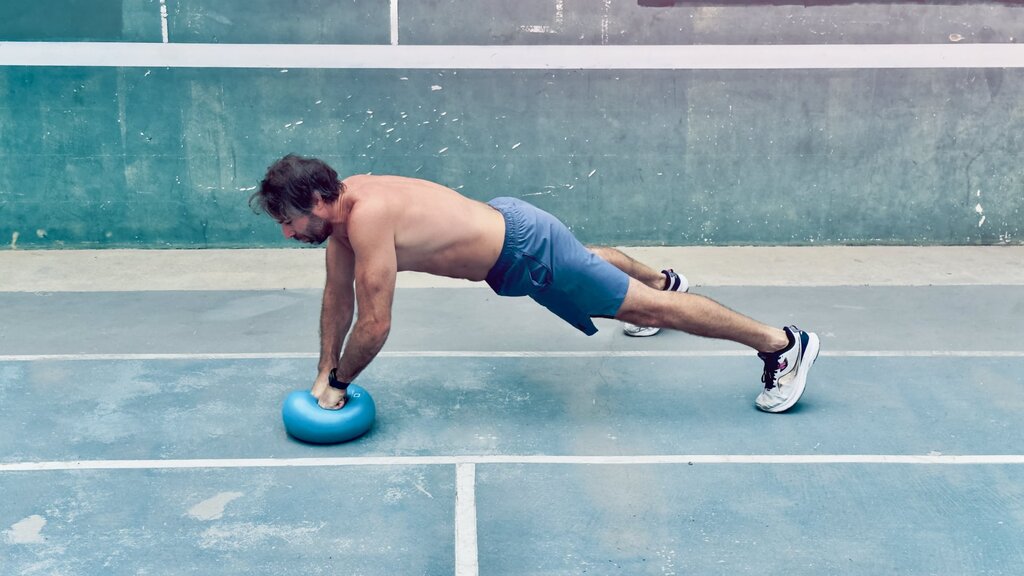
The same logic applies to single-limb, or unilateral, exercises. When you perform a push-up on one arm or a squat on one leg, you’re not just lifting the same weight with half the limbs. You are forcing your body to manage a dramatic shift in your centre of gravity.
Your core must work overtime to prevent your body from twisting. This anti-rotation challenge is another form of leverage, forcing smaller, stabilising muscles to engage powerfully to keep you balanced. This is how you build practical, real-world strength that goes far beyond just pushing and pulling.
Ready to test your understanding of these concepts?
According to the principles of calisthenics, what is the most effective way to make a bodyweight exercise like a push-up harder without adding external weights?
What is the primary purpose of the 'hollow body' position in exercises like the pseudo-planche push-up?
By understanding and applying these principles of leverage, you can continue to make progress indefinitely without ever needing to pick up an external weight.