Intermediate Boxing Tactics
Kinetic Chain Optimization
The Body as a Whip
A powerful punch isn't just an arm movement. It's a full-body event, a chain reaction that starts from the floor and ends at your knuckles. Think of it like cracking a whip. The power comes from the handle, flows through the length of the whip, and concentrates its force at the very tip. Your body works the same way.
This sequence of force transfer is called the kinetic chain. For a beginner, a punch is a push with the arm. For a professional, a punch is a carefully synchronized sequence that channels energy from the largest, strongest parts of the body—the legs and hips—into the smallest, fastest point: the fist. Mastering this chain is the difference between simply hitting and truly striking.
Power from the Ground Up
Every powerful strike begins with your connection to the ground. When you push off the floor with your feet, the ground pushes back with an equal and opposite force. This is Newton's third law in action, and in striking, we call it ground reaction force (GRF). It's the foundational source of all your power.
For a cross, this starts with a pivot of your back foot. As you drive off the ball of your foot, that ground reaction force travels up your leg, initiating a rotation in your hips. This isn't just a leg push; it's the start of a powerful weight transfer, shifting your body mass from your back leg to your front leg. You are literally throwing your body weight into the punch, but in a controlled, rotational manner.
The Engine of Rotation
Once the force leaves your legs, your core and hips take over. This is the engine room of your punch. The key principle here is hip-shoulder separation—the act of rotating your hips before your shoulders. Think of wringing out a towel. The greater the rotational lag between your hips and your upper body, the more elastic energy you store in your core muscles.
Your core's job is to act as a stiff conduit. As the hips decelerate their rotation, a stable core channels that built-up energy into the shoulders. If your core is loose, energy leaks out, and the power of the punch fizzles. A tight, braced core ensures that the massive force generated by your lower body is efficiently transferred to your upper body. This separation and transfer creates immense rotational torque, which is what gives hooks and crosses their knockout power.
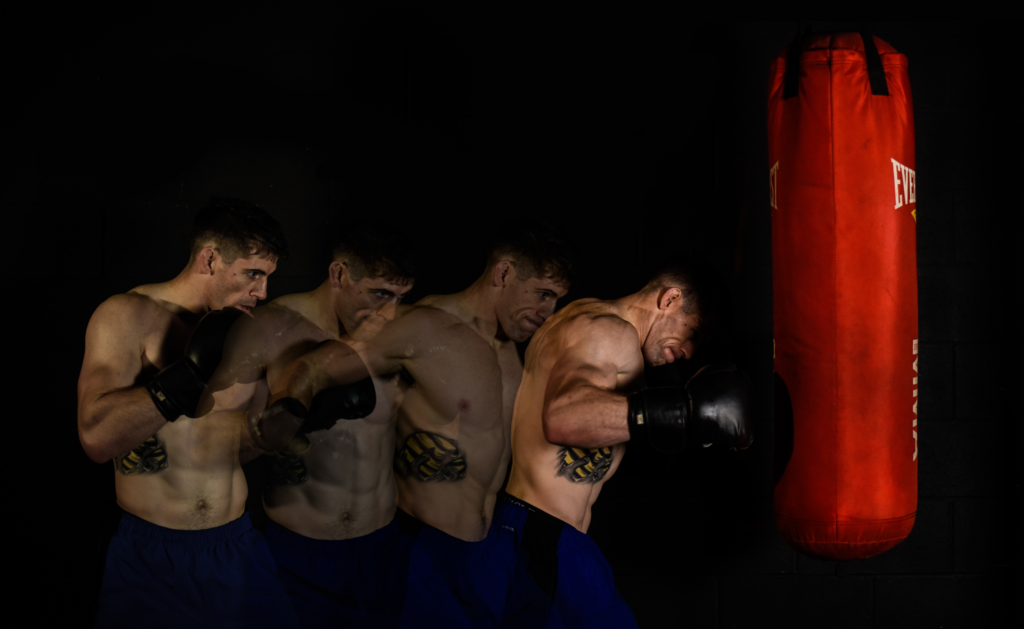
Snapping the Whip
The final stage is the delivery. The punch is not a push; it's a snap. As the arm extends, it should remain relatively relaxed until the last moment. Just before impact, the muscles tense, the fist clenches, and the forearm may rotate slightly to align the knuckles. This final, abrupt deceleration and tensing is what ensures maximum force is transferred to the target.
Relaxation equals speed. Tension equals power. The art is knowing when to switch from one to the other.
Just as important is the retraction. A punch that lingers on its target is a push. A proper strike snaps back to a defensive position just as quickly as it went out. This not only protects you from counters but also embodies the
That's it. Let's recap what we've learned with a few flashcards.
Now, let's test your understanding of these principles.
What is the primary source of power in a powerful punch, according to the principles of the kinetic chain?
The concept of rotating your hips before your shoulders to store elastic energy in your core is known as:
By viewing your body as an interconnected chain, you can move beyond arm-punching and start to unlock the real power behind every strike you throw.