Intermediate Astronomy and Astrophysics
Stellar Physics
The Stellar Balancing Act
Every star, from our Sun to the most distant giant, is in a constant, delicate balance. Gravity relentlessly tries to crush the star into the smallest possible space. Pushing back against this collapse is the tremendous outward pressure generated by the energy in the star's core. This standoff is called hydrostatic equilibrium. It’s the reason stars maintain a stable size and structure for most of their lives.
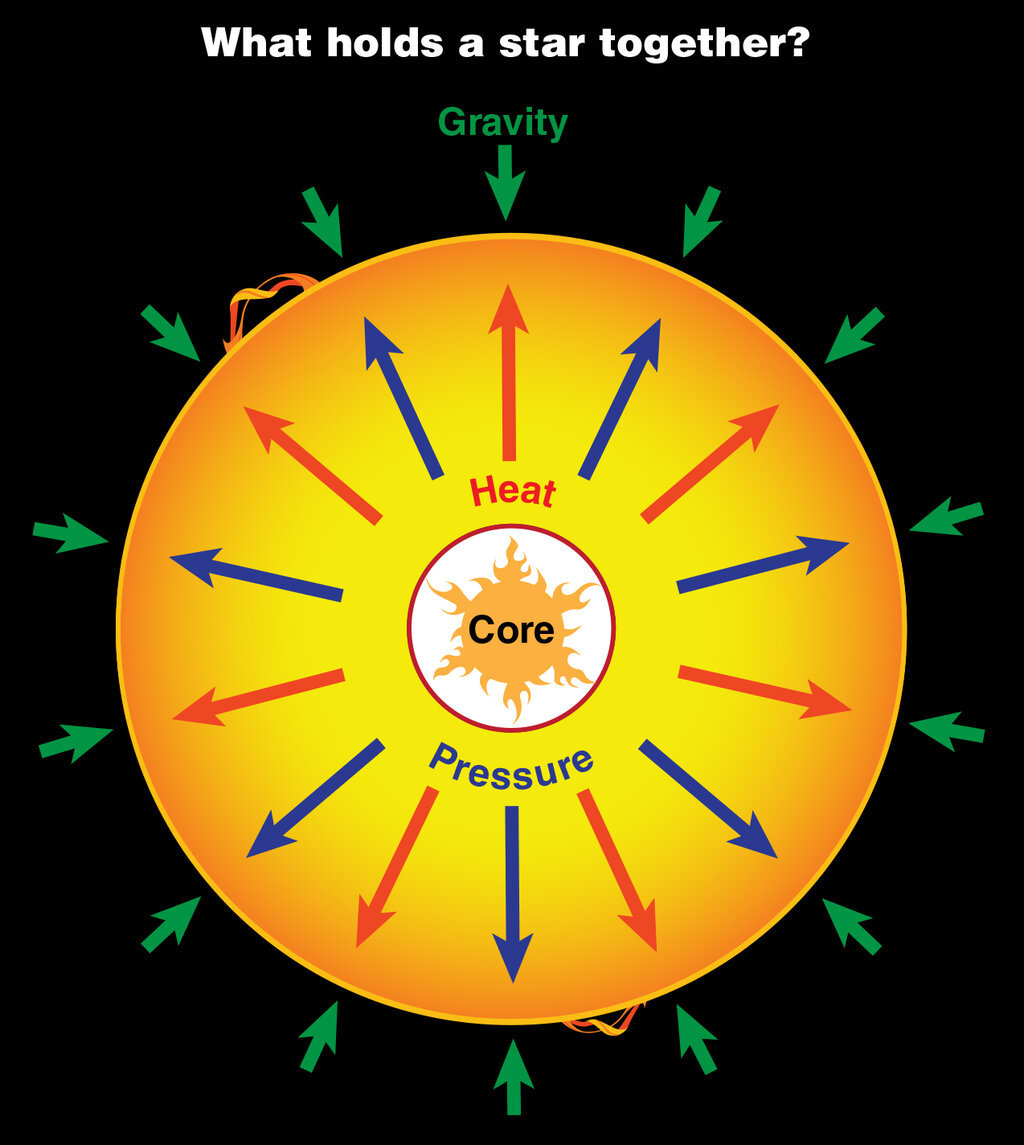
To model what goes on inside a star, astrophysicists rely on a set of equations that describe its structure. These aren't simple formulas; they are complex differential equations that account for how mass, pressure, temperature, and energy flow change from the core to the surface. One equation describes how mass is distributed, another enforces the principle of hydrostatic equilibrium, and others track how energy is generated and transported through the star's layers, either by radiation or convection.
The Engine of a Star
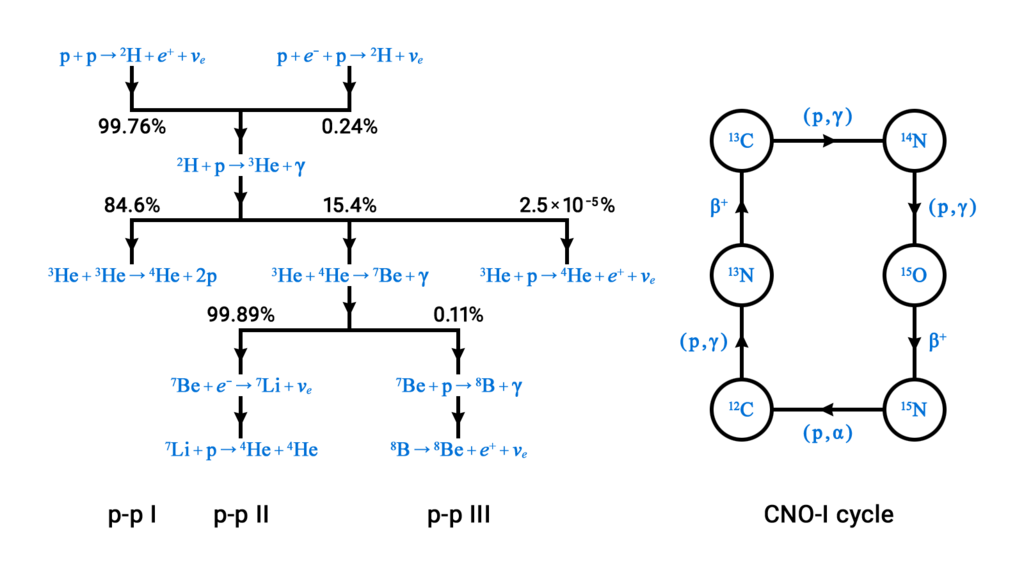
The outward pressure that counters gravity comes from the intense energy produced by nuclear fusion in the star's core. For main-sequence stars, this means fusing hydrogen into helium. While you're familiar with the basic idea, there are two primary mechanisms for this process: the Proton-Proton (PP) chain and the .
The Proton-Proton chain dominates in stars the mass of our Sun or smaller. It directly fuses hydrogen nuclei (protons) together in a series of steps to form helium. The CNO cycle, however, becomes the primary energy source in stars more than 1.3 times the mass of the Sun. In this process, Carbon, Nitrogen, and Oxygen atoms act as catalysts to facilitate the fusion of hydrogen into helium. The core temperatures in these massive stars are so high that the CNO cycle runs far more efficiently than the PP chain.
Forging Heavier Elements
When a star exhausts the hydrogen fuel in its core, fusion stops, and the equilibrium is broken. Gravity takes over, compressing the now helium-rich core and driving its temperature to even greater heights. Once the core reaches about 100 million Kelvin, a new fusion process ignites: the Triple-Alpha process. In this reaction, three helium nuclei (also known as alpha particles) fuse to form a carbon nucleus, releasing energy.
In lower-mass stars (between 0.8 and 2.0 solar masses), the onset of helium fusion can be explosive. The core is so dense that it's supported by a quantum mechanical effect called electron degeneracy pressure, which we'll discuss shortly. Because this pressure doesn't change with temperature, when helium fusion begins, the core temperature skyrockets without the core expanding to cool itself down. This creates a runaway reaction called the "Helium flash," which, for a few brief moments, can generate more energy than an entire galaxy. Eventually, the core heats up enough to expand, and stable helium burning begins.
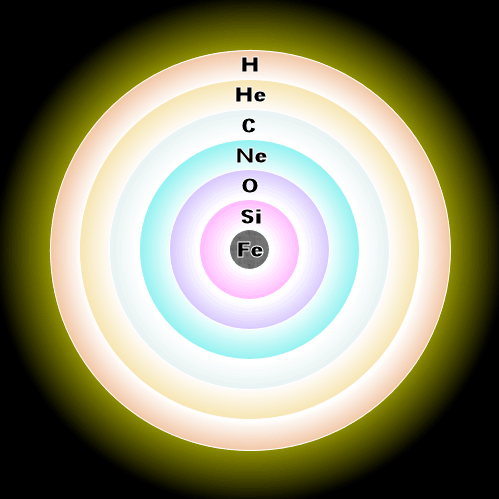
For massive stars (greater than 8 solar masses), the story continues. After exhausting their core helium, they have enough mass for gravity to continue compressing the core, reaching the temperatures and pressures needed to fuse even heavier elements. This creates a nested, onion-like structure of fusion shells. Carbon fuses into neon and magnesium, neon into oxygen, oxygen into silicon, and finally, silicon into iron. Each stage of burning is shorter than the last. While hydrogen burning can last for millions of years, silicon burning might only last for a single day.
This chain of fusion ends at iron. Fusing elements lighter than iron releases energy, but fusing iron or heavier elements requires an input of energy. The star hits a wall. When the core is full of inert iron, it can no longer generate pressure through fusion to fight gravity. This is the 'iron bottleneck', and it signals the catastrophic end of the star's life.
The Quantum Limit
What happens when a star isn't massive enough to ignite the next stage of fusion? Its core contracts under gravity, and the electrons are squeezed into a smaller and smaller volume. According to a quantum rule called the Pauli Exclusion Principle, no two electrons can occupy the same quantum state. This resistance to being packed too tightly creates a powerful outward pressure known as electron degeneracy pressure.
This quantum pressure is independent of temperature and can halt the gravitational collapse of a star's core, creating a stable, compact object like a white dwarf. However, this pressure has its limits.
In the 1930s, the astrophysicist Subrahmanyan Chandrasekhar calculated that if a star's core exceeds about 1.4 times the mass of our Sun, electron degeneracy pressure will fail. Gravity will overwhelm it, leading to a further collapse. This value, now known as the Chandrasekhar limit, is a fundamental dividing line in stellar evolution. Cores below this limit can peacefully end their lives as white dwarfs. Cores that exceed it are destined for a far more violent fate, collapsing to form a neutron star or a black hole.