Intermediate Artificial Intelligence Systems
AI Architectural Paradigms
The AI Architectural Stack
Artificial Intelligence is not a single technology but a stack of architectural paradigms. At the base is Machine Learning (ML), a broad field focused on algorithms that learn from data. A subset of ML is Deep Learning (DL), which uses complex, multi-layered neural networks. At the top of this stack is Generative AI (GenAI), a specialized application of deep learning that creates new content.
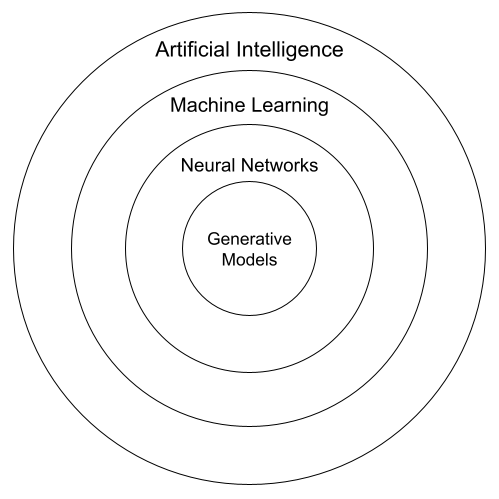
As an architect, your job isn't to always reach for the most complex tool. It's to select the right layer from this stack for the problem at hand. Moving up the stack from ML to GenAI typically increases predictive power and the ability to handle unstructured data, but it comes with significant trade-offs in cost, data requirements, and interpretability. The key is knowing when to climb and when to stay put.
ML for Structure and Clarity
Classical machine learning models are the workhorses of the data world. They excel at finding patterns in structured, tabular data—think spreadsheets or database tables. If your goal is to predict a specific outcome from a clean set of features, a classical ML model is often your best bet.
Consider a bank wanting to predict loan defaults. Their data includes columns like applicant income, credit score, loan amount, and years of employment. For this task, an algorithm like a Random Forest is ideal. It can parse these distinct features and build a decision-making model that is not only accurate but also relatively transparent.
You can often inspect these models to understand which factors most heavily influenced a prediction. This interpretability is crucial in regulated industries like finance or healthcare, where you need to explain your model's reasoning. Furthermore, these models are computationally efficient and can typically be trained on standard CPUs without specialized hardware.
| Use Case | Data Type | Why Classical ML? |
|---|---|---|
| Customer Churn Prediction | Tabular (Usage stats, contract length) | High interpretability, lower compute cost. |
| Sales Forecasting | Time-series (Historical sales figures) | Well-established statistical models, efficient. |
| Fraud Detection | Transactional (Amount, location, time) | Can quickly classify events based on clear features. |
DL for Complexity and Abstraction
Deep Learning becomes necessary when your data isn't neatly organized into rows and columns. Think of raw images, audio files, or long blocks of text. The power of DL lies in its ability to perform representation learning—automatically discovering relevant features from raw, unstructured data.
Instead of telling the model what to look for, a deep neural network learns the hierarchical patterns on its own. For image recognition, initial layers might learn to detect edges and corners, middle layers might combine these into shapes like eyes and noses, and final layers might recognize a complete face.
This power comes at a cost. DL models are data-hungry, often requiring millions of examples to perform well. They also demand specialized hardware. The massive number of parallel calculations involved in training a deep network makes GPUs (Graphics Processing Units) or TPUs essential. Without them, training times can stretch from hours to weeks or even months.
This is also where the "black box" problem becomes prominent. Due to the millions of interconnected parameters within the network, pinpointing the exact reason for a specific output is incredibly difficult. You trade clarity for predictive power.
GenAI for Creation and Innovation
Generative AI sits at the top of the stack. It uses the most advanced deep learning architectures, like , not just to classify or predict, but to create new data that resembles the data it was trained on. This could be generating human-like text, photorealistic images, or musical compositions.
GenAI models are chosen when the task involves creation, summarization, or translation of unstructured content. For example, building a customer service chatbot that can understand and respond to open-ended questions requires a generative model. Trying to use a classical ML model for this would fail, as it can't generate novel sentences.
The trade-offs here are an amplification of those in deep learning. Data requirements are astronomical—often a significant portion of the public internet. The cost to train a state-of-the-art foundation model can run into the tens or hundreds of millions of dollars, demanding massive clusters of GPUs or TPUs. Interpretability is even more challenging, leading to issues like "hallucinations," where the model generates plausible but incorrect or nonsensical information.
When choosing a model, ask yourself: Is my task about classification, prediction, or creation? Is my data structured or unstructured? And how much do I need to explain the outcome?
Ultimately, the choice of architecture is a balancing act. A classical ML model offers a cheap, fast, and interpretable solution for structured data problems. Deep Learning unlocks the potential of unstructured data at the cost of transparency and resources. Generative AI takes this a step further, enabling content creation at the frontier of scale and complexity. A great architect knows not only how to build but also which foundation to build upon.