Intermediate Ableton House Music Production
Advanced Arrangement Techniques
From Loop to Layout
The Session View is a brilliant canvas for brainstorming. It's where you throw ideas at the wall, mix and match loops, and find compelling combinations. But once you've found a groove, it's time to tell a story. That's where the Arrangement View comes in.
Moving from Session to Arrangement is about shifting from a non-linear, improvisational mindset to a linear, compositional one. Your goal is to take those exciting loops and stretch them out over a timeline, creating a complete song with a beginning, middle, and end. The simplest way to start is by hitting the global record button at the top of the screen and launching your clips and scenes from Session View in an order that feels right. This records your performance directly into the Arrangement timeline, giving you a raw structure to refine.
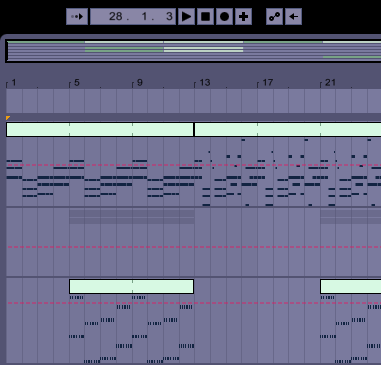
Once your clips are on the timeline, you can start sculpting. You're no longer just triggering loops; you're editing, cutting, copying, and pasting them to build out the full song structure. This is the foundational step in turning a repetitive loop into a dynamic piece of music.
Crafting the Journey
House music, like most electronic dance music, is all about energy management. A great arrangement takes the listener on a ride, building tension and providing satisfying releases. This is achieved through well-defined structural elements.
-
Builds: A build-up, or build, is a section where you create tension. You do this by gradually adding elements. Start with a core beat, then introduce a hi-hat pattern, then a bassline, and then slowly fade in a synth pad. Using effects like risers (sweeping white noise) or speeding up a snare roll are classic techniques to signal that something big is about to happen.
-
Drops: The drop is the payoff. It's the moment all the built-up tension is released, and the track hits its full energy. This is usually when the main kick drum and bassline come in together with the core melodic elements, creating the most danceable part of the song.
-
Breakdowns: A breakdown offers a breather. Here, you strip away most of the percussive elements, often leaving just a melodic or atmospheric part. This creates contrast and gives the listener a moment of calm before you start building the energy back up for the next drop.
Bringing Tracks to Life
A static arrangement is a boring one. To make your track breathe and evolve, you need automation. Automation is the process of recording changes to any parameter over time. This could be anything from volume and panning to the filter cutoff on a synthesizer or the feedback on a delay effect.
In a house track, automation is key to creating smooth transitions and interesting textures. For example, during a build-up, you can automate the cutoff frequency of a low-pass filter on your main synth lead. As you slowly open the filter, the sound gets brighter and more intense, adding to the tension. You can automate a reverb's 'Dry/Wet' control, making an element sound more distant in a breakdown and then bringing it back to the forefront for the drop.
Automation turns a static loop into a dynamic performance. It's the difference between a song that feels programmed and one that feels alive.
You can also use scenes in a more advanced way to flesh out your arrangement. Instead of just having one scene per loop combination, create multiple scenes that represent entire sections of your song. You might have a scene for your 'Intro', a few variations for your 'Verse', a 'Chorus' scene, and a 'Breakdown' scene.
By launching these scenes in different orders, you can experiment with the overall structure of your song in real-time without having to tediously move clips around in the Arrangement View. Once you find a structure that works, you can record this scene performance into the Arrangement View as a solid starting point for final edits and automation.
Now, let's test your knowledge on structuring a track.
What is the primary purpose of the Arrangement View in a digital audio workstation?
In the context of house music, what is the 'drop'?
Mastering these techniques will allow you to move beyond simple loops and craft full, compelling tracks that guide your listeners on an engaging musical journey.