Interdisciplinary Scientific Foundations
Thermodynamics in Bio-Systems
Life's Energy Budget
Living organisms, from the smallest bacterium to the largest whale, are governed by the laws of thermodynamics. They are intricate chemical systems that must constantly manage energy to survive, grow, and reproduce.
The First Law of Thermodynamics, the principle of energy conservation, applies just as much to a cell as it does to a star. Organisms don't create energy from nothing; they transform it. A plant converts light energy into chemical energy through photosynthesis. You convert the chemical energy in food into kinetic energy to walk and thermal energy to stay warm.
The First Law of Thermodynamics is the formal statement of the conservation of energy.
Unlike a sealed container, a living being is an open system. It constantly exchanges energy and matter with its environment. This is crucial for understanding the Second Law of Thermodynamics, which states that the total entropy, or disorder, of the universe always increases.
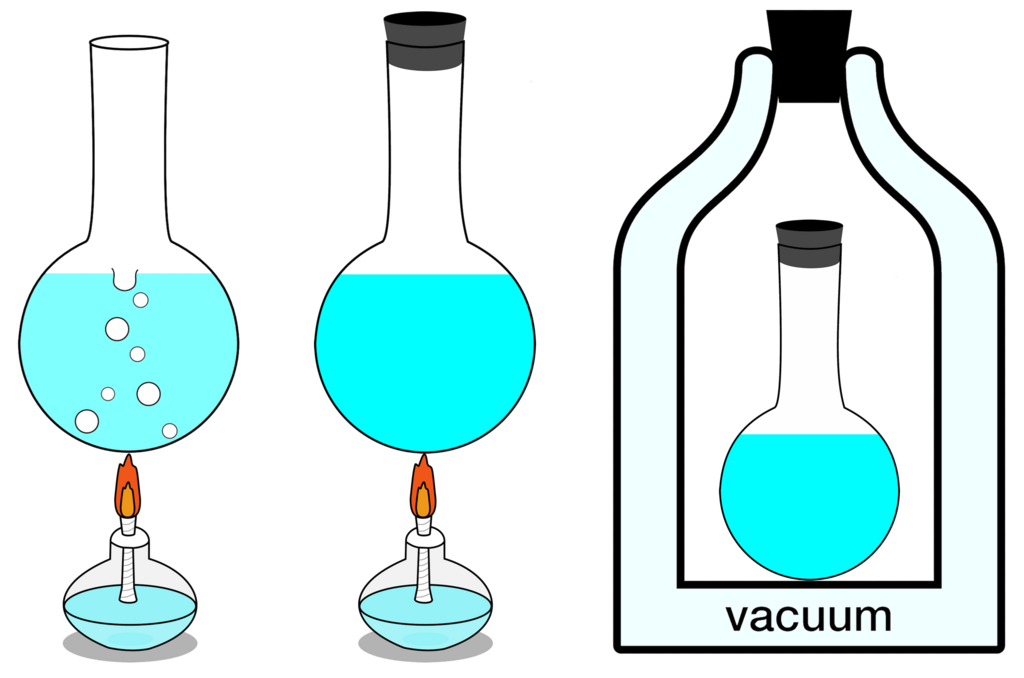
At first glance, life seems to defy this law. Organisms are highly ordered structures. A complex network of proteins, DNA, and cells is far from random. So, how does life maintain its order in a universe that tends towards chaos?
Order from Chaos
The key is that an organism is not an isolated system. To maintain its internal order (low entropy), it must increase the entropy of its surroundings. Every metabolic process, from building proteins to contracting muscles, is inefficient. This inefficiency releases energy, primarily as heat, which dissipates into the environment and increases the disorder of the molecules there.
A cell takes in ordered molecules like glucose and breaks them down into smaller, more numerous, and less ordered molecules like carbon dioxide and water. The decrease in entropy within the cell is more than offset by the increase in entropy outside it. The net result is an increase in total universal entropy, and the Second Law remains satisfied.
To determine if a biological process will occur spontaneously, we can't just look at heat or entropy alone. We need a value that combines them: Gibbs Free Energy (). It represents the energy available in a system to do useful work.
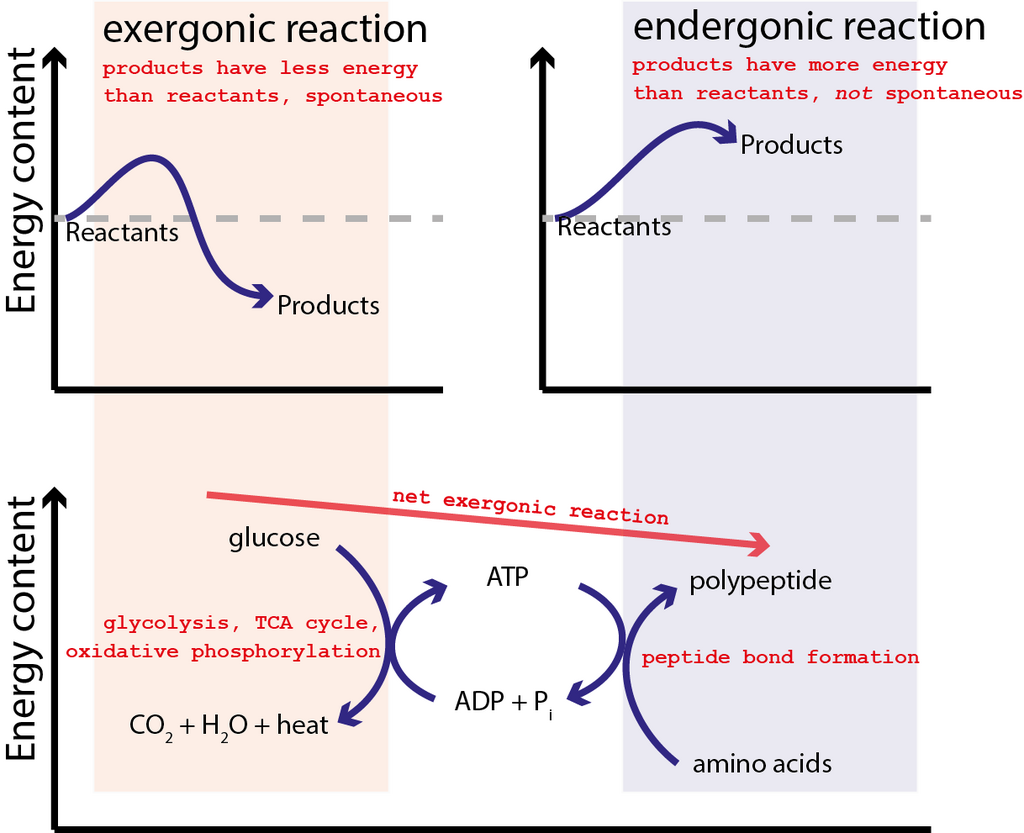
A reaction is spontaneous if it leads to a decrease in Gibbs Free Energy. In other words, if is negative, the reaction can proceed without an input of energy. These are called exergonic reactions. If is positive, the reaction is non-spontaneous and requires an energy input to occur. These are endergonic reactions.
The Currency of the Cell
Many essential biological reactions are endergonic. Building complex molecules like proteins from simple amino acids, for instance, requires energy. Cells power these reactions using a chemical energy shuttle: adenosine triphosphate, or ATP.
ATP
noun
Adenosine triphosphate, a molecule that carries energy within cells. It is the main energy currency of the cell.
The bonds between the phosphate groups in an ATP molecule are high-energy. When the terminal phosphate group is broken off through hydrolysis, a significant amount of energy is released. This reaction is highly exergonic.
Cells use a strategy called energy coupling. The energy released by an exergonic reaction, like ATP hydrolysis, is used to drive an endergonic reaction. Think of it like using the downhill rush of a waterfall (ATP breakdown) to turn a mill wheel that lifts a bucket of water uphill (an endergonic process).
For example, the cell might couple ATP hydrolysis to the synthesis of a protein. The overall for the coupled process is negative, allowing the otherwise non-spontaneous reaction to proceed.
Now, let's test your understanding of these energy principles.
According to the First Law of Thermodynamics, how does a living organism obtain the energy it needs to function?
How does a highly ordered living organism comply with the Second Law of Thermodynamics, which states that total universal entropy (disorder) always increases?
By transforming energy and coupling reactions, living systems create and maintain order in a universe that constantly tends towards disorder. This continuous dance with the laws of thermodynamics is the physical basis of life itself.