Interactive Plate Tectonics Mastery
Boundary Dynamics
When Plates Meet
Earth's surface isn't one solid piece. It's broken into giant, slow-moving slabs called tectonic plates. These plates float on the semi-molten mantle beneath them. While we don't feel it, they are constantly in motion, bumping, grinding, and pulling away from each other. The action happens at the edges, or boundaries, where plates interact.
These plates move in relation to one another at one of three types of plate boundaries: convergent, or collisional boundaries; divergent boundaries, also called spreading centers; and conservative transform boundaries.
Understanding these boundaries is key to understanding how mountains are built, why volcanoes erupt, and where earthquakes strike. Each boundary type is defined by one simple thing: the direction the plates are moving.
Pulling Apart: Divergent Boundaries
Imagine two large rafts floating next to each other on a lake. If they drift apart, water from below will well up to fill the space. This is exactly what happens at a divergent boundary, where two tectonic plates are pulling away from each other. As the plates separate, a gap forms in the lithosphere, the rigid outer layer of the Earth.
This separation reduces the pressure on the hot mantle below, allowing it to melt and form magma. The magma is less dense than the surrounding rock, so it rises to the surface, cools, and solidifies to create new crust. Most divergent boundaries are found on the ocean floor, where they form vast underwater mountain ranges called mid-ocean ridges. The Mid-Atlantic Ridge is a famous example, slowly pushing North America and Europe apart.
Coming Together: Convergent Boundaries
When two plates move toward each other, they eventually collide. This is a convergent boundary, and what happens next depends on the type of crust on each plate. Oceanic crust is denser and thinner than continental crust. If an oceanic plate collides with a continental plate, the denser oceanic plate will bend and slide beneath the continental plate.
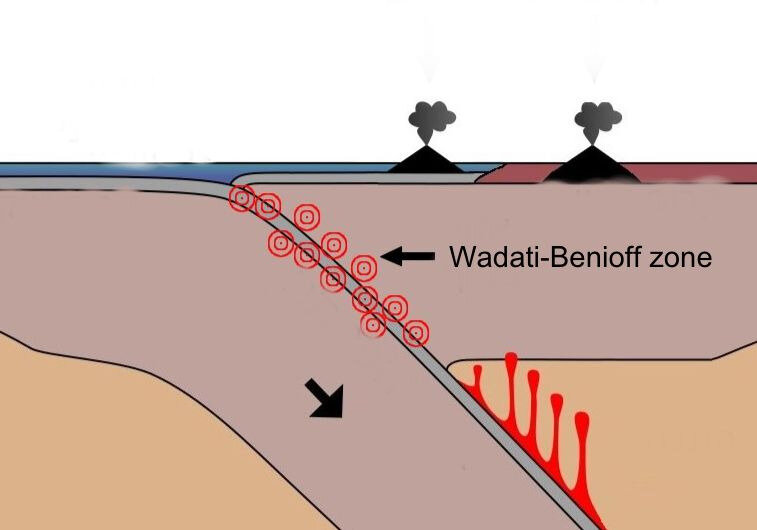
This process is called subduction. As the oceanic plate sinks deeper into the mantle, it heats up and releases water. This water lowers the melting point of the overlying mantle, creating magma that rises to form volcanoes on the continent. The collision also crumples the continental crust, pushing up massive mountain ranges. The Andes Mountains in South America are a direct result of the Nazca Plate subducting under the South American Plate.
When two continental plates collide, neither is dense enough to subduct. Instead, they smash into each other with incredible force, folding and faulting the rock. This creates immense mountain ranges, like the Himalayas, which formed when the Indian Plate crashed into the Eurasian Plate.
Sliding Past: Transform Boundaries
Not all plates crash or separate. Some slide horizontally past one another at a transform boundary. At these boundaries, crust is neither created nor destroyed. The two plates lock up against each other due to immense friction. Stress builds up over years, decades, or even centuries. When the stress finally overcomes the friction, the plates suddenly slip, releasing a huge amount of energy.
This sudden release of energy is what we experience as an earthquake. The San Andreas Fault in California is one of the most well-known transform boundaries in the world. It marks the boundary between the Pacific Plate and the North American Plate. The slow, steady grinding and sudden slips along this fault are responsible for the frequent earthquakes in the region.
Now let's check your understanding of how these plate boundaries work.
What is the primary characteristic that defines the type of a tectonic plate boundary?
The formation of the Himalayas is the result of which type of plate interaction?
The movement of tectonic plates at these three types of boundaries sculpts our planet's surface, creating its most dramatic features, from the deepest ocean trenches to the highest mountain peaks.